

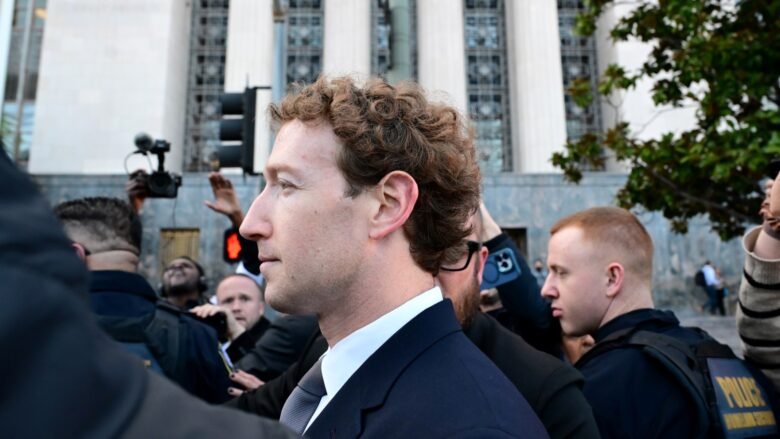
At a landmark trial where billionaire Meta CEO Mark Zuckerberg was grilled under oath, a Los Angeles jury handed a victory Wednesday, March 25, to a woman who said she became hopelessly hooked on Meta’s Instagram and Google’s YouTube as a child and suffered serious harm.
In her bellwether lawsuit — the first to reach trial among thousands of individual personal-injury cases filed in recent years against social media companies — the woman claimed her powerful addiction dominated her childhood, leading to anxiety, body dysmorphia, self-harm, and suicidal thoughts.
The jury awarded $3 million in compensatory damages to the plaintiff, known throughout the case by her initials, K.G.M. Jurors alloted 70 percent of responsibility to Meta and 30 percent to YouTube. Outside the courthouse, attorneys and family members with similar cases were seen hugging and wiping tears at the news of the verdict.
In opening statements last month, lawyers clashed on the question of whether the platforms, or K.G.M.’s complicated home life, caused her injuries. Lawyers for the social media companies pointed to evidence that K.G.M. witnessed domestic abuse at home as a young child and later struggled with depression over the absence of her father.
K.G.M.’s trial lawyer, Mark Lanier, argued that his client’s background made her particularly vulnerable to exploitation by the platforms’ design features, including infinite scroll, autoplay, cosmetic filters, and push alerts. He said the companies’ algorithms were engineered to maximize engagement by spacing out dopamine-triggering stimuli with intermittent “gaps,” a pattern he described as intentionally addictive. He argued Instagram and YouTube functioned as “digital casinos,” deliberately marketed to children despite their underdeveloped brains and limited impulse control.
“Imagine a slot machine that fits into your pocket,” he said. “It doesn’t require you to read. It doesn’t require you to type. It’s just one physical motion — the swipe. This motion is the handle of a slot machine.” The reward, he said, isn’t money but a “dopamine hit” in the form of likes or unexpected videos.
Shortly before the trial started, co-defendants TikTok and Snap reached private settlements with K.G.M. The deals meant the companies could watch the trial from the sidelines without facing public scrutiny of their executives or internal documents in the packed courtroom in downtown Los Angeles.
Now 20 years old, K.G.M. took the witness stand, telling jurors she started using YouTube when she was six years old and Instagram when she was nine. She described spending all of her free time on social media and feeling a powerful urge to return whenever she was offline. She claimed the use left her feeling anxious and insecure, leading to a diagnosis of body dysmorphia.
K.G.M. made her first appearance at the trial the morning Zuckerberg took the witness stand. During a full day of testimony, the Meta founder denied claims that his company tries to lure children under 13 onto Instagram or increase “time spent” on its platforms at the expense of users’ well-being.
Zuckerberg told jurors that Instagram’s terms of service have long barred users under 13, and that “when you sign up, you have to agree to the terms.” But Lanier pressed him on whether he truly expected a nine-year-old to read the “fine print” and comply. The lawyer also showed jurors an internal document indicating that in 2018, the company estimated about 4 million Meta users were under 13 years old. That’s around 30 percent of all children aged 10 to 12 in the U.S., Lanier said.
Lanier also confronted Zuckerberg with confidential company emails and slide decks obtained through discovery. In one internal exchange, Zuckerberg said he was concerned about “being paternalistic” in banning cosmetic filters. Zuckerberg said he didn’t want to be “overbearing” in dictating how people express themselves. Lanier suggested the billionaire was prioritizing a child’s right to free expression over the advice of 18 experts who warned the company that cosmetic filters posed a mental-health risk to children.
“I feel like you’re mischaracterizing what I’m saying quite a bit,” Zuckerberg replied. At one point, Lanier and his team unfurled a 35-foot banner showing thousands of photographs, many of them filtered selfies, that K.G.M. had posted to Instagram beginning at age nine.
Zuckerberg testified that he placed significant weight on a report from the National Academy of Sciences that reviewed more than 800 studies and concluded that social media had not caused changes in adolescent mental health “at the population level.” But Lanier pressed him on an April 2020 email from Meta’s vice president of product design, Margaret Gould Stewart, who wrote directly to oppose restoring many of the filters. “As a parent of two teenage girls … I can tell you the pressure on them and their peers coming through social media is intense with respect to body image,” she wrote. “There won’t be hard data to prove causal harm for many years, if ever.”
Zuckerberg said cosmetic filters had long been available on other platforms, and “if there had been harm,” experts would have been able to substantiate their claims with evidence. Meta struck what he considered a balanced approach by not actively recommending cosmetic filters to users and removing filters that promoted plastic surgery, he said.
The role of technology in teenagers’ lives loomed large at the trial. Lawyers for Meta and YouTube argued in opening statements that the apps help young people combat loneliness, pursue creative expression, and access educational resources. They also said Instagram and YouTube have steadily added safety features as the platforms have evolved.
In his own turn on the witness stand, Adam Mosseri, head of Instagram, said his job is to strike a balance between safety and freedom of expression. “We want to be careful about banning things because people get really upset. They feel they’re being censored, and they get really angry about that,” he said.
“I believe it’s our responsibility to keep people safe, particularly minors,” he continued. “We’re trying to be as safe as possible, but also censor as little as possible.”
During their first day of deliberations, jurors asked the court where they could find the “Project MYST” study that Mosseri allegedly signed off on as part of a research partnership with the University of Chicago. It was a survey of 1,000 teens and their parents that found teens who experienced more “adverse childhood events,” such as having an alcoholic parent or a bully at school, had greater difficulty moderating their use of social media. It also found that a parent’s “digital supervision” had little impact on teen use.
“We run hundreds of studies all the time,” Mosseri testified when asked why the study was never published. The Instagram boss said he wasn’t familiar with the findings, but either way, he didn’t think the results suggested “a dangerous situation” worthy of sounding an alarm. “I’m sure if we found something dangerous, we would talk about it publicly,” he testified.
Called as the first witness at the trial, Dr. Anna Lembke, medical director of Stanford University’s addiction-medicine program and author of Dopamine Nation, told jurors that adolescents’ brains are “especially vulnerable” to addiction because the prefrontal cortex is not fully integrated with midbrain systems that regulate behavior.
“There’s a lack of communication between the brakes and the accelerator,” she testified, explaining why teens take risks and struggle to anticipate consequences. Social media, she added, has “drugified” connection and validation, and “the younger the exposure, generally speaking, the greater the risk” of addiction.
The trial followed after a survey of American kids aged 13 to 17 from Pew Research found that 48 percent of teens say social media sites have a mostly negative effect on people their age, up from 32 percent in 2022. Alarmingly, suicide rates among young people aged 10 to 24 rose sharply between 2007 and 2021, spiking at 62 percent, according to the Centers for Disease Control and Prevention. Before that, the suicide rate for young people remained stable between 2001 and 2007.
“I want to be really clear. I think the world is changing increasingly quickly, and Instagram needs to change along with it to stay relevant,” Mosseri said during his testimony last month. “So you will always be able to, at any point, look back over a couple years and point out features that didn’t exist before. We’re going to always try to improve and launch new features. Honestly, I feel that’s something I’m proud of, innovating and improving ways to try to keep teens, to give teens a positive experience on the platform.”
The first question jurors had to answer on the verdict form was whether Meta and YouTube were “negligent in the design or operation” of their platforms. If they answered yes, they moved on to questions about whether Meta and YouTube knew, or should have known, their platforms were “likely to be dangerous when used by a minor in a reasonably foreseeable manner.” Another asked whether the platforms failed to adequately warn of the danger.
K.G.M.’s case was selected as a bellwether, a test trial whose outcome could help shape thousands of related lawsuits. But unlike a class action, its verdict is not binding on other plaintiffs.
Legal experts say a sweeping, global settlement — like the one reached in the litigation against tobacco companies — may be harder to achieve in cases involving social media. Meta and Google, among the world’s wealthiest corporations, have the resources to sustain prolonged and costly legal battles. They have already argued that they are shielded by Section 230 of the Communications Decency Act, which generally protects online platforms from liability for user-generated content, and are expected to challenge the ruling that allowed K.G.M.’s case to proceed to trial.
More broadly, defendants with vast financial resources may choose to continue litigating rather than settle, particularly if mixed outcomes in court allow them to preserve a business model that remains highly profitable. Still, the plaintiffs’ lawyers say the trials are necessary, even if they don’t win.
“This case is historic regardless of the outcome because it’s the first of its kind. We’re now getting their documents. We’re getting transparency. This is a plaintiff who survived motions to dismiss and for summary judgment,” Laura Marquez-Garrett, a lawyer with the Social Media Victims Law Center who represents K.G.M., tells Rolling Stone.
Marquez-Garrett, a member of the plaintiffs’ steering committee overseeing the thousands of claims consolidated in Los Angeles County, said a second bellwether trial, expected to begin by summer, would reveal additional internal communications the companies had sought to keep private.
“This is just like Big Tobacco. This is Big Tobacco designing their products to addict kids at a young age so they can create lifelong consumers. And some of them don’t survive,” Joann Bogard, 59, an Indiana mom who lost her 15-year-old son, Mason, when he died attempting a viral choking challenge, previously told Rolling Stone. “They know what they’re doing. Big Tech knows how their products are designed. And our kids aren’t just collateral damage, they’re targets. And these cases are going to bring all of that to the forefront.”
This is a developing story …