

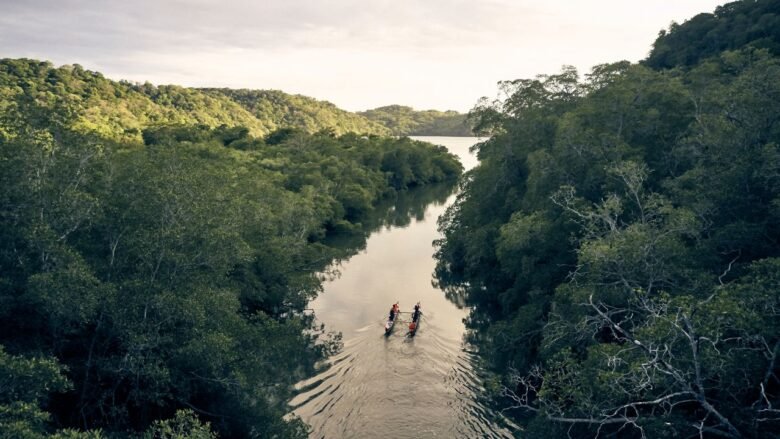
When Nekajui, a Ritz-Carlton Reserve, opened on Costa Rica’s Peninsula Papagayo last year, it quickly became inextricable from the tropical hillside it calls home. The property’s 107 rooms and suites (and 36 residences) emerge organically from among the tropical forest, where howler monkeys’ cries hang in the air and guests travel through the treetops by a suspended bridge. With views of the Pacific Ocean and access to abundant wildlife, Nekajui is a Venn diagram of the natural bounty and diverse beauty that has long drawn travelers to the country’s northwestern coastline.
A view of the Andaz propertyDaniel Morales
Other hospitality brands have followed suit, turning the larger Peninsula Papagayo area and Playa Penca, just across the bay, into a bona fide luxury enclave. The Waldorf Astoria arrived on Playa Penca (a brand first in Costa Rica) last April with a multitiered pool and cenote-inspired spa. An ambitious 50-acre St. Regis property is set to open nearby with multiple pools and, in addition to guest rooms and suites, private residences including the $30 million Astor mansion.
No other luxury hotels will crowd Peninsula Papagayo, though—part of a ruling by the Costa Rica government to protect 70 percent of the peninsula’s dry tropical forest. Since the Four Seasons Resort arrived there in 2004, Papagayo has evolved into a 1,400-acre community of hotels and residences that is managed like a golf club but feels like a jungle utopia. Kids enjoy science class in the trees and phys ed on surfboards, while their parents play on a native-grass golf course and reset at Papagayo Park, a $26 million, 23-acre wellness and recreation hub. “We basically live in a playground,” says Dale N. Smith, director of sales and marketing for Andaz Peninsula Papagayo Resort, which was a trailblazer when it opened in 2013.
.jpg)
The Andaz open-air lobby at sunsetAlex Fradkin