
SUZUKA, Japan — Toto Wolff’s messaging around Kimi Antonelli’s potential has been consistent since the Italian teenager first stepped into a Mercedes Formula 1 car: give him time.
There were moments in Antonelli’s debut season in which question marks were legitimately raised over his readiness, but Wolff has always kept the faith and diverted the pressure.
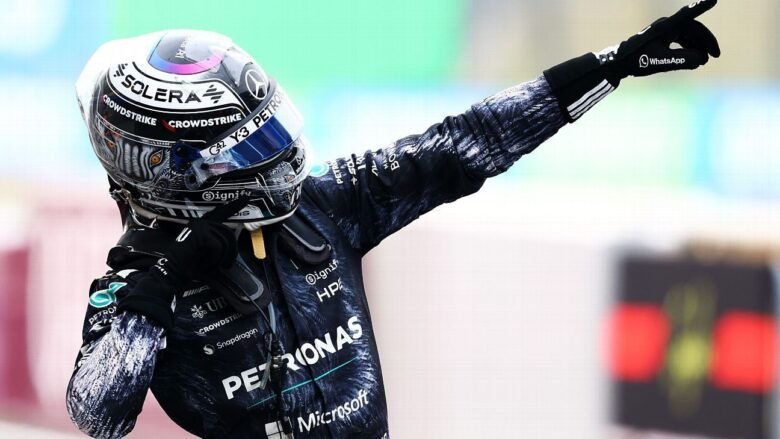
Now, after just the third race of his second season, Antonelli leads the world championship by nine points thanks to two consecutive victories in China and Japan. By his own admission, luck played a major role in his latest victory, but his level of performance was no less impressive because of it.
For Wolff, the messaging remains cautious, but increasingly optimistic.
“I think when we decided to give him the race seat one and a half years ago, we hoped for this trajectory,” he said after Antonelli’s victory on Sunday. “The ups and downs you expect from a young driver aged 18 in the first year, and eventually by the second year, [we hoped] the success would materialize and I think this is happening.
“Now, could we have predicted two wins out of three races at the beginning of the year for Kimi? No, but, you know, today he was quick when it mattered. Yes, the luck was on his side, but I think all of that contributed for him to have this consecutive victory.”
Was Antonelli’s win purely down to luck?
Within the opening meters of Sunday’s race at Suzuka, Antonelli’s youthful enthusiasm appeared to throw away a shot at victory as he botched his start from pole position. By releasing the clutch too quickly, the rear tires of his Mercedes W17 spun wildly when the lights went out, and he was passed by five of his rivals as he smoked his way down toward the first corner.
Teammate George Russell, who made a poor start of his own because he appeared to have some trailing brake pressure away from the line, dropped from second place to fourth as the sharp end of the pack reached Turn 1. If two cars had dropped from the front row of the grid to fourth and sixth by the end of the first lap at Suzuka in previous seasons, it would have spelled the end of a victory charge.
But as has been the case at all three grands prix this season, the underlying pace of the Mercedes meant the slow getaways for Antonelli and Russell were more of an inconvenience than an unmitigated disaster.
By Lap 6, Russell was on the tail of race leader Oscar Piastri, and by Lap 11, Antonelli had rallied back to fourth position. McLaren decided to take the strategic prerogative and pit Piastri before Russell on Lap 18, forcing the Mercedes’ strategists to tell both drivers to go longer into the race than planned.
In theory, the clear air would allow Russell to make the most of his car’s performance advantage and present the opportunity to retain the lead over Piastri after he made his own pit stop multiple laps later. But as he was released into clear air, Russell’s pace wasn’t what the pit wall had hoped and instead it looked increasingly like he would lose a place to Charles Leclerc if he stayed out much longer on his first set of tires.
Antonelli, meanwhile, was setting a blistering pace on his medium compound tires, creating the potential to gain a place on Leclerc after his pit stop as long as he didn’t get held up by Russell. That led Mercedes to pit Russell on Lap 21, thereby ensuring he emerged ahead of Leclerc and didn’t impede Antonelli.
After the race, Mercedes was convinced Antonelli’s pace was enough to bring him back into contention for victory regardless of the safety car period that followed. He was lapping roughly 0.5 seconds quicker than Russell before their pit stops and on Lap 21 was the fastest driver on the track despite having the oldest tires.
As it transpired, Antonelli’s impressive pace wasn’t the deciding factor in the race win, as a perfectly timed safety car period effectively handed him victory on Lap 22. Oliver Bearman’s huge accident at Spoon corner came just one lap after Russell had pitted, presenting Antonelli with the perfect opportunity to make a time-efficient tire change and retain the lead — undeniably lucky for Antonelli and desperately poor timing for Russell.
“I don’t really know why I pitted at that point,” Russell said after the race. “I think it was because Charles was coming, but, you know, what can you do? That is pure luck.
“If that was one lap later, we’d have won the race. And if there was no crash, maybe we would have regretted not pitting at that point. And in racing, sometimes it goes for you, sometimes it goes against you.”
Antonelli acknowledged his good fortune, but that should not take away from the clear pace advantage he seemed to have over the rest of the field — including his teammate — at that stage of the race.
“I think obviously we were very lucky with [the] safety car, but on the medium [tire], we were really strong once I got some free air, and then on the hard [tire] the pace was just incredible,” he said. “I don’t know what would have happened, how the outcome would have been, without the safety car, but yeah, it definitely made my life a lot easier.”
Can Antonelli take the title fight to Russell?
The resulting victory makes Antonelli the youngest driver to lead the F1 world championship at the age of 19 years and 216 days old. It should be said that leading the standings after three races counts for nothing unless you also lead it after a full season, but the early signs are that Antonelli has emerged as a much more complete driver in 2026.
“It’s been a big step,” Antonelli said. “Experience does a lot — obviously last year I’ve gone through a lot and it taught me massively more than what I anticipated, and for sure it’s helping so far this year. Of course there’s still a lot of work to do, but I definitely feel much more in control of the situation.”
With the cancellation of the next two rounds in Bahrain and Saudi Arabia, Antonelli will remain the championship leader by default for the next month. When racing resumes in early May, Russell will no doubt want to reassert his seniority within the team and take the fight to Antonelli at the Miami Grand Prix, but Antonelli is fully aware of the areas in which he needs to improve to close in on his teammate.
0:54
Antonelli reflects on second straight F1 win after Japanese GP victory
Kimi Antonelli and Oscar Piastri speak after the Japanese Grand Prix.
“I’ve been closing the gap with him,” Antonelli said. “I think still in qualifying he has the upper hand, especially when it comes to Q3. He’s always able to find that little bit of extra, which I’m working on.
“But in terms of race pace, I think we have a really strong base. So yeah, I feel he’s obviously a super, super strong, very complete driver. I think he showed many times last year, and that’s why it’s not going to be easy, and that’s why I need to do everything as perfect as possible.”
Despite the emerging threat from Antonelli, Russell played down suggestions that momentum could propel his teenage teammate into an even bigger championship lead over the coming races.
“No, not at all,” Russell said. “It’s three races down in 22. As I said, one lap different today and the victory would have been on my side, and I’m confident of that. In China, without the qualifying issue, maybe I was 0.3 seconds ahead based on the sprint qualifying. So maybe I could have been on pole there and won that race.
“So it’s just how it turns out. That’s racing. We’re now at a four-week break, so there’s no momentum to be carried. We’re going to reset and go again for another race.”
Russell’s experience still makes him the favorite at this stage of the season, but the title battle looks far more interesting than it did after the season opener in Australia earlier this month.
An accident waiting to happen
The moment that swung Sunday’s grand prix in Antonelli’s favor has also created one of the biggest talking points for the upcoming break from racing. When Bearman lost control of his car on the grass on the entry to Spoon corner, he was doing 308 km/h (191 mph) and had to take avoiding action after closing in on Franco Colapinto’s Alpine at a speed delta of 50km/h (31 mph).
The potential for this kind of accident had been flagged multiple times since the start of preseason testing, making it all the more galling when it played out in reality. The significant speed difference between cars not deploying any electrical power (in this case Colapinto) and those deploying full electrical boost (Bearman) was always going to lead to an accident like Bearman’s, yet no action was taken to avoid it.
For Carlos Sainz, a director of the Grand Prix Drivers’ Association, the situation was unacceptable.
“These kind of closing speeds and these kind of accidents were always going to happen, and I’m not very happy with what we’ve had up until now,” he said. “Hopefully we come up with a better solution that doesn’t create these massive closing speeds and a safer way of going racing.”
The FIA, F1’s governing body, issued a statement saying it would fully analyze the accident and it had always been its intention to reevaluate the new rules after the opening three races. However, it stressed the need to make the most of the upcoming break and avoid knee-jerk reactions that could lead to unintended consequences.
“Any potential adjustments, particularly those related to energy management, require careful simulation and detailed analysis,” the statement read. “The FIA will continue to work in close and constructive collaboration with all stakeholders to ensure the best possible outcome for the sport and safety will always remain a core element of the FIA’s mission.
“At this stage, any speculation regarding the nature of potential changes would be premature. Further updates will be communicated in due course.”
There is a push, however, to put the issue of closing speeds between cars at the top of the agenda. Driver complaints over F1 qualifying are also set to be addressed, but McLaren team principal Andrea Stella, who raised concerns over the safety of the new regulations during testing, said it was clear where the focus needed to be.
“When it comes to the incident that involved Oliver, I think this situation, when you know that the closing speed can be as big as can happen, is not a surprise,” Stella said. “We said that already in testing, it is in the agenda of the FIA in terms of the aspects of these 2026 regulations that should be improved. We don’t want to wait for things to happen to put actions in place. So today something happened. I think Oliver, luckily, it seemed like he got out of it with just some bruises, but nothing too major. …
“It is a case that should be studied with a certain level of analytical approach. I don’t think a simple solution exists, but we have the expertise, the engineers, the variables to put in place some actions. … This should jump at the top of the agenda.”
For all the thrills F1’s new regulations have provided, the opportunity to press pause on the 2026 season will no doubt be a welcome one for the sport’s regulators. It’s now crucial it is put to good use.