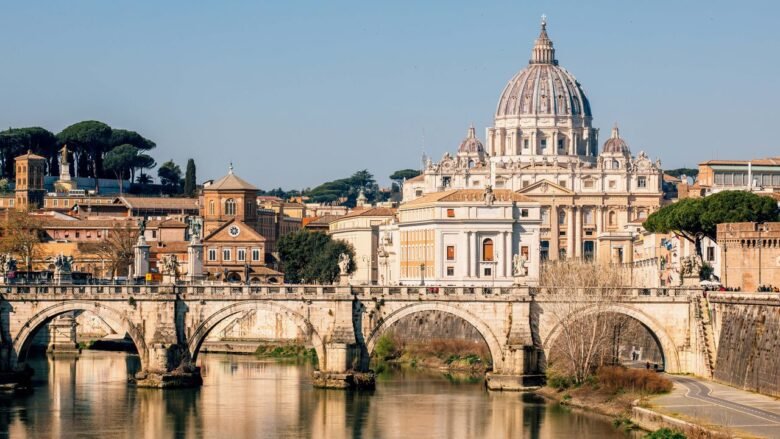
With only eight suites, the Hotel Dé Ricci feels like a private home right off one of my favorite streets in Rome, Via di Monserrato; it’s a street that hasn’t been commercialized and still retains the Roman charm I love. Speaking of charm, the courtyard at Hotel Locarno has been a second home for me. It’s a true Roman crossroads where locals and guests reunite for aperitivo; the rooms in the main historic building still capture the 1960s glamour of when it served as a living room for the likes of Fellini, Rossellini, and Mastroianni.
If you want to feel like you really live in Rome, the SuperAttico Monserrato is a real gem on Via di Monserrato. This beautifully designed penthouse is owned and tastefully curated by Daria Reina and Andrea Ferolla, the duo behind the cult-favorite boutique Chez Dédé. For an equally laidback vibe, The Hoxton is set in the Parioli district, it allows you to be based in a neighborhood that still belongs to the locals, yet it’s close enough to reach the historic center with a beautiful walk through Villa Borghese.
For a spa you’ll never want to leave, head to the Six Senses. I’m usually not one for spas (too high energy to chill), but after 20,000 steps through Rome, their signature holistic massage is the only thing that truly brings you back to life. And over at Vuotopieno, the apartments are curated spaces designed for multidisciplinary exchange, where travelers live alongside site-specific works left behind by visiting artists.
Day 1: Sights along the Tiber River
Breakfast spot: Carbs and coffee at Forno Campo de’ Fiori
Forno Campo de’ Fiori
The simple pizza by the slice at Forno Campo de’ Fiori—a bustling bakery in a crowded central piazza—is a thing of beauty. The staff can slice small pieces for you so you can try more than one topping; don’t miss pizza rossa (flatbread brushed with tomato sauce), pizza bianca (flatbread seasoned with salt and olive oil), and fior di zucca (zucchini flower, anchovy, and mozzarella). Note that the service isn’t particularly happy, helpful, or welcoming, but who has time for pleasantries when you’re slammed all day?
Read Full Review
Morning activity: Golden souvenirs
Lunch spot: Unfussy Italian fare
Afternoon activity: A walk through Aventino
Basilica di Santa Sabina
A peaceful walk away from the crowds that takes you past Circo Massimo, the Rose Garden, and the Liberty-style villas of the Aventino. Be sure to stop at Santa Sabina, a 5th-century basilica that remains one of the most perfectly preserved early Christian churches in existence.
Read Full Review
Dinner: A veggie-heavy feast
Piatto Romano
The menu at Piatto Romano may not be fancy, but it nails all the classics, serving gnocchi on Thursdays—when it’s traditionally eaten in Rome—and fish dishes on Fridays. The seafood is excellent, from the salt cod cooked with dried fruits and onions—a must—to the frittura mix of fried prawns and calamari, when it’s on the menu. But the star is the more meaty, milk-fed pajata: fat pasta tubes in an intestine-based sauce. There’s also an impressive range of side dishes made with seasonal vegetables. Desserts are simple but good: market-fresh strawberries sprinkled with sugar or slices of still-warm ricotta cake.
Read Full Review
Evening activity: A nightcap (or three)
Enoteca L’antidoto
From the off, it’s clear that Enotica L’antidoto is very cool. The warmly-lit interior is lined with brick arches and exposed cement walls, all covered by the original beam roof. It’s exactly the kind of place you go for a bottle or two of organic natural wines with friends, alongside a creative menu of small plates. This is a local crowd who live in and around Trastevere; fashion types discussing their day over dinner; a couple in yoga outfits catching up over a bottle of organic red from Puglia, mats tucked away in the corner. The team run monthly chef residencies, so there’s always someone new coming up with a creative new menu. Dishes are made to pair with the wines: there are figs wrapped in delicate slices of lard and savory tarts with olives fennel and green beans. On our visit it was the very un-Italian fried egg sandwich that had everyone talking, pressed as it was between two slices of toasted sourdough with rocket and anchovies. Even if you’re not ordering food, there’s a bag of complimentary bread and cultured, salted butter to go with your wine.
Read Full Review
Day 2: Centro Storico (and Beyond)
Breakfast spot: Baked goods at Regoli
Morning activity: A dose of contemporary art
FOROF
An archaeological site within Trajan’s Forum transformed into a space for contemporary art, where 2nd-century structures engage in a constant, site-specific dialogue with the present.
Read Full Review
Lunch spot: Classic Roman dishes
Afternoon activity: Gelato and Caravaggios
Chiesa di San Luigi dei Francesi
Even if not a huge art buff, take the five minutes to wander to the Contarelli chapel inside this small catholic church which is just a short stroll from the Pantheon. It’s home to three Caravaggio paintings which showoff the maestro’s command of chiaroscuro which can all be seen for free and away from the crowds that mob his works inside the museums.
Read Full Review
Dinner: A parade of seafood
Evening activity: Natural wine among locals
La Latteria
An oasis for natural wines from small producers—this is very local and legit even, in the midst of Trastevere’s growing “Disneyfication.”
Read Full Review
Day 3: A Day Trip to Campagnano Romano
Breakfast spot: Pastries and road-trip bread
Santi Sebastiano e Valentino
This neighborhood bakery is a delight to linger in (plus, they have fantastic bread), and plan a day trip out of the city. The walk here is also a joyous way to start the morning: You can easily get to this neighborhood on foot from the center of town by walking across Villa Borghese.
Read Full Review
Morning activity: A dip in a volcanic lake
Bracciano Lake
A volcanic lake with remarkably clear water, perfect for a morning swim before exploring the surrounding towns—specifically Trevignano for a stroll (possibly a swim) along the shore and Bracciano to visit the Castello Orsini-Odescalchi.
Read Full Review
Lunch spot: Farm-to-table favorites
Osteria Iotto
Worth the detour to Campagnano Romano, this family-run spot features an ever-evolving menu sourced almost entirely from their on-site farm; if available, the tacos alla picchiapò are a must.
Read Full Review
Afternoon activity: A masterclass in Italian Art Deco
Casa Molle Morpurgo
Head back to Rome for a true hidden gem that only recently opened for private tours—this residence is an untouched masterpiece of Italian Art Deco. I love the green living room, with drapery by Fides Testi, engraved mirrors by Pietro Chiesa, and corals by Martinuzzi.
Read Full Review
Dinner: Offal at Trecca
Trecca – Roma
It can be easy for modern osterias to follow a distinct design pattern that feels too modern and out of place in a historic city like Rome. Trecca is just a few years old but manages to feel exactly like a young Roman restaurant should: spacious and inviting. There’s a brown-tiled checkered floor, pendant lighting and marble-topped tables–with an ancient Roman terracotta sink thrown in, for good measure. The short, well-thought-out menu is full of supremely delicious creations. If off-cuts make you queasy, you needn’t worry: the pastas keep mostly to tradition (carbonara, amatriciana), but the taglioni pasta with chicken livers and butter is the standout. But, quite frankly, Trecca isn’t where you go to play it safe. They do those off-cuts far too well. If you’re going to try them, do it here–there’s a section on the menu for ‘refined palates’ (aka the brave ones). Or don’t bother with the menu, ask the waiter for his daily recommendations instead. You won’t be disappointed.
Read Full Review
Evening activity: Nightcaps at La Mescita
La Mescita
To wind down your trip, grab a seat at this bar, which is usually filled with locals. Ask your server for their opinion on the natural wines, or go for a low-key aperitivo.