

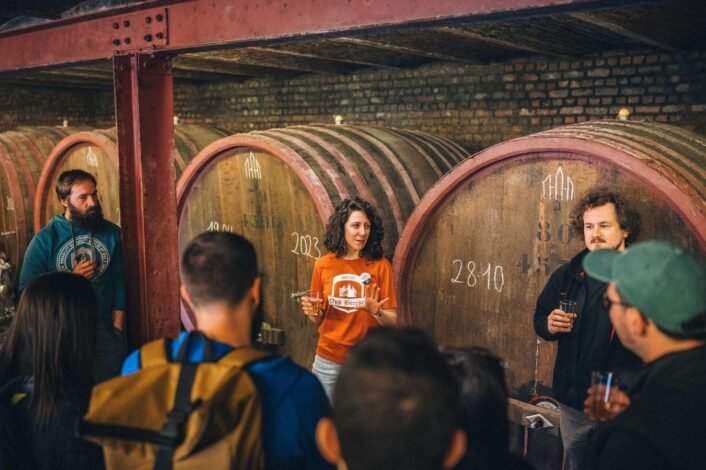
During the Toer de Geuze, traditional lambic breweries such as Oud Beersel open their doors to beer lovers from around the world.
Courtesy of Oud Beersel
The biennial Toer de Geuze offers beer lovers the opportunity to visit breweries making what are possibly the most traditional beers in the world—lambics spontaneously fermented in the area around Belgium’s Zenne Valley and Pajottenland.
The 2026 edition of the Toer de Geuze takes place on May 9 and May 10.
What Are Lambic And Geuze?
Lambic is a type of beer most famous for being spontaneously fermented. Unlike modern brewing techniques where yeast, and sometimes other microbes, are deliberately selected to ferment the beer, lambic is exposed to the air, allowing it to be inoculated by microbes naturally occurring in the air and also in the barrels in which the beer is placed to mature for years.
Through trial and error, over the centuries, it was determined that these beers taste best when brewed with a significant portion of unmalted wheat, along with the malted barley usually found in beers. Special brewing techniques are used to create an environment friendly to the microbes that produce the best flavors. And the hops used in lambic are aged, so that they don’t impart the usual aromas and flavors associated with that plant, but still inhibit the growth of certain undesirable microbes—hops have some antibacterial properties—while allowing others to flourish in the beer.
Despite all of this care in brewing, the most well-known characteristic of lambic remains the fact that it is spontaneously fermented. Some believe that the microbes in the Zenne Valley and Pajottenland are unique, such that lambic can only be brewed there, though one traditional lambic brewer is located in the city of Brussels.
The production of lambic is largely unchanged over several centuries. And for this reason, lambic enjoys a protected designation in the European Union of Traditional Specialties Guaranteed status. Lambic, geuze—discussed below—and several other terms related to this style of beer, are the only beer styles that enjoy this protection.
Some breweries outside of Belgium take inspiration from the brewing and spontaneous fermentation techniques of lambic producers, but generally eschew using the word “lambic” or even derivations of it, such as “lambic-style,” out of reverence to the unique character of the spontanenously-fermented beers of Belgium’s Zenne Valley and Pajottenland.
Geuze, sometimes spelled “gueuze,” also enjoys Traditional Specialties Guaranteed status. Lambic is flat, but by blending older, fully-fermented lambic, with younger, still-fermenting lambic, producers can create a carbonated beverage that is bright and lively.
Lambic and geuze are the most interesting beer styles in a broader culture of beer in Belgium. In 2016, UNESCO inscribed beer culture in Belgium on its Representative List of the Intangible Cultural Heritage of Humanity, the only such designation provided to the beer culture of any country.
HORAL And The Megablend
Many of the producers of lambic and geuze have formed an organization to protect and promote these beers; The High Counsel For Artisinal Lambic Beers (HORAL) was founded in 1997.
The President of HORAL, Gert Christiaens, is the owner of one of the association’s member breweries, Oud Beersel. His story illustrates the lengths to which people are willing to go to protect this historic beer style.
“Oud Beersel was founded in 1882. And the end of 2002, it was going to close its doors,” said Christiaens on a video call. “I have a wine background and this was my favorite beer. I was at Le Zageman beer bar in Brussels when I was told I wouldn’t be able to get the beer anymore.” In response, Christiaens, who has a background in economics and IT management, bought the brewery and had the old brewmaster—who was 77 years old at the time—teach him how to make the beer. And in 2005, Oud Beersel was revived.
Today, Oud Beersel is one of 14 members of HORAL, though there are other producers of lambic and geuze. As part of the biennial Toer de Geuze festivities, members are HORAL get together to create a Megablend geuze, containing lambic from all 14 members. The 2026 Megablend will be released at beer bars the day before the start of the Toer de Geuze.
The Beer That Isn’t Like Beer
“Don’t think about beer. It is more like natural wine, traditional cider or Champagne,” said Christiaens, when asked to describe the flavor of geuze. “Don’t look for malty flavors or hoppy flavors.
While many include these beers in the broader category of sour beer, Christiaens says these beers are not about sourness. Like wine makers, lambic makers limit the exposure of the aging beer to oxygen, which can create vinegar-like flavor. “Lambic makers are not trying to make sourness,” says Christiaens. “I compare the process of making lambic to making sourdough bread. The baker doesn’t want to make sour bread. The baker wants character. Making sourdough is making bread with a different texture and taste.”
“Lambic is the oldest style of beer still made in Belgium,” said Christiaens. “At one time, all beer would have been spontaneously fermented. Lambic is pure character from the past.”
Details Of The 2026 Toer De Geuze
The 2026 edition of the Toer de Geuze takes place on May 9 and May 10 and will be the largest edition of the event to date.
All 14 members of HORAL will open their doors to the public, though some may be open only one of the two days. The tour has no official schedule; beer lovers are welcome to visit as many or as few of the breweries as they wish. For those wanting more organization, there are organized bus tours, for a fee, which can be prebooked on the tour’s website.
The 14 members of HORAL are: Brouwerij Boon, De Cam, Brewery De Troch, Den Herberg, Brewery Eylenbosch, Hanssens, Brouwerij Kestemont, Lambiek Fabriek, Brouwerij Lindemans, Mort Subite, Oud Beersel, Sako Brewery, Brasserie Timmermans and Gueuzerie Tilquin.
Admission to any of the breweries during Toer de Geuze is free. Beer will be available for purchase at each brewery.
The Toer de Geuze is held every two years, usually in the beginning of May, though it can occur near the end of April.
“The Toer de Geuze is a great opportunity to get a good glass of geuze in a good atmosphere,” said Christiaens.
Starting in 2027, HORAL will begin hosting a biennial lambic beer festival in Brussels city center in years in which the Toer de Geuze is not being held, providing an opportunity for people to try these unique beers without travelling to the Zenne Valley and Pajottenland.