
One morning in 1987, my first week of eighth grade, I woke up to my mother sitting at the end of my bed. “Dad didn’t come home last night,” she said. I knew he was dead.
Eddy Crane co-owned a trucking business in Curtis Bay, an industrial area of Baltimore. He and his business partner had been locked in a blistering dispute about embezzlement. Once like brothers, they could no longer stand the sight of each other. Baltimore Police suspected the business partner was behind my father’s disappearance. But they couldn’t prove it, especially in the absence of a body.
Time passed. At home, we didn’t talk about it. I moved in and out of debilitating episodes of depression. In 2007, as the 20-year anniversary loomed, an alarm clock went off in my gut. I had to do something.
In this excerpt from What Ever Happened to Eddy Crane?: A Memoir and a Murder Investigation, I set up the before and after. After school one day, en route to snacks and cartoons, I stumble on my father, an imposing German-American with a graying widow’s peak and Elvis Presley looks, hunched over the kitchen table. He’s got a problem, and his solution takes me by surprise.
Then he’s gone. In his absence: Silence swells.
***
I slammed the door of my mother’s Mercedes. For someone only four feet tall or so, a car-door slam was more about physics than carelessness—I was too little to close a car door with much precision. It was the early 1980s and, wearing my plaid Catholic-school poly-cotton jumper and white knee-highs, I was coming home from second or third grade. I’m not sure if it was spring or fall, but I don’t remember struggling out of a winter coat.
Every school day Mommy drove me, and when she got old enough, also my sister, about ten minutes down Belair Road to St. Joseph, a Catholic school in a well-cared-for working-class area of Baltimore County. Until high school, I never rode a school bus except for field trips. Me, my mother, sister, father and Rottweiler were still living in the house I call the first house.
I thought I had the most normal childhood, that nothing could be more normal than our life and that little house on Silver Spring Road. Normal was, of course, good. But things were changing all around me. I was aware, as kids are, and unaware, as kids are.
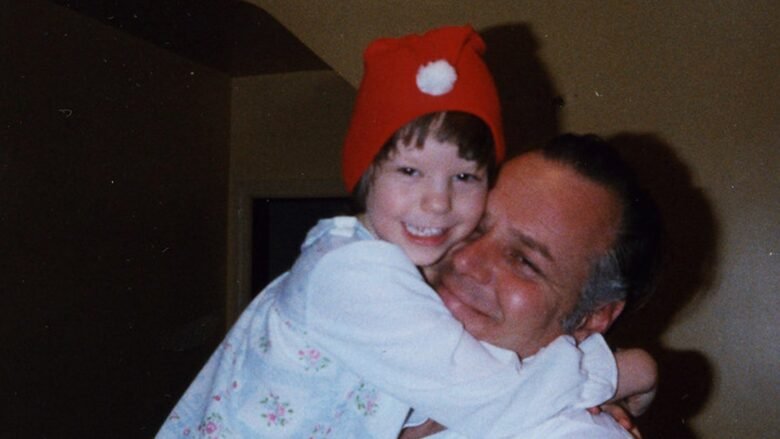
Crane’s father, Eddiy Crane, and the family dog, Brutus.
Courtesy of Kate Crane
White Marsh, a massive shopping mall, had opened in 1981, and Silver Spring Road, already a river of lead feet, was going to double from two lanes to four, which meant our driveway would shrink. As far back as I could remember, Mommy and Daddy had been planning a big house, a dream house, away from the car horns and the exhaust fumes. Expansion, escape. Blueprints covered the kitchen table as often as dinner plates. The idea of the new house filled me with joy—I’d have my own room, no more sharing. But I was also apprehensive.
“Daddy, will we have the same zip code?” I asked one day. Stout and serious and large, a graying bear of a man in a white undershirt, arms like delicatessen wursts bursting from their casings, he eyed me skeptically. There in his sagging blue crushed-velvet throne, the dank armchair parked next to the front door, he would almost certainly have been reading the classified ads. He loved to see what cars were selling for, call up their owners and ask them to give him a good reason why he should give up a Mercedes for a Chevrolet. “The day you show me a car that’s better than a Mercedes, I’ll stop driving a Mercedes.”
I began to cry. I loved 21128. It was an artistic number—a palindrome with the infinity symbol at the end. 21236, an adjacent zip, was devoid of charm.
“How about you worry a little more about the C’s you’re pulling in religion class and a little less about our—” he growled, and here paused to regard me in disbelief “—zip code?” He looked at my mother. “Why are we paying for her to go to that school when she brings home those grades?”

Kate Crane and her dad horsing around.
Courtesy of Kate Crane
I shrank at what seemed a willful misinterpretation of my report card, and at the scorn for my worry. I cared about Dad’s opinion more than anyone’s—his opprobrium stung. I didn’t understand how I could be his favorite and also the occasional, unpredictable target of his judgment. 21128 was lovely—why couldn’t he see? I got A’s in reading and spelling. Who cared about popes and sacraments? I was already reading Shakespeare and writing a novel on a heavy blue typewriter in my grandparents’ red-and-black-tiled basement.
A bookish nerdchild, I kept to myself in part because of preference and in part because I didn’t have friends. My mother once set up a playdate—I wandered off to read a book and never came back. When I was immersed in A Midsummer Night’s Dream on the faded floral sofa, my eccentricity was cute, and when I fretted about losing the zip code I dearly loved, I think my parents found me exasperating.
Today, though, I pushed through the front door, dropped my book bag on the staticky acrylic living room carpet, and began roaring toward snacks and Scooby-Doo. But something was weird. Dad was home.
This was not part of the school-week routine, which was: Dad was still asleep when I left for school, gone when I got back and usually walking back in the door when I was getting ready for bed. In the morning, I would kiss him goodbye on his sleep-sour, stubbly cheek before I ran out to the car with Mom.
My father’s weight swelled and receded, but he was often close to three hundred pounds. So his presence could be audible: big man, big sounds. At other times it was like sharing a house with a mountain: Wordless, Dad would retreat into the blue armchair and vanish beneath his state-of-the-art plush black headphones, spiral cord lazing out to the tall stereo unit. He drifted to destinations unknown with Patsy Cline or Elvis Presley.
Entering the front door that day, I knew immediately he was there, but I could not hear him. I checked for his headphones—hanging on their hook. And the blue velvet armchair was empty but for the permanent impression of his corpulence.
The silence was loud. It was wrong.
“Daddy!” I knew he’d be happy to see me. Often I climbed into the front seat of the tan Mercedes and we took car rides together, stereo playing rock ‘n’ roll as loud as it would go. I typed out stories on his secretary’s typewriter when I went into Curtis Bay with him to his business, E & M Machinery—“Eve and Mary,” Dad said it stood for, laughing. If it actually stood for anything, he never told me. I wrote my pen pal in Scotland that my father owned a junkyard, and Mommy and Daddy cried laughing. At E & M, glittering towers of truck parts were my first skyscrapers. They shimmered in the rain, ringed by toxic moats of rainbows and tadpoles. I loved it.
I rounded the corner into the tiny kitchen, all seventies oranges and olives, only a few steps from the front door of the house. My heart soared to see him, this constant in my limited world, solid in his body and the steady way he held a room. Cigarette smoke and Old Spice made my nose prickle. The Sun was spread out on the table where we ate, and a Viceroy smoldered in the glass ashtray. I stifled a gag. Even though that was the nice ashtray, as opposed to the black plastic ones that were in the garage or on the back brick steps. I was always trying to evade the reek of cigarettes that pervaded the house, our cars, our clothes.
“Hey, little girl. How was school?” He wanted to sound cheerful but it was forced, distracted. I could tell he was tense but not mad at me. He was concentrating, but on what?
For a few seconds I stood back, swaying with gladness. My daddy had deep brown eyes and crow’s-feet and a slicked-back widow’s peak. I always thought of his hair as jet-black, but if I looked hard, I knew it was streaked with gray. He looked a lot like the Elvis we both loved, but my dad’s face had more worry lines than the guy on the LP covers. I loved him.
I started to go in to hug him and stopped short. Daddy was holding something strange. And there was something peculiar about his hand.
“Daddy, what are you doing?”
I looked more closely, craned my head from where I stood. Dad was holding a metal tool. Medieval. It was a grim iron implement that looked like a pencil sharpener, or one of my Mee-Mom’s baking tools. But I didn’t see any cake batter. Just Dad’s thumb. I lacked the vocabulary for what I was looking at: a thumb, yes, on my daddy’s hand, yes. Discolored, it appeared to be pulsing.
That’s when it clicked. The tool was some kind of key. And Daddy was going to use it to unlock the pressure inside his thumb. Don’t gag, don’t cry — and my stomach lurched. To impress him, I had to be tough.
No one had ever told me that sometimes we turned garage tools onto our bodies. If Daddy was doing this, I guess it had to be normal. All the same, an alarm inside me began to sound.
Daddy was gripping the drill. It looked like something an Edward Gorey villain would use to carry out a nefarious deed. My father’s thumb was huge and blackened. The nail seemed to have expanded and warped and stiffened. Below the surface I could glimpse a hint of green and of red. Whatever was going on with that hand, I didn’t want a good look, but I couldn’t look away, either.
“What happened, Daddy?” I whispered, not wanting him to send me away.
The metal tip was nestling against the uppermost layer of his nail. His face was set in determination. The pain, which must have been extreme, seemed of no consequence to him. He sighed.
“Dropped a drivetrain on my thumb, prideandjoy.” This man with a drill bit poised to burrow into his thumbnail sounded about as perturbed as if he’d dropped a bag of groceries and realized an egg or two was broken.
I didn’t know it then, but drivetrains put food on the table. My father was not, as I’d told my pen pal, a junkyard proprietor. Rather, E & M, which he co-owned with my Uncle Augie, bought, refurbished and resold heavy-duty truck parts. Heavydutytruckparts was one of my first words, along with prideandjoy, which meant me.
My father was losing interest in our exchange. “Hon, why don’t you go in the other room.”
Soon I heard a muffled snarl coming from the kitchen. But Daddy did not cry. If he needed follow-up care from a doctor, I never heard about it. Our bathroom cabinet held the holy trinity: hydrogen peroxide, Betadine and Neosporin. Provided he kept it clean, he might have pulled his home surgery off.
A menace had raged beneath his fingernail. He released it, rinsed it away. And eventually the ravaged thumbnail fell off.
The days filed by, one largely indistinguishable from the next. Life went on as before.
SEPT. 10, 1987, CHANGED EVERYTHING FOR MY anonymous, working-class Baltimore family. That’s the night our family of four became a family of three, as if the kitchen table dropped a leg. Each of us was alone when it happened: My father was on an isolated truck yard in industrial Curtis Bay in South Baltimore. My mother was in their bed, an hour to the north in a rural corner of the county, waiting and waiting. She was the first one to realize. The unthinkable dawned with first light into her bedroom, a quiet, private space she shared with her husband. My sister and I were in our very own rooms, a very new thing, at the corner of our brand-new house, down two hallways from our mother. Fast asleep, we were unconscious to the new reality that was seeping through the freshly laid bricks, burrowing toward us.
We’d been living in the new house since last fall, but I slept in the same bed as always, a tiny twin from Sears. The house still smelled of timber, paint, concrete dust. Mom and Dad let me pick the color of my bedroom walls, and I had, surprisingly, chosen well: a pale yellow that amplified sunlight. So in the new house, I woke up each day to a lemon glow that evoked The Wizard of Oz.
But on an early September morning, a school day at the start of eighth grade, I opened my eyes and tensed. Something was wrong.
Mom usually called my name from the doorway until I made credible maneuvers toward getting up. This, in tandem with a beeping clock radio and a bowl of instant oatmeal, was the morning routine. Today, though, Mom was perched at the foot of my bed in her green belted bathrobe. I felt myself clutch for the warmth of the cotton Strawberry Shortcake sheets. They were safe. This deviation from routine was not.
I looked up and the fear pooled through me. What I could see, I did not like. My mother’s face, fine boned, lovely, reserved but quick to smile, wore a haunted, strained expression. Her eyes were bleary and red. My mother had been crying. She had been smoking. I did not like this, the taut, wary look in her eyes that telegraphed something frightening. I did not like how very, very still she sat. I was afraid. My mother was afraid too.
When Mom spoke, her voice came out thick and mucky. “Katy . . . Dad didn’t come home last night.”
I knew instantly: Daddy was dead.
In my memory, I am stoic, but my mother is clear on this point: I let out a wail.
I weighed about ninety pounds. I was a child, and a sheltered one. I had a mommy and a daddy and a little sister and a dog. Now my daddy and my dog, a lovable hulking Rottweiler barely out of puppyhood, were gone. Sherlock went to work every day with my father. Where was my puppy? If Dad was dead, and I guessed that he was, then our puppy must be too.
In our family, and in my young life, practically nothing had ever been wrong. This was Perry Hall, Maryland, a blue-collar suburb in northeast Baltimore County. We had strip malls, a farm stand called Huber’s, Persing’s for cheeseburger subs, Santoni’s for groceries. Sometimes we got Chinese at the Golden Bowl in the Perry Hall shopping center, where B&L Photo was, next to Woolworths and Michaels. There was a snowball stand on Joppa Road; a gas station and hardware store named Butt’s; Klausmeier & Sons, an auto shop. There were no famous people, and crime was negligible.
Kate Crane with her dad on her first birthday.
Courtesy of Kate Crane
We were as normal, I felt, as the loaf of store-brand sandwich bread that Mommy used to make my school lunches. My parents were both close to their parents. I spent Friday nights with my Mee-Mom and Pop, in the house where my mother grew up, sleeping alongside my four-foot-ten grandmother, who sang tome about Gina Lollobrigida to lull me off to sleep. On Sundays we often visited Grandmom Hilda, Dad’s stout, white-haired German mother. Pappy, his taciturn father, had died a few years before, and Grandmom Hilda now lived alone with a bulldog named Sammy. I thrilled for her stollen, an arid flat cake riddled with dried fruit that looked like a tree root doused in powdered sugar, and her springerle, leaden Christmas cookies shaped like tiny Mount Sinai tablets, pressed with inscrutable etchings and flavored with anise. My mother called them an assault on teeth. I loved those cookies so much I hoped fervently that Grandmom Hilda would never die.
I knew Dad was dead because he always came home. He was not home all the time, but he always came home. He called at nine and then he showed up an hour or so later. He never slept at the office. He took exactly one business trip that I know of, to somewhere in Asia—he brought me back a yellow silk kimono. Every night, he called and then he came home. This was gospel.
He’d called Mom around nine to say he was on his way. Failing to complete the nightly ritual could mean only one thing.
If Daddy was gone, how would we live? Could we stay in this house?
My mother left my room to go tell my sister, who was about three years younger than me. Family outings had been a challenge as long as I could remember, as my sister became anxious and often got sick at movie theaters and restaurants. I resented her for this, never considering she might be reacting to something I couldn’t sense.
I got dressed in a daze. On any other weekday I would be wearing a Catholic school uniform. But Mom was keeping us home. I chose something to wear from my little wooden dresser. I was an awkward kid. And even though my mother was stylish with excellent taste, she bought me clothing that was durable and reasonably priced, at places like Sears and JCPenney. The other kids harassed me relentlessly. So the uniforms were a blessing—they gave the bullies less to work with.
“What happened to Daddy? When is Daddy coming back?” my sister asked, her face hot and flushed, streaked with tears. Our closeness ebbed and flowed. Today we were allies of necessity. “Did Uncle Augie do something to Daddy?” she whispered. We were huddled shoulder to shoulder on the floor at my bedroom door, listening at the decent-size crack. We couldn’t hear much. But, yes, I could make out something about Uncle Augie in the hushed voices. People were coming and going—my godmother, Mom’s cousins. Someone had brought McDonald’s, and this time I thought I’d be the one to vomit.
I had to be wrong; Dad couldn’t be dead. Dad always came home. It was the Gospel of Eddy Crane: Phone home then come home. He had just gotten stuck somewhere. Any second, surely, Dad’s tan Mercedes would glide into view and start its rumbling, lumbering ascent up the gravel drive. It had to. Any minute.
It didn’t.
The minutes and hours yawned, taut and terrible. Every time the phone rang, I prayed it would be Dad. I’d been enrolled at St. Joe’s since nursery school in the incense-redolent church chapel, where every surface was gleaming and mausoleum-chilly. Over my short life I’d formed an obsequious but direct relationship with God. He was an almighty big shot who listened to prayers if you phrased them properly and enunciated. Every night my mother led me in a Hail Mary, Our Father and a shout-out to the dead: Eternal rest grant unto them, O Lord, and let perpetual light shine upon them. May they rest in peace. Amen. I wasn’t sure how anyone could get eternal rest with perpetual light shining upon them, but I figured it would make sense when I grew up. Or died.
I prayed now: Dear God, let Daddy call. Dear God, please send Daddy home.
In early September in Baltimore, the days are long and humid, and they are contradictory. Summer is over, and also summer lives on. The night of September 11, 1987, full dark settled in slowly over our house, a velvet creep onto the fresh bricks and their mortar, a chic olive-putty color we’d chosen as a family. Shadows deepened from brown and green and slate orange to a full, final black. The new landscaping, in the middle of all those empty acres, vanished as night fell.
I wrote in my diary: My father is a missing person. I keep hoping that I’m going to wake up and everything will be okay.
Into my pillow, I moaned and wept. My puppy, my puppy, I want my puppy . . . I want my daddy . . . I want my puppy . . .
I never saw my daddy again.
Excerpted from What Ever Happened to Eddy Crane? by Kate Crane, Copyright © 2026 by Kate Crane. Published by Hanover Square Press.