
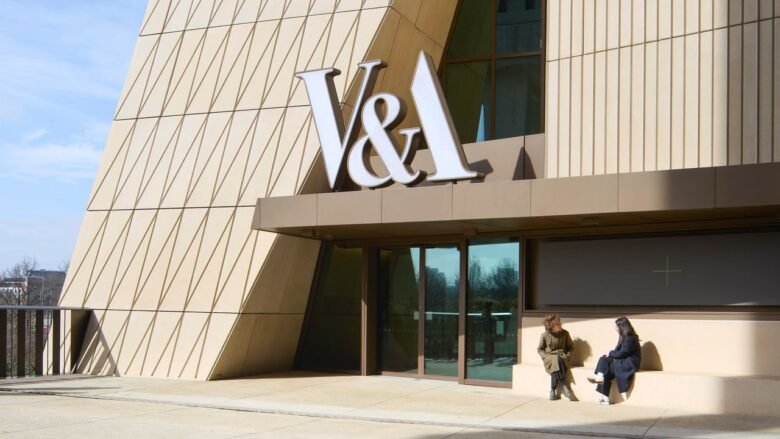
“It wasn’t that difficult to convince people to lend us objects because it’s the V&A,” curator Jacqueline Springer tells me as we stand in the brand-new V&A East Museum. After all, people’s willingness to loan—and even donate—personal objects has made the V&A one of the most influential collections in the world.
Now, London’s most exciting new museum in recent memory has finally opened. It’s the latest V&A space in the capital, part of a lineage that began with the Victoria and Albert Museum, which opened in 1857 as the South Kensington Museum. Since then, the V&A’s collection has expanded into something many directors could only dream of, with artifacts spanning centuries on rotation behind sparkling cabinets. Naturally, a plethora of treasures requires adequate space. The opening of the East London site comes after recent and considerable expansions: Young V&A in Bethnal Green, the just-opened V&A Storehouse, and the V&A Dundee in Scotland.
V&A East comprises two permanent spaces: the V&A Storehouse, which opened in 2025, and the V&A East Museum, which opens on April 18, 2026. The Storehouse allows visitors to request to view its masses of artifacts. The V&A East Museum will house permanent collections and temporary exhibitions.
“What we wanted to do was to make this about people,” Gus Casely-Hayford, the V&A East’s director, tells me. “When I came into my role, it was exactly at the time that the pandemic began. We built a team, an idea, and a vision through remote work. And part of that was informed by the period when we wanted to invest in building connectivity and in creating an institution that could emotionally connect with the communities we serve. As soon as we were able, we got out there to see those communities, to talk to them, to ask them what it was that they would want in a V&A East Museum.”

The local community was happy to oblige, says Casely-Hayford. He recalls zipping between local schools around the Queen Elizabeth Olympic Park to speak in assemblies, engage with smaller groups in classrooms, and uncover what V&A East had to offer the local residents and beyond. He recounts young people’s aspirations to work in creative spaces, which were giving way to frustration due to limited opportunities, each unsure how to break into what’s increasingly seen as an elitist industry.
On the second floor, I meet Springer, the V&A’s curator of Africa and Diaspora: Performance, whose background spans journalism, academia, and event curation. I’m taken on a whistle-stop tour of The Music is Black: A British Story, an exhibition four years in the making that explores 125 years of Black music in Britain. In hushed tones, she explains that the exhibition is arranged into four sections, likened to vertebrae. “The first establishes the vertebrae for the entire project,” she says, guiding me through.