
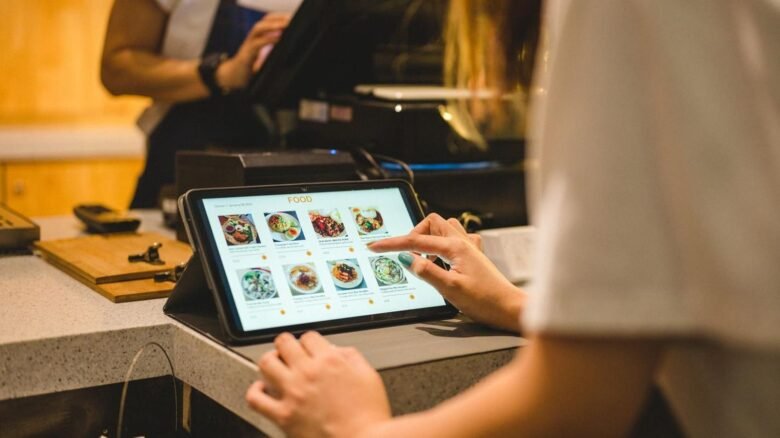
Close-up on a waitress using a tablet to take an order at a restaurant – food service concepts
getty
As 2026 rolls along, restaurant technology is no longer a side project, a trade show attraction, or a nice extra for larger brands. It has become central to profitability, speed, consistency, guest retention, and decision making. The restaurant industry is still growing, with the National Restaurant Association projecting $1.55 trillion in sales and 15.8 million jobs this year. Still, operators are also dealing with uneven traffic, inflation, labor pressure, and rising expectations around convenience. In that environment, technology is not about looking modern. It is about staying competitive.
The industry is growing, but that does not make the job easier
There is a tendency to confuse top line growth with operating comfort. That would be a mistake in 2026. The National Restaurant Association says the business is on track for real, inflation-adjusted gains this year, and that February restaurant sales reached $100.1 billion on a seasonally adjusted basis. But the same industry sources also point to persistent cost pressure, a flatter real sales trend over recent months, and tighter consumer budgets. Qu’s 2026 restaurant technology benchmark adds another layer of pressure, showing that declining guest traffic, food inflation, and labor costs remain the most cited headwinds among restaurant brands.
That is why technology deserves management attention in 2026. Not because software is fashionable or because artificial intelligence dominates conference agendas, but because the margin for operational sloppiness has narrowed. Restaurants that use technology well are putting it to work against friction, waste, delay, inconsistency, and blind decision making. Restaurants that use it poorly are simply adding cost and complexity.
1. Margin protection now depends on operational technology
The first reason to focus on technology in 2026 is simple. Margin protection has become an operational technology issue. Toast’s 2025 Voice of the Restaurant Industry Survey found that 40% of operators named improving profitability as their top goal, while 47% said they were focused on increasing staff efficiency amid hiring difficulties. That lines up with the National Restaurant Association’s 2026 outlook, which says operators are looking to invest in more technology to boost efficiency and strengthen guest connections.
Handsome Indian man coffee owner sit calculating income and expenses accounts. Man employee wearing apron sitting on table and clear account before closing shop, personal business concept.
getty
The practical meaning is more important than the headline. When operators talk about efficiency, they are not talking only about cutting labor. They are talking about reducing rework, improving order accuracy, shortening ticket times, better forecasting, simplifying scheduling, tightening inventory control, and making every shift less chaotic. Qu’s 2026 report shows that 62% of brands say improving order flow across all channels is their top priority for 2026, followed by workflow and station efficiency at 52%, and more accurate ready and pickup times at 48%. That is not a conversation about gadgets. It is a conversation about execution.
For many restaurants, the biggest financial gains in 2026 will not come from a dramatic increase in traffic. They will come from preserving more of the sales they already have. A better kitchen display system, tighter labor scheduling, stronger POS reporting, integrated inventory management, and more accurate prep timing can quietly create a much bigger profit improvement than a flashy marketing push that drives volume into a strained operation.
2. Digital ordering and off premises demand are now core parts of the business
The second reason is that digital demand is no longer a side channel. It is part of the core business model. The National Restaurant Association’s 2025 off premises research shows how deeply that shift has taken hold. Off-premises traffic accounted for 19% of traffic at full-service restaurants in 2019 and 30% in 2024. For limited service restaurants, it rose from 76% to 83% over the same period. Another Association summary says that nearly 75% of all restaurant traffic now occurs off-premises.
The digital side of that story is just as important. Qu’s 2026 benchmark found that 57% of restaurant brands generated more than 25% of total sales through digital channels in 2025, up 8 points year over year. Its 2025 report also found that 40% of brands viewed first party digital ordering as the top revenue growth driver, and 64% were looking to upgrade to unified systems that centralize data and improve reporting and efficiency.
That should change how operators think. In 2026, the question is not whether digital ordering matters. The real question is whether the restaurant controls enough of that experience to make it profitable. First-party ordering, integrated menus, accurate promised times, stable third-party connections, and clear pickup workflows matter because digital volume can create as many problems as it solves when the underlying operations are fragmented. Qu’s 2026 findings make that clear, with third party ordering ranked as the most unstable area by 35.7% of respondents, followed by first party ordering at 27.44%. Digital growth without operational control is not progress. It is just faster disorder.
3. Guests now treat convenience, speed, and frictionless payment as part of the value equation
A young woman interacts with a digital kiosk in a stylish caf, selecting items for her order, A woman in a white jacket chooses drinks and orders food for dessert in a restaurant or pizzeria coffee shop through a touchscreen screen on her own. The restaurant menu is displayed on the screen in the terminal.
getty
The third reason to focus on technology is that guest expectations have changed. Customers still care about food quality and hospitality, but they increasingly define value through ease, speed, accuracy, and convenience. The National Restaurant Association’s off premises work says customers count on five main factors when ordering food to go: speedy service, good customer service, technology that eases ordering and payment, value offers, and access to loyalty programs. The same research notes that more than 8 in 10 off premises customers say they would take advantage of common value offers such as specials, combo meals, and buy one get one offers.
The restaurant technology data tells a similar story. The Association’s 2024 Restaurant Technology Landscape Report found that 7 in 10 adults look for deals when ordering takeout, delivery, or dining in. It also found that 7 in 10 limited service customers would likely place an order using a smartphone app, and 8 in 10 delivery customers would order delivery through a smartphone app. In full service, most consumers said they would likely use a tablet at the table to order or pay, and many were comfortable using contactless or mobile payment methods.
That matters because convenience has moved from differentiator to baseline. A restaurant can still win on hospitality, but if ordering is clunky, pickup is confusing, payment is slow, or loyalty rewards are hard to access, the guest often experiences that as poor value even if the food itself is strong. In other words, technology now shapes perceived hospitality. It influences whether the guest feels the restaurant is easy to do business with. That is a commercial issue, not just a user experience issue.
4. Better data and unified systems create better decisions
The fourth reason is that restaurants cannot manage what they cannot see. Many operators are running more channels than they did a few years ago, but their systems still do not talk to each other well enough. That creates reporting lag, menu inconsistency, duplicated labor, fulfillment errors, and weak guest insight. Qu’s 2026 report says 37% of brands cite fragmented systems and data as one of the top barriers to a better guest experience across channels. Its 2025 report found that 64% of enterprise restaurant brands were looking to upgrade to unified systems, while 87% said unifying payments was important.
This is where technology becomes strategic rather than merely tactical. Integrated systems allow operators to connect sales, labor, menu performance, loyalty activity, inventory movement, and guest behavior in a usable way. That is how smarter forecasting happens. That is how promotions become more precise. That is how a brand learns which channel produces the best mix, which dayparts are leaking margin, which items deserve menu space, and which locations are struggling with throughput rather than demand.
The National Restaurant Association’s own investment data reinforces the point. In its 2024 technology report, 52% of operators said they planned to invest in back office technologies, 52% in inventory control and management, and 48% in POS systems. These are not vanity purchases. They are attempts to create cleaner information and faster decisions in a business where small errors compound quickly.
5. AI has moved from curiosity to selective execution
The fifth reason to focus on technology in 2026 is that AI is no longer hypothetical. It is entering restaurant operations specifically and in commercial ways. But the lesson from current data is not that every restaurant should rush to install every available AI tool. The lesson is that operators should understand where AI is genuinely useful and where the return is still immature.
Toast’s AI in Restaurants survey found that 81% of operators believe AI will help them be more efficient, 81% say they plan to use more AI in the future, and 86% say they are comfortable using it. Operators are already using it for marketing automation, real time insights, menu optimization, forecasting, and benchmarking. Qu’s 2026 benchmark shows the next stage of that shift: 73% of brands are investing in AI now or within the year, with spending focused first on marketing, CRM, and personalization, then predictive analytics, voice ordering, and inventory and demand management.
The caution is just as important as the enthusiasm. Qu reports that only 9% of brands say AI is producing meaningful or transformational impact so far. In comparison, 33% say value is still emerging, and 43% report limited value. That is a useful reality check. In 2026, AI should be treated as a precision tool, not a branding exercise. The restaurants that benefit most will be those with clean data, integrated systems, clear use cases, and disciplined pilots tied to measurable outcomes, such as lower labor waste, better forecasting, improved conversion, faster service, or stronger guest retention.
Conclusion
Restaurant leaders should focus on technology in 2026 because the business no longer gives them much room to separate growth from execution. Demand is spread across more channels. Guests expect convenience as part of value. Labor remains difficult. Margins remain tight. And the brands that can see their data, control their order flow, personalize intelligently, and remove friction from the guest journey are in a stronger position to protect both profit and reputation.
The smartest operators will not chase every new platform. They will ask harder questions. Does this tool reduce friction for the guest? Does it improve the team’s accuracy and speed? Does it improve visibility for decision makers? Does it strengthen first party relationships and long term loyalty? In 2026, restaurant technology should not be judged by how advanced it sounds. It should be judged by whether it helps the restaurant run better, serve better, and earn more from the business it already has.