
The 2026 NFL draft began Thursday night in Pittsburgh (on ESPN/ABC/ESPN App).
We’re tracking all 257 picks for Rounds 1-7, and you also can check out all the best available draft prospects.
The draft continues with Rounds 2 and 3 on Friday (7 p.m. ET) and concludes with Rounds 4-7 on Saturday (noon ET).
ESPN’s team of reporters will submit pros and cons below for each of the 32 players selected in Thursday’s first round.
More NFL draft coverage:
Kiper’s Round 1 winners, losers, value picks
Top prospects at every position
Kiper’s position rankings

Round 1 picks / order

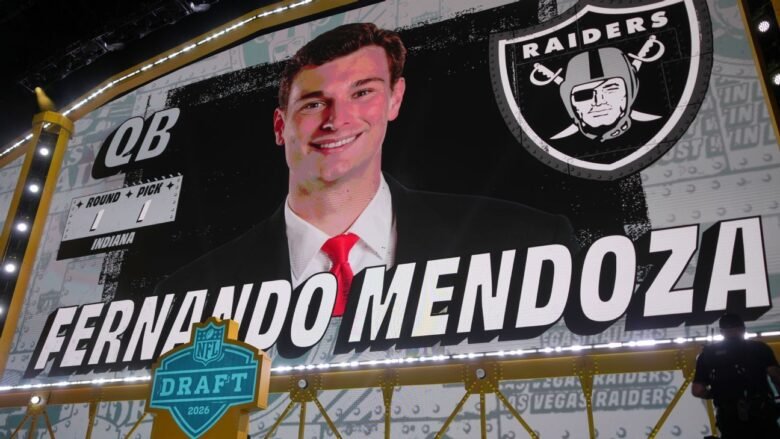
Why they picked him: With the Raiders in the midst of a rebuild, they needed a long-term answer at quarterback, and Mendoza has the potential to fill this need. His skill set is a natural fit for new coach Klint Kubiak’s offense, and the two can develop into a strong pairing for years to come. Similar to most quarterbacks coming out of college, Mendoza will have to adjust to playing under center. But his decision-making and accuracy should carry him a long way.
Biggest question: Even though general manager John Spytek and Kubiak prefer letting a young quarterback sit until ready, the best players will ultimately play. The Raiders signed Kirk Cousins ahead of the draft, giving the organization insurance at the position. The best-case scenario is that Cousins begins the season as the starter before Mendoza takes over for the rest of the way, similar to Russell Wilson and Jaxson Dart with the New York Giants last year. — Ryan McFadden

Why they picked him: Did you see what opposing quarterbacks did to the Jets last season? We’re talking 36 touchdown passes and zero interceptions. The Jets’ pass rush was so benign (26 sacks) that the safest place in the stadium was the pocket behind center. Bailey should change that. In 2025, he led the FBS in sacks (14.5) and quarterback pressure percentage (20.4%). His outside speed is real and should attract double-teams, creating one-on-ones for the interior rushers. The Jets haven’t had a consistent, double-digit sack threat in a decade. Bailey needs to be that guy.
Biggest question: Did they blow it by passing on Arvell Reese? Most talent evaluators believe Reese has a higher ceiling than Bailey. Another question will be about Bailey’s liability against the run. By his own admission, this is an area in which he needs to improve. He had only eight run stops (tackles at or behind the line of scrimmage) in 14 games. The Jets will leave themselves vulnerable against the run if they roll with Bailey (251 pounds) and Will McDonald IV (245) as their two edge defenders. — Rich Cimini
0:33
David Bailey’s ‘ready to work’ after being drafted No. 2 to Jets
David Bailey says he wants to be a sponge and he’s “ready to work” after being drafted No. 2 to the New York Jets.

Why they picked him: Love gives the Cardinals even more offensive skill talent for first-year head coach Mike LaFleur to utilize. Love is a dynamic back, who will slide into the RB1 role immediately. Arizona has several other needs that will help the Cardinals win in 2026, but it can build around Love and he will complement the likes of Marvin Harrison Jr., Michael Wilson and Trey McBride.
Biggest question: Having a talent such as Love in the backfield could lead to offensive fireworks, if Arizona can both protect the quarterback — whomever it might — and block for Love. Arizona has a major need at right tackle, so addressing the offense from the outside in is a major risk for a general manager on the hot seat with a first-year head coach. — Josh Weinfuss

Why they picked him: The Titans took Tate to add playmakers for quarterback Cam Ward. Tate is a complete receiver who developed into a downfield threat last season. He averaged 32.5 yards per touchdown last season with five scores of 40 or more yards. It’s a relatively safe pick for the Titans, who are banking on his continued development as a pass catcher. He’ll get to work with wide receivers coach Greg Lewis and figures to settle in at the No. 1 receiver for Ward. Tate is also a willing blocker.
Biggest question: How will Tate adjust to being the No. 1 receiver? As the draft’s fourth pick, Tate will be asked to immediately be the Titans’ lead receiver. That’s new territory for him after serving as the No. 2 wideout at Ohio State alongside Jeremiah Smith. The coverage is going to be rolled toward Tate now. He’ll also face the opposing team’s top cover corner when they play against man defense. How Tate adjusts to the new defensive focus on him will be the key to his success. The good thing is he’ll have an accomplished playcaller in Brian Daboll and veteran receivers Wan’Dale Robinson and Calvin Ridley to show him the way. — Turron Davenport

Why they picked him: Quite simply, he’s one of the best prospects in this draft. The Giants didn’t expect him to be available. Reese projects primarily as an edge rusher but also has played inside linebacker at Ohio State. He can move around the field and is a unique athlete, having run the 40-yard dash in 4.46 seconds at 241 pounds. As general manager Joe Schoen said at the NFL combine: “You can’t have enough pass rushers.” That applies here.
Biggest question: How do the Giants fit Reese into the mix? They already have edge rushers Brian Burns, Abdul Carter and Kayvon Thibodeaux on the roster. This would seem to put Thibodeaux’s future in further doubt. Thibodeaux is set to play this season on his fifth-year option. A trade could be on the horizon. Even with Burns, Carter and Reese, it will be a challenge for new defensive coordinator Dennard Wilson to get the talented rookie on the field enough to justify this high pick. — Jordan Raanan

Why they picked him: After trading All-Pro cornerback Trent McDuffie to the Los Angeles Rams seven weeks ago, the Chiefs have found their new starter in Delane, who has the potential to be a star. One of Delane’s best traits is his coverage ability, especially in press, man-to-man coverage. In 11 games last season, he recorded two interceptions and 13 pass breakups. Delane is also not afraid to be a physical tackle in the open space. With the Chiefs, Delane will be a starter who can help replace the lost production of McDuffie and Jaylen Watson, who are both with the Rams.
Biggest question: Did the Chiefs really need to make this trade? By trading three picks, the Chiefs made sure they took the top cornerback in the draft, becoming the first team to execute a trade to move ahead of the Washington Commanders and New Orleans Saints in draft order. But were the Chiefs worried that one of those teams would select Delane? By executing this trade, the Chiefs went from nine picks to only seven. The trade will be successful if Delane turns out to be valuable enough to surrender the Nos. 9, 74 and 148 selections. — Nate Taylor

Why they picked him: Styles offers terrific length, speed, leadership and versatility at linebacker. Styles ran a 4.46 in the 40-yard dash at the combine and would give the Commanders the speed they have lacked at the position, pairing with Leo Chenal (4.53) to form a fast tandem alongside Frankie Luvu. Another potential starter, Jordan Magee (4.55) also offers speed and versatility. In new coordinator Daronte Jones’ defense, Styles would provide flexibility in coverage — at 6-foot-5, he covers ground — and they can use him as a blitzer, something Chenal can also do. Also, Styles missed only two tackles last season and is considered a strong on-field communicator and leader.
Biggest question: Does he keep ascending and can he impact the quarterback? Styles made a big leap in his second season at linebacker for Ohio State after transitioning from safety. The latter position has helped in some route recognitions, but he’ll also have to prove he can handle one-on-one coverage against backs or tight ends. Also, can he become an effective blitzer? OSU linebackers coach James Laurinaitis said they would have used him similarly to Arvell Reese this year — if they didn’t have Reese. In other words, yes they think he can blitz. — John Keim

Why they picked him: The Saints needed wide receivers at the end of the 2025 season, and when they didn’t sign one in free agency, the speculation about adding a pass catcher intensified. The Saints have a young quarterback in Tyler Shough and need to surround him with offensive players. The wide receiver room, which doesn’t have much depth right now, gets an immediate upgrade with Tyson, who had 18 touchdown receptions the past two seasons. He can become an immediate starter next to Chris Olave.
Biggest question: Tyson’s injury history is extensive, which could be a concern. Olave, the Saints’ No. 1 wideout, suffered health issues of his own when he had several concussions in 2024. Tyson has had hamstring issues, knee issues, an ankle injury and a broken collarbone. Keeping him healthy will be a top priority for the Saints, who have acknowledged they are more risk-averse when drafting than they might have been in the past. — Katherine Terrell
0:35
How Jordyn Tyson fits with the Saints
Katherine Terrell reacts to the Saints’ selection of Arizona State wide receiver Jordyn Tyson at No. 8.

Why they picked him: The Browns’ commitment to the trenches this offseason continues. After bringing in three outside offensive linemen in free agency, Cleveland adds its possible left tackle of the future. Fano played the past two seasons at right tackle but began his college career at left tackle. The Browns still have a big void at left tackle, a position group that gave up a league-worst 16.2% pressure rate and 36 quick pressures last season, according to NFL Next Gen Stats. Dawand Jones, a 2023 fourth-round pick, has suffered season-ending leg injuries in three straight seasons.
Biggest question: Is Fano’s future actually at left tackle? Throughout the draft process, there has been speculation that Fano could move inside to guard or tackle because of his sub-33-inch arm length. Cleveland has added a pair of interior linemen this offseason (Elgton Jenkins and Zion Johnson) but only one offensive tackle (Tytus Howard) — Daniel Oyefusi
Why they picked him: He was considered by many to be the top offensive lineman in this draft. He can start at the vacant right guard spot and potentially slide out to tackle in future years if Andrew Thomas struggles with injuries or when Jermaine Eluemunor’s contract expires. Mauigoa had only 11 snaps as a guard at Miami and was a consensus All-American this past season at right tackle. His 1.1% pressure percentage allowed was third best in FBS. Mauigoa plays with the size and strength that should transition well to guard. Some NFL evaluators think his best fit is actually as a guard.
Biggest question: He has a herniated disc in his back. It’s possible that Mauigoa could eventually need surgery. That left questions about how high a team would take him in the draft because it could affect his rookie season. And then who knows how it would respond long term. There was never any doubt that Mauigoa would still be a high pick, but would a team take the risk in the top 10? — Jordan Raanan

Why they picked him: Some people consider Downs the best player in the draft. Others have called him the safest pick in the draft. The Cowboys’ defense needs all kinds of help, and Downs can fill spots at safety, but he most likely will be the nickel defender, which is of huge importance for new coordinator Christian Parker. Downs can diagnose things quickly and is unafraid.
Biggest question: There have been rumblings of a knee condition in the lead-up to the draft, but he never sat out a game in college. He didn’t do testing at the combine or at his pro day, so there is no 40-yard dash time, but on film, there isn’t much question about his speed. — Todd Archer
0:50
Cowboys land pass rusher Malachi Lawrence at No. 23
Todd Archer reports on the Cowboys trading down to select UCF edge Malachi Lawrence at No. 23, adding a 20-sack pass rusher to boost their defense.

Why they picked him: Proctor brings massive size to the field at 6-foot-7, 352 pounds, and gives Miami two of the biggest tackles in the league alongside Patrick Paul. The Dolphins want to run the ball and Proctor is a mauler who can help them do so. With no set starter at right guard, and Austin Jackson’s expiring contract at right tackle, Proctor could play both positions over the next two years.
Biggest question: Where will he play? Proctor played left tackle for the Crimson Tide, but it’s unlikely he takes Paul’s job in Miami. Jackson has struggled to stay healthy over the past few seasons but is productive when he’s on the field — so right guard might be Proctor’s clearest path to early playing time. — Marcel Louis-Jacques

Why they picked him: Last month, when asked whether the Rams are thinking about life after quarterback Matthew Stafford, head coach Sean McVay said the team was preparing for the short- and long-term outlook at the position. They took a big step toward setting up the future at quarterback by drafting Simpson, who was widely considered the second-best QB in the draft behind No. 1 pick Fernando Mendoza. Last season at Alabama, Simpson completed 64.5% of his passes for 3,567 yards and 28 touchdowns. He will sit behind Stafford and have the chance to learn from the reigning NFL MVP as long as the veteran quarterback wants to play.
Biggest question: What went into the decision to think about the future at quarterback instead of solving an immediate need on a team considered a Super Bowl contender in 2026? Ultimately, general manager Les Snead and the Rams hope they’re not picking this high in the first round of the draft in the foreseeable future, as this is the pick they have after trading out of the first round a year ago. Snead has been clear that the Rams want to maximize the roster for as long as Stafford is playing, but by going into the draft with no major voids on the roster, it allowed them to take a player who they hope can help keep their Super Bowl window open after Stafford’s retirement. — Sarah Barshop
0:45
Rams GM Les Snead praises Ty Simpson
Les Snead expands on Ty Simpsons perseverance and journey from Alabama to the Rams.

Why they picked him: Baltimore addresses one of its biggest needs with Ioane, who is considered the best guard in this draft class. By taking Ioane over Miami edge rusher Rueben Bain Jr. and Oregon tight end Kenyon Sadiq, the Ravens are showing their commitment to upgrading the pass protection for quarterback Lamar Jackson.
Last season, Baltimore’s quarterbacks were sacked on 8.9% of their dropbacks, which was the worst rate in franchise history. Ioane is known for being dominant in the run game, but he has been equally strong in shutting down pass rushers. He didn’t give up a sack in his past two seasons at Penn State. Ravens general manager Eric DeCosta described the 6-foot-4, 330-pound Ioane as coming “straight from central casting for what you want your guards to look like.”
Biggest question: Will Baltimore regret using such a high pick on a non-premium position? Teams are typically taking quarterbacks, wide receivers, offensive tackles, cornerbacks and edge rushers in the top half of the first round — not interior offensive linemen. Over the past decade, only five guards have been selected in the top half of the first round: Quenton Nelson (sixth), Chris Lindstrom (14th), Alijah Vera-Tucker (14th), Kenyon Green (15th) and Tyler Booker (12th). There have been mixed results with as many Pro Bowl players (Nelson and Lindstrom) as players no longer with their original teams (Vera-Tucker and Green). — Jamison Hensley

Why they picked him: The Bucs have sought edgier and more physically imposing players on defense this offseason. Bain gives them that at 6-foot-3 and 275 pounds, along with production: He had 9.5 sacks, 15.5 tackles for a loss, an interception and a forced fumble this past year en route to winning ACC Defensive Player of the Year. He also had five sacks in the postseason, showing up for the Hurricanes when it mattered most.
Biggest question: Bain was involved in a 2024 motor vehicle accident that resulted in the death of a passenger. He was cited for careless driving, but the charge was dismissed. There have been concerns about his shorter arms at 30⅞ inches and his speed, running a 4.69 40-yard dash at the combine. But the Bucs have a high-character locker room to absorb a player who might need support, and the team has always believed in tape over testing times. — Jenna Laine
Why they picked him: The Jets needed an explosive pass catcher, whether it was a wide receiver or a tight end. Sadiq is a wide receiver in a tight end’s body. At 6-foot-3, 241 pounds, he ran the 40-yard dash in a sizzling 4.39 seconds at the combine. He played up to his speed in his only season as a starter, producing 13 receptions of at least 20 yards. His overall stats were relatively modest — 51 catches for 560 yards and eight touchdowns, as some felt he was underutilized by Oregon. The knock against him? Six drops last season.
Biggest question: Should they have picked a wide receiver instead of Sadiq? There were some good ones still on the board, including Makai Lemon and Omar Cooper Jr. The Jets used a second-round pick last season on Mason Taylor, who still figures prominently in their plans. They will be using a lot of two-tight-end packages, deploying Sadiq as the flex and Taylor as the traditional in-line tight end. This doesn’t bode well for veteran Jeremy Ruckert, who signed a contract extension late last season — Rich Cimini

Why they picked him: The Lions’ offensive line wasn’t up to par last season, finishing with the second-worst pass block win rate in the NFL (56%), according to ESPN Analytics/NFL Next Gen Stats. After missing the playoffs in 2025, Detroit continues to retool its offensive line by adding Miller, with an emphasis on improving the pass protection around veteran quarterback Jared Goff. His experience is primarily at right tackle for Clemson, and he has a prototypical frame for an offensive tackle — at 6-foot-6, 315 pounds — to help immediately.
Biggest question: Was Miller the best option among available offensive tackles to help right away? Fans should be cautious about questioning Lions GM Brad Holmes’ decisions based on his track record in the NFL draft, but it’s still a fair question. Either way, the Lions addressed one of their top positional needs with an elite prospect on the offensive line. This is another foundational building-block pick and a solid player who started all 54 games of his college career. Miller is the first offensive lineman selected by the Lions in the first round since they took Penei Sewell seventh in 2021. — Eric Woodyard

Why they picked him: First and foremost, there was a massive need at the position. The Vikings spent big at DT last season, signing veterans Jonathan Allen and Javon Hargrave, but neither made a big impact and were released after the season. That left a promising but inexperienced group of incumbents, including Jalen Redmond, Levi Drake Rodriguez and Tyrion Ingram-Dawkins, a fifth-round pick in 2025, and Elijah Williams. They did not sign a free agent at the position, so there is an immediate opportunity for Banks to play. That is, of course, if he is healthy.
Biggest question: Banks is a massive prospect at 6-foot-6 and 330 pounds, but he has had a series of injuries to his left foot. He recently underwent surgery to repair a broken bone in the foot, which he suffered at the NFL combine, and played in only three games last season because of an injury to the same foot. NFL teams received a letter last week about the condition of his foot and were told that Banks hopes to be back on the field for June minicamp. He’s a potentially dominant player when healthy, but the injury history is worrisome. — Kevin Seifert
0:54
How Vikings are reacting after taking Caleb Banks with pick No. 18
Kevin Seifert explains where the Vikings stand after drafting Caleb Banks with the 18th overall pick.

Why they picked him: The Panthers’ offensive line needed to be upgraded after a disappointing 2025. They ranked 23rd in pass block win rate (59.4%), 28th in run block win rate (69.7%), and 29th in pressure rate allowed (36.1%), per ESPN Research. Left tackle Ikem Ekwonu ruptured his patella tendon in a playoff loss to the Los Angeles Rams and two other starters (center Cade Mays and guard Austin Corbett) left in free agency. Freeling has played both right and left tackle, and he gave up just seven pressures and two sacks last season.
Biggest question: Freeling was a second-team All-SEC selection last season, but has just 18 starts — all coming in 2025. That makes him one of the more inexperienced tackles, but he showed improvement during the season. But any concern about his inexperience could be offset by his athleticism: He had the fourth-fastest 40-yard dash (4.93 seconds) and had the agility score of 90 (100), tied for the second-best by any offensive lineman. — Mike DiRocco

Why they picked him: The Eagles move up and make a major addition at receiver in advance of A.J. Brown’s expected departure. The 2025 Biletnikoff Award winner as the nation’s top receiver, Lemon posted 150-plus receiving yards in four games this past season — the most by a USC player since Drake London in 2021. He emerged as one of the nation’s top slot targets, posting 1,281 yards out of the slot since 2024. “[Lemon] is as good as I’ve seen,” Iowa coach Kirk Ferentz said after Lemon went for 153 yards on 10 catches against his team. “Going back 20-plus years, I don’t know if anybody’s impacted the game more.”
Biggest question: How soon will they address the offensive line? The front was a vulnerability for Philadelphia for the first time in a long time last season. With RT Lane Johnson and LG Landon Dickerson both pondering retirement this offseason, there is urgency to add to the group. There was some thought that the Eagles might go O-line in the first round, and Georgia’s Monroe Freeling got within range before being selected by the Panthers at 19. Instead, they get good value with Lemon, who wasn’t expected to be available this late in the draft. — Tim McManus

Why they picked him: With experience at left and right tackle, Iheanachor offers the Steelers coveted position flexibility, something both coach Mike McCarthy and general manager Omar Khan emphasized Thursday night after making the selection. Iheanachor, who moved to the United States from Nigeria at 13, played basketball and soccer before switching to football later in life, and that background gave him a strong foundation to develop his football footwork. In picking Iheanachor, the Steelers spurned adding a top-tier wide receiver and are instead betting on their ability to develop and mold one of the more raw prospects and help him hit a high ceiling.
Biggest question: What does this mean for OT Broderick Jones? The Steelers’ 2023 first-round pick sustained a season-ending neck injury and had surgery soon after, and his timeline to return is still murky. While the Steelers maintain he is on an expected timeline to return following the surgery, it remains unclear if he’ll be able to play by training camp or the start of the season as he works to regain his strength. Khan on Thursday night admitted there is some concern with Jones, but Iheanachor’s position flexibility made him the right pick regardless of Jones’ health. — Brooke Pryor
0:56
What Max Iheanachor brings to the Steelers
What Max Iheanachor brings to the Steelers

Why they picked him: After losing edge Odafe Oweh in free agency, edge was one of the Chargers’ most prominent needs heading into the draft. The Chargers have historically rotated their edge rushers — including playing three in pass rush scenarios — and Mesidor allows them to continue doing so under first-year coordinator Chris O’Leary. Mesidor also gives the Chargers a potential cornerstone piece for the future of this room, as 35-year-old Khalil Mack could be playing his final season in Los Angeles.
Biggest question: Why didn’t the Chargers go offensive line? Justin Herbert was the league’s most-hit and pressured quarterback last season, making the need obvious. With Pro Bowl tackles Joe Alt and Rashawn Slater set to return from injuries, the offensive line will be much improved, but the Chargers still have holes at guard. This pick, however, falls in line with GM Joe Hortiz’s approach of taking the best player available and fills a need for the Chargers. The expectation is that L.A. can get a talented guard on Day 2. — Kris Rhim
Why they picked him: A defense can never have enough pass rushers. The Cowboys traded for Rashan Gary at the start of the offseason. Now, they add Lawrence with the 23rd overall pick. He had 20 sacks in his career at UCF and was an All-Big 12 selection in 2025 when he had seven sacks and 11 tackles for loss. He is considered a high-energy run defender with the ability to chase down plays, while also impacting the quarterback. The last time the Cowboys used two first-round picks on defensive players was in 2005 with DeMarcus Ware and Marcus Spears.
Biggest question: Is he ready for the NFL game? The Cowboys have Gary, Donovan Ezeiruaku (their second-round pick last year), Sam Williams and James Houston as their pass rushers to pair with Lawrence. Ezeiruaku is coming off hip surgery and had two sacks last season. Williams, who re-signed as a free agent in the offseason, had one. Houston had 5.5. But for Parker, the new DC, Lawrence is active and fits the profile of what he wants on the edge. — Todd Archer
Why they picked him: The Browns needed to upgrade the wide receiver room, which has been the NFL’s least productive since the 2025 season. Cleveland’s receivers accounted for the fewest receptions, yards and touchdowns last season. KC Concepcion was one of the most dynamic wide receivers in college football and also a threat as a returner.
Biggest question: Can Concepcion fix his issues with drops? His 6.7% drop rate ranked 285th out of qualifying pass catchers. — Daniel Oyefusi

Why they picked him: The Bears’ top three defensive backs in snaps last season all left in free agency, including safeties Kevin Byard III and Jaquan Brisker. While assistant GM Jeff King said the team would be confident starting Elijah Hicks and Cam Lewis, who boast a combined 29 starts, Thieneman gives Chicago a high-end Day 1 starter opposite marquee free agent signing Coby Bryant. From Bryant to Lewis and now Thieneman, Chicago has focused heavily on replenishing its secondary over the past two months after its defense allowed 61 completions of 20-plus yards (tied second most) and 13 passing touchdowns of 20-plus yards (tied for the most with Dallas).
Biggest question: How does Thieneman fit with Bryant? The first trait that Bears college scouting director Breck Ackley said drew the team to Thieneman is the safety’s versatility and how that will allow defensive coordinator Dennis Allen to carve out roles for both the rookie and Bryant. “That’s what’s so exciting,” Ackley said. “When you look at how you want your defense to play, you want to be able to play with two guys that can both play high and low, both field the run on both sides. So there’s really not a weakness because they can both do everything.” — Courtney Cronin

Why they picked him: The Texans needed to add young talent on the interior of their offensive line, and this pick does that. Houston has perceived starters in guard Wyatt Teller and Ed Ingram, with Jake Andrews at center. This at least gives Houston a potential starter at a position of need, who, if he becomes effective, would allow the Texans to have a cost-effective player on the interior for the next four to five years. Houston also isn’t in a rush to play him either, so the Texans can take their time developing him.
Biggest question: Will Rutledge become a starter in Year 1? The Texans traded the Nos. 28, 69 and 167 overall picks to get Rutledge, so they’re clearly excited about what he can become in Houston. The former All-American succeeds at combo blocks while moving up to the second level. That works in Houston because Texans offensive coordinator Nick Caley loves to run gap schemes on the interior where double-teams are called from the guard-and-center combo. — DJ Bien-Aime
0:42
What Keylan Rutledge brings to the Texans
What Keylan Rutledge brings to the Texans
Why they picked him: There is no starting cornerback on the Dolphins’ roster, and Johnson could take the job from Day 1. He has good size at the position (6-foot, 193 pounds) and ran a 4.4 40-yard dash — so he can keep up with essentially any receiver he faces. He tested through the roof at the combine and possesses the footwork to match his athletic traits. First-year coach Jeff Hafley specializes in coaching defensive backs and now has his potential CB1.
Biggest question: Will his game translate at the next level? It’s low-hanging fruit for any prospect coming out of a Group of 5 conference, but Johnson had limited reps against NFL-caliber competition. Sauce Gardner and Quinyon Mitchell both made the transition smoothly, and the Dolphins hope they have found the next great Group of 5 cornerback. — Marcel Louis-Jacques

Why they picked him: The Patriots traded up to No. 28, giving the Bills their No. 31 pick as well as a fourth-rounder (No. 125) to ensure they landed their likely new swing tackle behind Will Campbell (left) and Morgan Moses (right). With the 35-year-old Moses entering his 13th NFL season, Lomu could be a future starter on the right side, while also adding insurance should Campbell — last year’s first-rounder — struggle in his development. Lomu also has the flexibility to play guard if needed. Building more infrastructure around QB Drake Maye is never a bad idea, and the 21-year-old Lomu, who started 22 games over the past two seasons at left tackle, adds a promising developmental prospect.
Biggest question: Lomu isn’t considered a powerful run blocker, and as ESPN draft analyst Field Yates noted, he still needs to build out his core strength at the NFL level. — Mike Reiss
Why they picked him: The Chiefs turn the centerpiece of the Trent McDuffie trade into an athletic defensive tackle in Woods, who should be a rotational contributor as a rookie. The Chiefs need depth behind pass rusher Chris Jones and Omarr Norman-Lott, last year’s second-round pick who sustained a season-ending torn ACL in his right knee in October. Woods is an intriguing athlete. Last week, general manager Brett Veach acknowledged that the Chiefs needed to add two players at the interior position.
How quickly can Woods help ease the burden on Jones? With impressive quickness, Woods can learn a lot from Jones, the Chiefs’ best defensive player. The Chiefs hope that Woods will grow in Kansas City after an up-and-down college career. If that happens, sooner rather than later, Woods could help Jones avoid being on the field for 80% of the snaps, as he has done. With a need at the position, Woods should have plenty of opportunity to earn snaps. — Nate Taylor
0:50
What Peter Woods brings to the Chiefs
What Peter Woods brings to the Chiefs
Why they picked him: Wide receiver was a major need, and the consensus top-three receivers were off the board (Jordyn Tyson, Carnell Tate and Makai Lemon). Cooper joins Garrett Wilson and Adonai Mitchell to give the Jets a potentially formidable receiving trio. The former Indiana star provides a yards-after-catch dimension, something the Jets lacked in 2025 (4.5 YAC per reception, 30th). Strong and physical with the ball, he produced 30 plays of 20-plus yards over the past two seasons. The Jets need some of that — desperately.
Biggest question: Did the Jets give up too much to get Cooper? They traded up three spots, giving a second-round pick (33) and a fifth-rounder (179) to the 49ers to move up three spots. That second-round pick was valuable because, at the top of the round, it would’ve attracted suitors for a potential trade. The Jets didn’t want to take a chance on losing Cooper to someone else, and they also wanted that fifth-year option for a first-rounder. That’s why they moved up, giving them a three-player haul in the first round. — Rich Cimini
Why they picked him: Faulk has the prototypical size to play defensive end for Saleh. His versatility is a plus for the Titans, allowing him to set the edge as a defensive end on early downs and possibly bump inside to defensive tackle to offer a different look as an interior pass rusher. Saleh likes to use a rotation on the front four and wants players who can line up at multiple spots along the defensive line. This pick is one in which the Titans are banking on Faulk’s upside and their ability to maximize a prospect with good measurables who’s only 20 years old.
Biggest question:: Why so little production at Auburn? Faulk accounted for only 10 sacks in 37 games at Auburn, including only two last season. However, he did accumulate 30 quarterback pressures, which shows he can get to the quarterback. Turning more of the quarterback pressures into sacks will be the ultimate task for Saleh and Co. Faulk admitted to playing with his pad level too high as one of the reasons he hasn’t been able to finish the deal and actually sack the quarterback. At worst, Faulk will be a plus run defender. Ironically, that’s an area where he said his pad level is correct because he has fired out of a three-point stance and was asked to occupy two gaps in college. — Turron Davenport

Why they picked him: Their backfield cupboard wasn’t bare, but it was easily the Seahawks’ biggest need. In a weak draft for running backs, a significant dropoff to the next-best option and an unimpressive list of available free agents, this was Seattle’s best shot at finding a replacement for Kenneth Walker III. Price didn’t run a blazing 40-yard dash at the combine (4.49), but he has plenty of explosive runs on his résumé as well as three touchdowns on kickoff returns over his career, so he can help fill the need for speed in Seattle’s backfield with Walker gone. Beyond that, Price, who stayed at Notre Dame as Love’s backup despite offers to transfer, seems like the Seahawks’ kind of person.
Biggest question: Price was a backup in college — albeit behind the third pick in this year’s draft — and will now be asked to fill a pseudo starting role, with Walker gone and Zach Charbonnet likely out for much of the season after knee surgery. Seattle also signed Emanuel Wilson to be a power runner and has George Holani in the mix. Another question about Price pertains to his ability to contribute in the passing game. He caught only 15 passes over three seasons, though that was in part a function of Love’s versatility. — Brady Henderson