
Topline
President Donald Trump credits himself with resolving nine conflicts—after saying repeatedly he’s solved the eight “wars” listed below—and while he has clearly tried to improve relations in most of these situations, there’s no evidence he’s been able to bring a lasting peace to any of them.
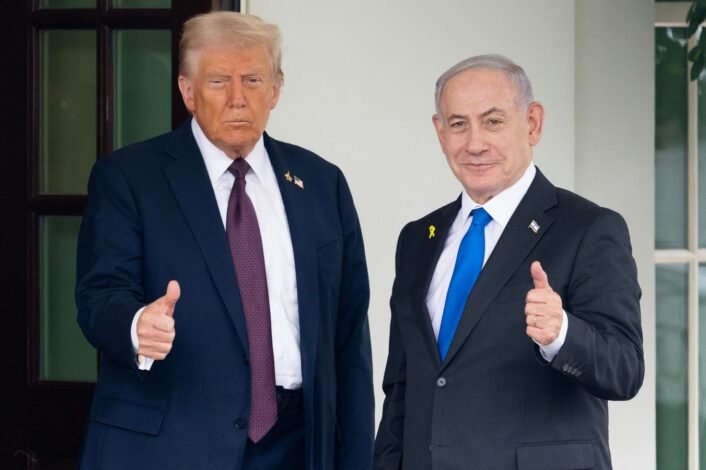
President Donald Trump greets Israeli Prime Minister Benjamin Netanyahu as he arrives at the West Wing of the White House in Washington, DC on September 29, 2025. (Photo by SAUL LOEB / AFP via Getty Images)
AFP via Getty Images
Key Facts
Armenia and Azerbaijan: The agreement Trump brokered last year was widely considered a historic breakthrough in the 40-year conflict, but no military action was underway at the time from either side. The treaty, signed in the Oval Office, establishes diplomatic relations between the two countries and mandates the construction of the Trump Route for International Peace and Prosperity connecting Azerbaijan to its Nakhchivan exclave, which is separated from the rest of the country by Armenia.
Democratic Republic of the Congo and Rwanda: The two countries signed an agreement in December at the White House to force Rwandan troops to withdraw from eastern Congo within 90 days and establish a regional economic framework. Still, fighting continues between the two sides—though there are small signs of progress, including Congo’s army beginning to take steps last month to disarm a militant group linked to Rwanda’s 1994 genocide.
Israel and Iran: Ending the so-called 12-day war in June 2025, Trump announced a ceasefire shortly after the U.S. bombed Iran’s nuclear facilities, which Trump claimed at the time helped avoid a larger conflict. But the credit Trump wanted to take at the time “has sort of been superseded by the fact he himself contributed to the outbreak of a resumption of violence on a much larger scale, involving the same parties,” Brookings Institution senior fellow Michael O’Hanlon told Forbes.
Israel and Hamas: Widely viewed as a significant foreign policy achievement for Trump, the ceasefire agreement remains fragile six months after it took effect, with major disagreements on both sides about a path to a permanent end to the conflict.
Kosovo and Serbia: Trump claimed in June last year that he thwarted a potential renewed military conflict between the two countries by threatening to freeze trade relations with the U.S., though the underlying territorial dispute remains as Serbia has not recognized Kosovo’s independence.
India and Pakistan: India rejects Trump’s claims he helped broker a ceasefire last year that ended four days of military violence that killed more than 100 people, the worst fighting between the two nuclear-armed countries in decades. Pakistan, however, has repeatedly thanked Trump for his role in the agreement as it’s cozied up to the U.S. and secured a more prominent role on the international stage.
Cambodia and Thailand: Trump threatened tariffs against the two countries if they didn’t agree to a ceasefire in their violent border dispute last year, and an agreement was reached in July and officially signed in October in Malaysia, with Trump in attendance. But fighting resumed later in 2025 and a second ceasefire commenced in December, after Trump again threatened tariffs.
Egypt and Ethiopia: These countries have disagreed for decades over Nile River water supply, but it’s never risen to the level of military conflict and a solution hasn’t been reached, despite Trump’s repeated offers to mediate.
What We Don’t Know
The ninth conflict Trump says he solved. He said that the Lebanon-Israel ceasefire that took effect April 16 would be his 10th war solved. Trump could be including the two-week ceasefire between the U.S. and Israel and Iran that was extended Wednesday. He could also be referring to the normalization of U.S.-Venezuela relations after the U.S. captured its president, Nicolás Maduro, in January as the ninth “war.” When asked by Forbes what the ninth conflict is—and why he continues to say he’s solved so many wars—the White House pointed to the eight conflicts Trump has said he’s solved.
Crucial Quote
“I think he gets a little bit of credit on a few. I’m not sure he was the decisive factor on any of them,” O’Hanlon said. “I like that he wants to be measured and evaluated as a peacekeeper . . . you have to take the usual Trump bombast and hyperbole with a lot of salt, but this is an area where I don’t mind him exaggerating a bit.” O’Hanlon noted Trump seems to have strayed somewhat from his peacekeeping mission in 2025 with attacks on Venezuela and Iran.
Tangent
Multiple countries on the list nominated Trump for a Nobel Peace Prize in 2025, including Israel, Cambodia, Pakistan, Armenia, Azerbaijan and Rwanda—raising questions about whether the nominations were an attempt to curry favor with Trump. “There seems to be a competition of how effectively they can flatter him,” Jon Alterman, chair of global security and geostrategy at the Center for Strategic and International Studies, told Politico.
Key Background
Trump has repeatedly expressed a desire to be remembered for ending global conflicts. In his 2025 inauguration address, he said his “proudest legacy will be that of a peacemaker and unifier.” But the president has also waded into unprecedented clashes with international allies, gone to war with Iran and launched a legally questionable campaign to seize so-called drug boats in the Pacific and Caribbean. He’s disparaged NATO and threatened to revoke the U.S.’ involvement, started a global trade war and insisted the U.S. should take over Greenland and Canada. Trump’s military campaigns in Venezuela and Iran have fractured his base, with some of his supporters saying they feel betrayed given his campaign promises of “no new wars” and “America First” ideology. Multiple Republicans voted alongside Democrats earlier this year to prevent him from future military action in Venezuela without congressional approval, though the measure failed to pass. A coalition of Republican lawmakers have also expressed serious reservations about the war in Iran, especially as it nears the 60-day mark, the point at which Trump would need congressional approval to continue using military force against Iran under the 1973 War Powers Act. Sending ground troops to Iran is also a hard line for some Republicans. Several influential right-wing figures have fervently opposed the Iran war, including Megyn Kelly, Tucker Carlson, former Rep. Matt Gaetz, R-Fla., and former Rep. Marjorie Taylor Greene, R-Ga.
Further Reading
Trump Claims He’s Solved 9 Wars—What’s He Talking About? (Forbes)