

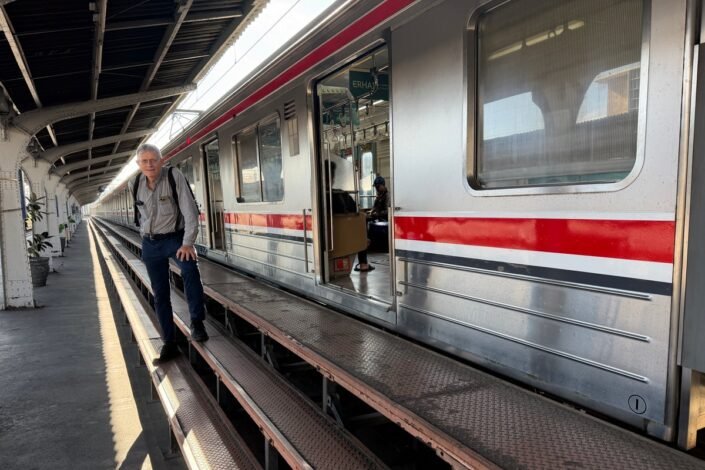
How much? I am writing this column on Saturday night in my hotel in the Indonesian capital, Jakarta. News reports say that more Iranian missiles and drones have struck Abu Dhabi. This is relevant to me because I have a Sunday evening flight to the UAE capital, with a connection to London Heathrow.
The Boeing 787 that is currently scheduled to operate the flight is currently on its way from Manila to Abu Dhabi. Assuming it gets in, there will be a quick turnaround for an overnight flight to Jakarta. But what if military action scuppers the schedule? That is why I have been checking the alternatives.
In the middle of March, I would expect typical air fares to be around £500-£600 for the 7,300-mile one-way trip. I paid £583 for my flight on Etihad via its UAE hub.
So how does the competition compare? Well, I have been checking a wide range of flights in case my plane is unable to perform. One of the lower quotes was £1,300 on Singapore Airlines. Thai Airways came in at around £1,550 via Bangkok. And Turkish Airlines wanted almost £2,000 for the courtesy of flying me via Istanbul.
“Airline[s] profiteering from stranded passengers is absolutely disgraceful,” wrote a disgruntled traveller on X.
Annoying, certainly. Absolutely disgraceful? I am not so sure. Airlines have a long (and not particularly proud) history of bumping up fares when they can. Going back to the Icelandic volcano of 2010, British families were paying many thousands of pounds to escape the Dominican Republic for Spain on Iberia. It was the only show in town for crossing the Atlantic.
“Companies should not be making money out of a crisis,” you might respond. “War is a tragedy affecting millions of people, many of whom are trying desperately to get home. Multiplying fares fourfold will simply keep options open for the rich, while the poor are excluded by price. It’s not right that there should be some type of hierarchy in terms of whether you can get back to your home country.
“Name and shame airlines that are acting in such a customer-unfriendly way. Passengers will be able to draw their own conclusions for the future. We will remember!”
If that is your view, I respect it. But please tell me how you propose to allocate the scarce resource of a flight that does not touch down in the Gulf? Price does a pretty good job of enabling prospective buyers to decide how desperately they need that commodity.
You could decide a maximum fare for a particular route, which on popular days would sell out almost at once. Where would that leave someone desperate to travel for urgent family or business matters? Better to leave a bit of capacity on board, both as a service and a potential moneymaker.
The airlines will contend, with some merit, that they are not actually forcing anybody to pay the outlandish fares quoted. If you have more time than cash, I recommend that you find a cheap way from your Asian location as far west as Istanbul. You will probably be presented with enticing options by fare-comparison websites. Choice is good in aviation: thankfully, we have plenty of it, even with so much capacity cut out of the market.
Looking ahead: flying home from Alicante or Malaga to Gatwick on easyJet on 29 August could cost you £300 plus, even if you book immediately. Most people simply want to get where they need to be, when they need to be there. And some of us will pay a fortune for that precious last seat on the plane.
Simon Calder, also known as The Man Who Pays His Way, has been writing about travel for The Independent since 1994. In his weekly opinion column, he explores a key travel issue – and what it means for you.