

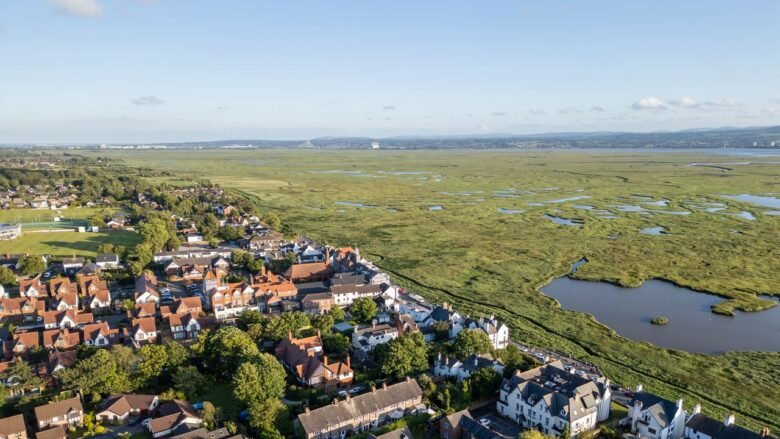
It never did, of course, but it’s only now, three decades on and returning to Parkgate, that I think I’ve stopped accepting it as just “that place that thinks it’s by the sea but isn’t.” The truth is that this place is far stranger than I ever gave it credit for at an age when, understandably, silting wasn’t as important as sex, cider, and cigarettes.
But silting is at the root of why Parkgate, with its ice cream parlor and long promenade, offers a wide view of mud and marsh where its seaside should be.
Sitting on the eastern edge of the Dee Estuary, Parkgate in the 18th century was a busy port with a sandy shore that was used as a departure point for ships sailing to Ireland. But the estuary, which had been silting up since the 11th century, had different ideas. What used to be open water was heading towards alluvium, and oblivion.
By the early 19th century, ships could still sail from Parkgate, but navigation became increasingly difficult thanks to the ever-growing mudflats, salt marsh, and sandbanks. By the turn of the 20th century, the sea was effectively gone, the village stopped functioning as a port and began its long and continuing afterlife.
Seeing a place stripped of its reason for existence, through no fault of its own, is to view the unsettling beauty of absence. I’m reminded of pictures I’ve seen of the drained Aral Sea in Russia; except that was a manmade disaster, prompted by a warped Soviet cotton planting experiment.
Cord grass ripples across these languorous northern marshes and, while ships lay wounded and stranded in the former Aral, all that remains of the old Parkgate are some very old photographs, showing frigates, sand, and some very fetching Victorian bathing attire.
I buy a cone from Nicholls ice cream parlor and look at the marsh stretching out like a soft, silvery pelt towards North Wales. But sucking at vanilla here is like taking popcorn to a cinema without a projectionist or waiting for a lover who has long since left you. The cone crunches in my mouth; the palimpsest of former sea is beyond indifferent to the fate of those left behind when it shrank, then vanished.