

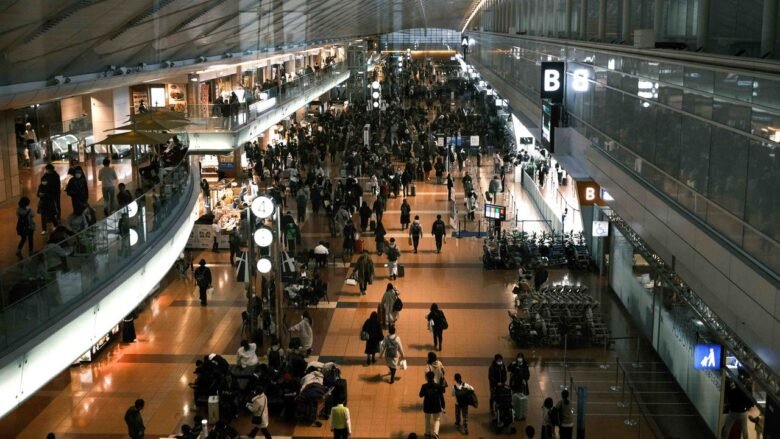
President Donald Trump deployed roughly 150 Immigrations and Customs Enforcement (ICE) agents into more than a dozen US airports across the country on Monday, after a partial government shutdown led to hours-long security lines and air travel chaos over the weekend. The president initially framed the move as an effort to relieve the long TSA lines and support the Transportation Security Administration (TSA), whose agents are calling out sick and resigning by the hundreds in their first week without pay due to the shutdown. But after the first full day of ICE’s deployment in airports, it remains unclear exactly what duties these immigration agents have been sent to perform. Still, travelers should be aware of their legal rights as they prepare to face a new kind of security hurdle en route to catch a flight.
While the government hasn’t released a list of the airports it’s sending ICE to, agents were confirmed to be present at 14 as of Monday evening: Chicago-O’Hare, Cleveland, Hartsfield-Jackson in Atlanta, William P. Hobby and George Bush Intercontinental in Houston, John F. Kennedy and Laguardia in New York, New Orleans, San Francisco, Luis Munoz Marin in San Juan, Newark, Philadelphia, Phoenix, Pittsburgh, and Southwest Florida International Airport in Fort Myers.
Travelers on social media documented ICE agents, mostly unmasked, standing around behind TSA agents observing their duties and walking around in small groups. The night before ICE was deployed into airports, a video went viral of them arresting a Guatemalan woman at the San Francisco airport in front of her child because she couldn’t prove her citizenship. The arrests of that woman and her family member were believed to be an “isolated incident,” SFO spokesperson Doug Yakel said in a statement, and unrelated to ICE assisting TSA at other airports.
“The airport’s role is to ensure the safe and efficient operation of the facility for all passengers and staff,” Yakel said. “We were not involved in or notified in advance of this incident. Airport operations continued without disruption, and there was no impact to flights or passenger processing.”
Trump said in an interview Monday that ICE will remain at airports until Congress agrees to fund the Department of Homeland Security fully, including ICE itself, and that we can expect the arrests at airports to continue. “ICE loves it because they’re able to now arrest illegals as they come into the country,” he told reporters. “It’s very fertile territory.”
Victoria Slatton, a former asylum officer and current immigration attorney at Slatton & Hass who has trained alongside TSA agents at Homeland Security, says she is advising any non-citizen without a green card to avoid air travel in the US right now unless it is an “absolute emergency.” And she would advise all travelers that their legal rights at airports are already diminished compared to elsewhere in public life. “As a general rule, all individuals have limited rights at airports,” she says. “The reasonable expectation of privacy that exists in most spaces does not apply in the same way at a security checkpoint. This is the legal baseline before ICE even enters the picture.”
Under the Immigration and Nationality Act, ICE agents have authority to arrest anyone they believe to be undocumented or deportable–even if they’re serving in place of TSA agents at airports. “These are not two separate functions,” Slatton explains. “The agent checking your ID at the security line today is simultaneously an immigration enforcement officer. That dual role has no modern precedent in domestic airport security.”
Practically, this means that in addition to running your bags through the scanner and conducting physical pat-downs, the agents at security checkpoints may request proof of citizenship, ask personal questions, and demand to go through a traveler’s phone. And these situations may fall into some legal grey areas due to the unprecedented nature of immigration agents being deployed to airports. Travelers have the constitutional right to remain silent, for instance, but “asserting that right in a security line in front of an ICE agent carries real practical consequences including delays, additional scrutiny, and potential detention,” Slatton says. She adds that travelers also “can and should verbally state that they do not consent to a search of their device, but agents may still detain it. Anyone traveling with sensitive information on their phone should be aware of this gray area right now.”
The bottom line is that travelers should not physically resist officers and should document everything they safely can in case a legal challenge is necessary down the road. Non-citizens should carry immigration documents at all times and avoid air travel right now if possible. And every traveler, Slatton says, “should understand that the legal framework governing this deployment is brand new, actively unsettled, and likely heading to court.”
In other words, there’s a lot we simply don’t know yet.