

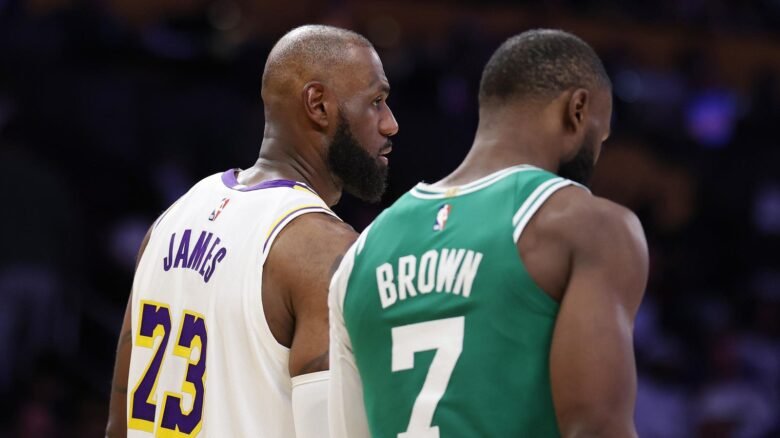
LOS ANGELES, CALIFORNIA – FEBRUARY 22: LeBron James #23 of the Los Angeles Lakers looks on during the second half of their game against the Boston Celtics at Crypto.com Arena on February 22, 2026 in Los Angeles, California. NOTE TO USER: User expressly acknowledges and agrees that, by downloading and or using this photograph, User is consenting to the terms and conditions of the Getty Images License Agreement. (Photo by Luiza Moraes/Getty Images)
Getty Images
Another regular season is nearly in the books. So, it is time for our second annual addition of the best and worst contracts in the association.
It is easy to look at the numbers these guys are getting and just marvel at all the zeros attached to their checks. But basketball is just as much about money as it is anything else, whether or not we care to admit it. The best teams tend to use their resources wisely, while the bottom-feeders usually have reckless spending habits.
After highlighting some of the best contracts from this year in Part One, it is time to identify some of the league’s least fruitful deals.
The Methodology
In the past, we have used multiple methods to try and project how much a player should make on their next contract. Well, in this article, we are going to focus on a method inspired by Seth Partnow’s book, “The Midrange Theory.”
In his book, the former Director of Basketball Research for the Milwaukee Bucks discusses a formula that teams use to estimate a player’s monetary value. In its essence, the formula involves multiplying how many points a player is “worth” by the amount a win “costs” in a given season. Unfortunately, Real-Adjusted Plus-Minus (RAPM) — a major component in the formula — is no longer available. So, I’ve revised Partnow’s formula a bit.
The Website Dunks & Threes offers a metric called Estimated Wins (EW). As the name implies, this measure quite literally estimates how many wins a player earned for their team in a given season. Theoretically, by multiplying this number by the amount a win is worth in a given season (3.8 million in 2025-26), we can get an idea of how much they should be making next season. From there, we can compare the average annual value of the contract they received to the amount this exercise produced to see the disparity in how much they got paid versus what they are actually worth.
Thanks to the help of Data Scientist Fran Huzjan (@FHuzjan on Twitter), we were able to calculate the production value of every NBA player who played meaningful minutes and subtract that number from their actual salary this season – giving us the best/worst contracts of the year.
Now, there are some shortcomings to using such a simple equation for calculating a player’s value. First, we are limited to the methodology used to compute EW. As is the case with any catch-all metric, EW can only tell you how many wins a player added in their specific role on their specific team.
And second, as we will soon see, this sort of method biases against players who struggle with injuries — since they aren’t on the court to help have an impact on winning. In some instances, like with players who are consistently injured, this can be helpful. But in one-off cases, where a player is uncharacteristically unhealthy for a year, this can make a player look far less valuable than they actually are.
Two Types Of Bad Contracts
To account for this negative bias toward injured players, I will show you two separate bottom ten lists – one featuring all players, and one that filters out players who have played less than 50 games this season.
The Worst Injury Contracts
Now, with all our qualifiers established, it is finally time to reveal the worst contracts of the 2025-26 NBA Season:
Dishonorable Mentions: Jimmy Butler III, Jordan Poole, Jalen Green, Giannis Antetokounmpo, and Franz Wagner.
Jayson Tatum is the perfect example of the one-off case we were speaking about. Before this season, Tatum never missed more than ten games in a season. Even if you factor in some potential load managing, Tatum has proven to be reliable enough for us not to worry about his presence on this list this season.
Two guys who we should be concerned about are Joel Embiid and Paul George, both of whom are in the bottom ten for the second straight season.
Interestingly, the Washington Wizards traded for two of these guys (Trae Young and Anthony Davis). Although, a big reason why they are here is that Washington has been trying to keep them off the court as much as possible this year.
Most of these other names are pretty self-explanatory. The more telling list is the one that includes the players who have been playing and are still not performing up to standards.
The Worst Non-Injury Contracts
Now, here are the ten worst contracts among players who have played at least 50 games this season:
Dishonorable Mentions: Zion Williamson, Jerami Grant, Anfernee Simons, Karl-Anthony Towns, and John Collins.
For the second straight year, LeBron James, Jaylen Brown, and Patrick Williams are on this list. James and Brown (along with Devin Booker, Pascal Siakam, and Brandon Ingram) show us how hard it is for a player to actually produce the on-court value that warrants a massive payday (not to pocket watch anyone). Williams’ contract continues to be a complete albatross for the Chicago Bulls.
On the subject of Brown, he continues to grade out as one of the worst contracts in basketball, despite all he has done to keep the Boston Celtics formidable this season, because one-number metrics still don’t view him in the brightest light (another subject for another article). This season, he is the ninth-highest paid player in the league, but only 63rd in Estimated Plus-Minus (per Dunks & Threes)
Khris Middleton, Draymond Green, and Kentavious Caldwell-Pope are not the players they once were. Unfortunately for their teams, they are still being paid like they are in the midst of their glory days.
Evan Mobley being here is fascinating because, last year, he was one of our ten best rookie contracts. What changed? Well, last season, Mobley was being paid 11.2 million dollars, and now, he’s been making over four times that (46.4 million). Mobley’s production has dipped a touch from the All-NBA level he was at last year, but again, we have yet another example of a player struggling to increase their production enough to merit their drastic pay spike.
It is also notable that Zion Williamson is the healthiest he’s been in quite some time (on pace to play the second-most games of his career), yet he still comes in as one of the worst contracts of the 2025-26 season.
Which Teams Did The Worst Job This Season?
Just like we did in Part One, we are also going to look at this through a team-wide lens. This season, the five teams with the greatest negative difference between what they are paying players and what they are actually getting out of them are (in order from greatest disparity to least) the Sacramento Kings, Washington Wizards, Chicago Bulls, New Orleans Pelicans, and Milwaukee Bucks – all teams that will not be in the postseason this year.
Be sure to check out Part One of this contract analysis mini-series. All data is up-to-date as of March 30, 2026.