

Finding Meaning in Craft
Why hands-on experiences turned out to be the secret to teenage travels
From my own travel experiences, I know that when you engage with craft in a meaningful way, the experience becomes reciprocal. It supports the people who sustain these traditions while giving visitors a deeper understanding of the culture, history, and community. And for our family, it offered something our teenagers needed: participation rather than observation. Instead of simply moving from monument to monument, they could sit beside artisans, carve blocks, dye with indigo, and appreciate the patience and skill required to create something by hand.
The trick was finding the right partners to make these experiences possible. We mapped our journey across Rajasthan between two anchor points: Jaipur, where the wedding would be held, and Udaipur, the shimmering city on the waters of Lake Pichola.
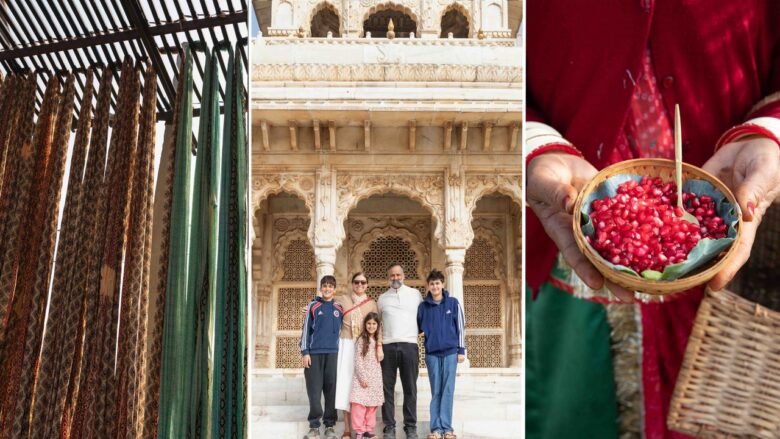
When we arrived in Jaipur, we began our trip right where Rajasthan’s textile story begins, just beyond the city limits. A half an hour outside Jaipur lies the village of Bagru, where almost every home doubles as a workspace for one step of the block printing process—washing, dyeing, carving, printing. For nearly five centuries, this small village along the Sanjaria River has been an epicenter of block printing in Rajasthan. We spent a morning meeting artisans on a guided village tour with Avinash Maurya, founder of Wabisabi Project. We then settled into their breezy studio to try our hands at mud-resist block printing and indigo dyeing. My kids stamped, dyed, experimented, and ended the day with scarves of their own design.
This early outing actually turned out to be the favorite day of the trip for all of us. Watching my sports-leaning sons fully surrender to creative play reminded me how much curiosity still lives on even as they get older, if we make room for it. There was also the added connection of spending an entire day interacting with the Bagru community—flying kites with kids off their roof, sharing cups of steaming chai, slowing down and allowing ourselves to move at the pace of the rural village.
In Jodhpur, a 5-hour car ride away from Jaipur, painter Vijay Raj and his son guided us through the intricate world of Rajasthani miniature painting at Umaid Heritage Art School, a welcoming storefront in the old city. Miniature painting, a centuries old court tradition known for its jewel-toned pigments, delicate, nearly minuscule brushwork, and scenes from royal life and Hindu mythology, requires extraordinary precision. Our teachers were endlessly patient—even when our son Vijay veered into manga sketches instead of tradition—and what began as a short lesson stretched into hours.