
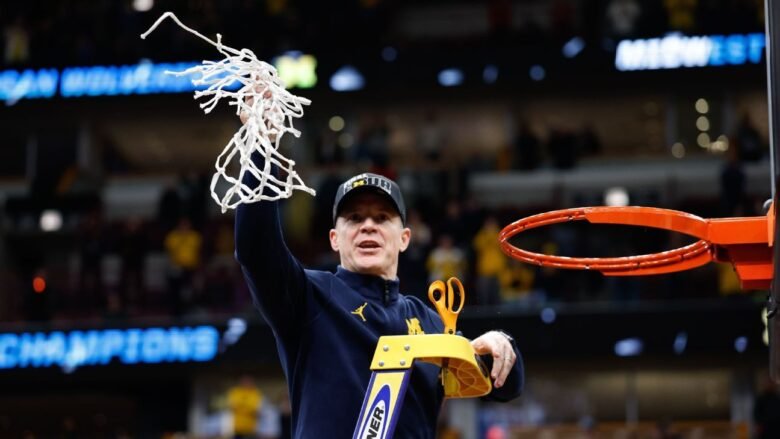
CHICAGO — Michigan coach Dusty May leaned back on the basket support, beaming proudly as his players, one by one, climbed a ladder and snipped pieces of the net.
In just his second season with the Wolverines, May guided Michigan back to the Final Four, as his team thumped Tennessee 95-62 on Sunday to win the Midwest Region. May had engineered a more surprising Final Four run in 2023 with Florida Atlantic, but he also inherited a seemingly broken Michigan program, which emerged from a season with only eight total wins and three in the Big Ten, its fewest since 1966-67.
Now the Wolverines are headed to face Arizona on April 4 in a national semifinal in Indianapolis, after adding to the team’s single-season record wins total, which stands at 35 after Sunday.
“They’re playing a child’s game, I’m coaching a child’s game,” May said, “so when you look in one spot, there are all these people who poured into them — their old coaches … parents, they made countless sacrifices for them to have this opportunity. It’s just rewarding to see these moments when everyone’s together. It’s not that I’ve been here before. It’s man, it’s really cool to see all these people that helped us get to where we are.”
He smiled and paused.
“I highly recommend next year’s team doing it, also.”
The Wolverines will return to the Final Four the first time since 2018 and for the fourth time in the past 11 seasons. Michigan is seeking its first national championship since 1989.
“We have a sign in our locker that [reads] ‘April Habits,’ and from day one, we challenged these guys to develop championship-level habits that would allow us to win a Big Ten championship, and would also allow us to turn the calendar from March until April,” May said. “Now we’ve put ourselves in position to do that.”
After an uneven start offensively through the game’s first nine minutes, Michigan took control on both ends midway with a 21-0 surge, whipping the ball with precision and pace, and passing up good shots for great ones. Forward Yaxel Lendeborg and center Aday Mara, playing with two fouls, fueled the run, and Michigan finally got its perimeter game going with 3-pointers from Elliot Cadeau and Roddy Gayle Jr.
May said the game “loosened up” and credited his assistants for managing the foul situation, ultimately allowing Michigan to display “a beautiful brand of basketball” that became contagious during the burst.
“We start off every practice pretty much with hibachi passing, that’s pretty much the drill, we go out there and we make the right pass,” Lendeborg said. “So this group of guys, nobody cares about their stats on this team.”
Lendeborg’s stats stood out, though, as the Big Ten Player of the Year was named the Midwest Region’s most outstanding player. The UAB transfer finished with 27 points, seven rebounds, four assists and no turnovers, and became the first Wolverines player to score 20 or more points in three consecutive NCAA tournament games since Juwan Howard — who preceded May as Michigan’s coach — in 1994.
“When this group got together … we all wanted to make it to the national championship and win,” Lendeborg said. “We worked tirelessly on making sure that our mental is right, not just physical, and we all trust each other. We all play hard for each other.”
Michigan also received boosts from transfers Mara (UCLA) and Cadeau (North Carolina). Mara had 11 points, four rebounds and two blocks, and Cadeau had a game-high 10 assists and became the first Big Ten player to record seven or more assists in four consecutive NCAA tournament games since former Wolverines guard Trey Burke in 2013 on a Final Four team.
Charlie May, son of the Wolverines’ coach, capped the scoring by swishing a 3-pointer with 1:02 to play. The Wolverines have scored 90 or more points in each of their four tournament victories, following a Big Ten tournament championship loss, also at the United Center.
“My mindset was to cut two more nets after the Big Ten championship, the regular season,” guard Nimari Burnett said. “And I didn’t know that you could cut nets for [making] the Final Four, so basically, we still have two more, we have this and we have the national championship ahead.”
Tennessee dropped its third consecutive Elite Eight matchup under coach Rick Barnes, who was hoping to lead the Vols to their first Final Four and his first since coaching Texas in 2003.
“Simply, we all have to get better, we all have to keep working at it,” Barnes said. “We certainly know what it takes to get here, and now we’ve got to figure out getting through to the next level, on this day, you’ve got to really be at your best.”
Much like last season’s loss to Houston, the Vols’ chances were doomed in the first half, as they managed only 15 first-half points against the Cougars. Senior guard Ja’Kobi Gillespie led the Vols with 21 points, but second-team All-SEC selection Nate Ament struggled from the field, and Tennessee’s bruising frontcourt dealt with foul trouble the entire game.
Tennessee hit just 5 of 26 attempts from 3-point range, but Barnes wanted to get the ball inside and the Vols still were only 19-of-50 on two-point shots.
“We had open looks, had some open shots that didn’t go down, and that’s where [Michigan] were able to get out and capitalize,” Barnes said. “And I thought that a little bit because we weren’t making shots, not that we quit, because we would never quit, but it put us back on our heels a little bit.”
Barnes, 71, says he will be back at Tennessee for the 2026-27 season, which will mark his 12th at the helm.