

Cinderella hasn’t shown her face much of late.
Only five double-digit seeds won in the first round of the 2025 men’s NCAA tournament, and two were 10-seeds, which don’t qualify as Giant Killers for the purposes of this column. The Elite Eight was tied for the chalkiest of all time — all top-three seeds or better — and the Final Four was just the second ever to feature four 1-seeds.
But we know that part of what makes March Madness so fun is the upsets and trying to identify them before they happen.
To find this year’s potential candidates, we consulted ESPN’s BPI projections to find the matchups with the highest upset probabilities. Just keep in mind that probability does not mean predictability when filling out your brackets. And the probability of there being multiple upsets this March is low. NCAA tournament betting lines are larger than ever, and our Giant Killer model doesn’t give any team seeded 11th or worse even a 40% chance of winning in the first round. It gives only one No. 12 seed — the perennial upset pick so many like to identify — even a 20% chance to bust brackets.
By comparison, last year there were four matchups with an upset chance of greater than 40%, and eight above 25%. Still, if you’re looking for ways to differentiate your bracket and win a pool, let’s run through upset options to consider.
Note: Because two No. 6 vs. No. 11 games are still to be determined by the outcomes of First Four games on Tuesday and Wednesday, the Giant Killers model takes all possible matchups into consideration.



Upset chance: 39%
6:50 p.m. ET on Thursday
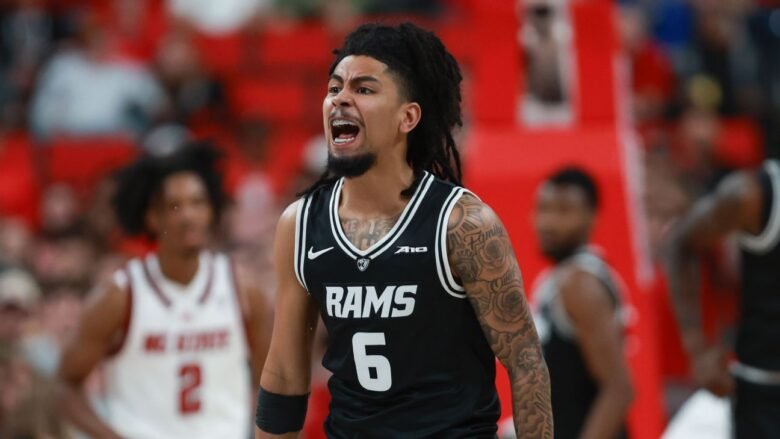
North Carolina’s ceiling is significantly lower with star freshman Caleb Wilson (broken thumb) out for the season. Predictably, the Tar Heels’ efficiency numbers dropped off in the eight games Wilson missed, especially on the offensive glass and in 2-point field goal percentage on offense and defense. That opens the door for a VCU team that has won 16 of its past 17 games entering the tournament. The Rams have a balanced, versatile and aggressive attack. All eight of VCU’s regular rotation players have hit at least 18 3s this season, and the Rams get to the free throw line at the 15th-highest rate in the country.


Upset chance: 37%
Potential matchup: 7:25 p.m. ET on Thursday
NC State enters the tournament having lost seven of its past nine games. But just two years ago, the Wolfpack made a run to the Final Four as an 11-seed. That team also stumbled to the finish line in regular-season ACC play before winning five games in five days to win the ACC tournament and earn a spot in the Big Dance. Although this year’s group is much better offensively than the 2024 edition and can keep up with the Cougars on the scoreboard, the Wolfpack’s defense will have to show some teeth in order to pull off the upset. NC State has allowed 87 points and nearly 11 3-pointers per game over its past nine outings. BYU is not as potent without Richie Saunders (ACL), but the duo of AJ Dybantsa and Robert Wright III is quite formidable. Provided they beat Texas in Tuesday night’s First Four matchup, the Wolfpack will need to play to their strengths of valuing the ball (ninth-best turnover rate in the nation) and shooting the 3 (10th best at 39%) to win this one.

Upset chance: 37%
Potential matchup: 4:25 p.m. ET on Friday
The Longhorns, like the Wolfpack, are limping into the Big Dance, having lost five of their past six. Scoring isn’t a problem for Texas, but defense is. It will be important for 7-footer Matas Vokietaitis to stay on the court. He has been in foul trouble often this season but can be a difference-maker in this matchup as Texas looks to keep pace with a thinner but still potent BYU attack. Texas will have to beat NC State first, though.


Upset chance: 25%
Potential matchup: 4:25 p.m. ET on Friday
The Giant Killers model likes SMU to take care of Miami (Ohio) in the First Four on Wednesday, but it isn’t as keen on the Mustangs building on that against the Vols. Their upset hopes might hinge on how B.J. Edwards — the team’s best defender — looks in his return from the ankle injury that caused him to miss SMU’s past five games (the Mustangs went 1-4 in those games). Tennessee is the nation’s best offensive rebounding team but is susceptible to turnovers. The Mustangs will have to win the turnover battle and cash them in.


Upset chance: 24%
1:50 p.m. ET on Thursday
High Point is the only 12-seed with at least a 20% chance to win, according to the model, and this could be one of the highest-scoring games of the first round. The Panthers are all about turnover differential. They are in the top five nationally in turnover rate at both ends of the court and score 21 points per game off miscues. However, no one is better at avoiding live-ball turnovers than Wisconsin, and the Badgers shoot it well, too. Wisconsin guards John Blackwell and Nick Boyd have combined for 50 points per game over their past four outings, so slowing that duo will be critical for High Point.


Upset chance: 19%
1:30 p.m. ET on Thursday
Although the upset chance appears low here, the uncertainty surrounding the health of Louisville freshman guard Mikel Brown Jr. (back) could play a big part in whether the Bulls will play the role of Giant Killer. USF is 19-3 since late December, with those three defeats coming by a combined five points. Both teams want to push the pace but have distinct approaches. No bones about it, Louisville wants to shoot the 3 — the Cards make 11.5 per game, accounting for 41% of their scoring. And although the Bulls do have a pair of snipers with 100-plus 3s (Wes Enis and Joseph Pinion), they lead the country in second-chance points thanks to Izaiyah Nelson. There’s a reason this game has the highest total on the board in the first round.


Upset chance: 19%
3:15 p.m. ET on Thursday
This 5 vs. 12 matchup has some similarities to High Point-Wisconsin. McNeese thrives off takeaways (22.3 points per game off turnovers, tops in the nation), but Vandy takes good care of the ball. Which strength will win out? The backcourt duo of Tyler Tanner and Duke Miles might be tough for the McNeese ball pressure to crack, but don’t count out the Cowboys, who were one of two 12-seeds to win in last year’s Dance.


Upset chance: 18%
12:40 p.m. ET on Friday
Tech’s national championship hopes took a big hit when All-American JT Toppin suffered a season-ending ACL injury a month ago. The Red Raiders enter with three straight losses, but they are still as dangerous as any team from beyond the arc and are led by the dynamic Christian Anderson (18.9 PPG, 7.6 APG). Texas Tech relies heavily on the 3-ball (43% of its points come from deep) and so does Akron (39% from 3), which has won 10 in a row and 19 of 20 entering the tourney. The Zips are the shortest team in this year’s field, so it will be important for them to be efficient offensively and guard the line at the other end, which has been an issue for them this season.


Upset chance: 15%
7:10 p.m. ET on Friday
If UNI is going to pull off the upset, it will have to control the tempo, make perimeter shots and limit the Johnnies to one shot per possession. St. John’s is among the nation’s leaders in second-chance points, thanks especially to Zuby Ejiofor and Dillon Mitchell. Unfortunately for the Panthers, their ability to run opponents off the 3-point line won’t be so helpful against a Red Storm team that prefers to do damage in the paint. Northern Iowa turned the corner this season after getting 6-6, 235-pound Tristan Smith back from injury in February, and the Panthers will need his presence if they are to pull a stunner.
Where’s Miami (Ohio), you might ask?
The model gave the RedHawks only a 10% chance of upsetting Tennessee, should they beat SMU to advance to the first round. After being sent to Dayton despite losing only one game all season, Travis Steele’s squad will certainly have plenty of motivation to prove itself.