

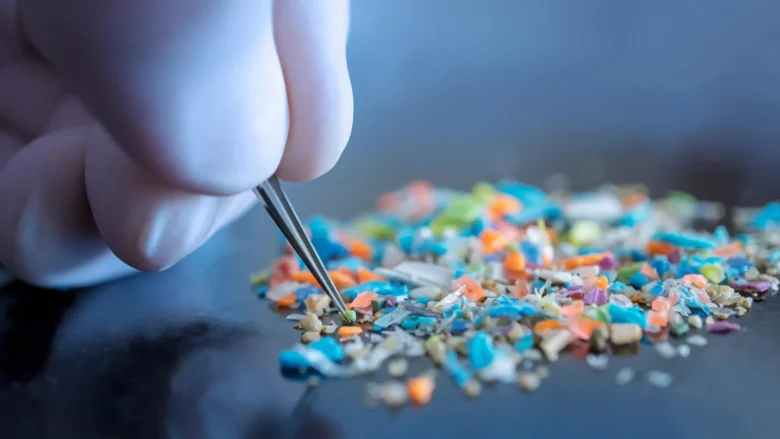
A University of Michigan study suggests that the nitrile and latex gloves scientists commonly use could be causing microplastics levels to appear higher than they actually are.
Researchers found that these gloves can unintentionally transfer particles onto lab tools used to analyze air, water, and other environmental samples. The contamination comes from stearates, which are not plastics but can closely resemble them during testing. Because of this, scientists may be detecting particles that are not true microplastics. To reduce this issue, U-M researchers Madeline Clough and Anne McNeil recommend using cleanroom gloves, which release far fewer particles.
Stearates are salt-based, soap-like substances added to disposable gloves to help them separate easily from molds during manufacturing. However, their chemical similarity to certain plastics makes them difficult to distinguish in lab analyses, increasing the risk of false positives when studying microplastic pollution.
The researchers emphasize that this does not mean microplastics are not a real problem.
“We may be overestimating microplastics, but there should be none,” said McNeil, senior author of the study and U-M professor of chemistry, macromolecular science and engineering, and the Program in the Environment. “There’s still a lot out there, and that’s the problem.”
Clough added, “As microplastic researchers looking for microplastics in the environment, we’re searching for the needle in the haystack, but there really shouldn’t be a needle to begin with.”
The research, led by Clough, a recent doctoral graduate, was published in RSC Analytical Methods and supported by the U-M College of Literature, Science, and the Arts’ Meet the Moment Research Initiative.
Unexpected Source Behind Inflated Results
The discovery began during a collaborative project examining airborne microplastics in Michigan. The effort involved researchers from multiple U-M departments, including Chemistry, Statistics, and Climate and Space Sciences Engineering. Clough and McNeil worked with collaborators such as chemistry professor Andy Ault and graduate students Rebecca Parham and Abbygail Ayala to collect air samples.
To capture particles, the team used air samplers equipped with metal surfaces that collect material from the atmosphere. These samples were then analyzed using light-based spectroscopy to identify the types of particles present.
While preparing the sampling surfaces, Clough followed standard practice and wore nitrile gloves. However, when she reviewed the results, the number of detected microplastics was thousands of times higher than expected.
“It led to a wild goose chase of trying to figure out where this contamination could possibly have come from, because we just knew this number was far too high to be correct,” Clough said. “Throughout the process of figuring it out — was it a plastic squirt bottle, was it particles in the atmosphere of the lab where I was preparing the substrates — we finally traced it down to gloves.”
Testing How Gloves Affect Microplastics Data
To investigate further, the researchers tested seven different types of gloves, including nitrile, latex, and cleanroom varieties, along with commonly used methods for identifying microplastics.
Their experiments recreated typical lab conditions, such as a gloved hand touching filters, microscope slides, and other equipment used during analysis. Even these routine interactions transferred particles from the gloves to the testing surfaces.
On average, the gloves introduced around 2,000 false positive signals per square millimeter.
“The type of contact we tried to mimic touches upon all varieties of microplastics research,” Clough said. “If you are contacting a sample with a gloved hand, you’re likely imparting these stearates that could overestimate your results.”
Cleanroom gloves performed significantly better, releasing far fewer particles. This is likely because they are made without stearate coatings and are intended for use in highly controlled environments.
Distinguishing Real Microplastics From False Positives
The team also explored whether it is possible to visually tell apart real microplastics from stearate particles. Using scanning electron microscopy and light-based microscopy, they found that stearates look nearly identical to polyethylene, a common plastic.
Despite this challenge, Clough and McNeil, working with graduate student Eduardo Ochoa Rivera and statistics professor Ambuj Tewari, developed methods to separate true microplastics from glove-related contamination. These techniques could allow scientists to revisit earlier datasets and produce more accurate estimates.
“For microplastics researchers who have these impacted datasets, there’s still hope to recover them and find a true quantity of microplastics,” Clough said.
The findings highlight the importance of chemistry expertise in microplastics research, especially when it comes to identifying subtle differences between materials.
“This field is very challenging to work in because there’s plastic everywhere,” McNeil said. “But that’s why we need chemists and people who understand chemical structure to be working in this field.”