
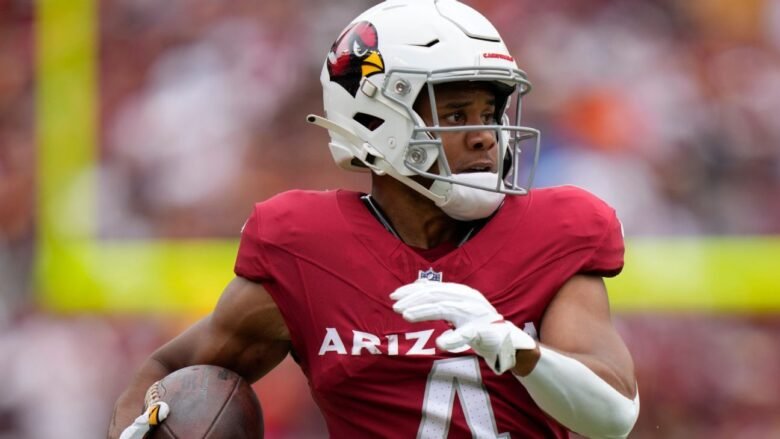
Former Purdue star and NFL wide receiver Rondale Moore died Saturday, the Minnesota Vikings said in a statement.
Moore was 25.
Police in New Albany, Indiana, told WHAS11 that Moore was found in a garage with a suspected self-inflicted gunshot wound. Floyd County Coroner Matthew Tomlin did not share additional details on the circumstances of Moore’s death but said an autopsy will be conducted Sunday.
“We are deeply saddened by the passing of Rondale Moore,” the Vikings said in a statement. “While we are working to understand the facts, we have spoken with Rondale’s family to offer our condolences and the full support of the Minnesota Vikings. We have also been in communication with our players, coaches, and staff, and will make counseling and emotional support resources available to anyone in need. Our thoughts are with Rondale’s family and friends during this devastating time.”
A second-round draft pick of the Arizona Cardinals in 2021, Moore had been sidelined the past two seasons because of injuries. He missed the 2024 season after suffering a dislocated right knee while with the Atlanta Falcons.
He most recently spent time with the Vikings, participating in their 2025 offseason and training camp, before suffering a season-ending left knee injury while returning a punt Aug. 9 in the team’s preseason opener.
“I am devastated by the news of Rondale’s death,” Vikings coach Kevin O’Connell said in a statement. “While Rondale had been a member of the Vikings for a short time, he was someone we came to know well and care about deeply. He was a humble, soft-spoken, and respectful young man who was proud of his Indiana roots. As a player, he was disciplined, dedicated and resilient despite facing adversity multiple times as injuries sidelined him throughout his career.
“We are all heartbroken by the fact he won’t continue to live out his NFL dream and we won’t all have a chance to watch him flourish. My prayers are with Rondale’s family, friends, teammates and coaches as we all deal with this tragic news.”
In three seasons with the Cardinals, Moore started 23 games. He caught 135 passes for 1,201 yards and three touchdowns while also rushing 52 times for 249 yards and one score.
At Purdue, Moore was an Associated Press first-team All-American as an all-purpose player during his freshman season in 2018 while also winning the Paul Hornung Award for most versatile player. Moore had 1,915 receiving yards and 14 touchdowns while also rushing for 248 yards and three touchdowns in three seasons with the Boilermakers.
“Rondale Moore was a complete joy to coach,” said Louisville’s Jeff Brohm, who coached Moore at Purdue. “The ultimate competitor that wouldn’t back down from any challenge. Rondale had a work ethic unmatched by anyone. A great teammate that would come through in any situation. We all loved Rondale, we loved his smile and competitive edge that always wanted to please everyone he came in contact with. We offer all of our thoughts and prayers to Rondale and his family, we love him very much.”
The Associated Press contributed to this report.