
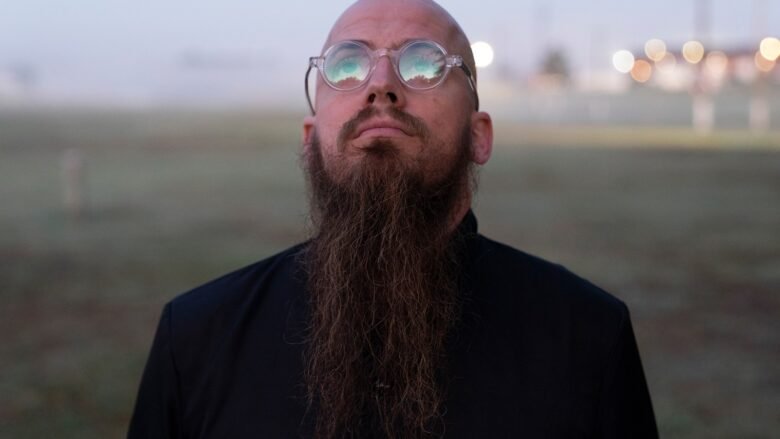
Producer James Chase Sanchez is used to people thinking their stories are worthy of a documentary. When Reverend Jeff Hood — a spiritual advisor who accompanies men on death row — reached out to him on Facebook, though, he was intrigued. “He sent a DM to see if we wanted to do a doc on him,” says Sanzhez, of Texas’s a Pound of Snow Productions. “There’s so many people that say, ‘I think you should do a documentary about my work,’ and you roll your eyes. But that’s not Jeff. He believes he’s doing important work and he wants people to see that.”
The result is The Spiritual Advisor, a short documentary made in partnership with Rolling Stone Films and Documentary+ that follows Hood for five days as he travels from his home in Arkansas to McAlester, Oklahoma, to try to stop the execution of a man named Emmanuel Littlejohn. As his guilt was in question, Littlejohn had been recommended clemency by the state’s Pardon and Parole Board, but Gov. Kevin Stitt had yet to stay his Sept. 26, 2024 execution. The doc sees Hood appealing to the local government, leading protests, and comforting Littlejohn’s family. It’s 23 minutes of passion and prayer, a slice of a life of painful purpose.
The film — which was shot and directed by Sanchez’s business partner, Joel Fendelman, and is available now to stream on Rolling Stone‘s YouTube and the Documentary+ platform — was made in partnership with a March 2025 feature I wrote about Hood titled The Last Face Death Row Inmates See. Around the time Hood reached out to Sanchez and Fendelman, I was talking to Hood weekly, delving into his life and work. I’d first spoken to him after he stood by death row prisoner Kenneth Smith as the Alabama inmate became the first man to die by nitrogen gas, a then-untested process that could have killed Hood if the gas were to leak. Hood was physically unharmed, but was scarred by the experience of watching a man who had become his friend die slowly.
Sanchez and Fendelman had worked with Hood previously, on 2018’s Man on Fire, a documentary about a Texas pastor named Charles Moore who self-emolated in 2014 in protest of racism. Hood appears in that film, as he was outspoken about the pastor’s death — adamant that he’d not died in vain. “I was really puzzled by Jeff; he was someone who I perceived as very radical, especially in relation to the rest of Texas,” says Sanchez. “He challenges you. I think I was a little afraid of Jeff, or intimidated by him, at first, and then really learned to love him and his persona, which is really big.”
The pair stayed in touch with Hood, but they started seeing his face all over Twitter, and discussing Smith’s death. They were already considering reaching out when Hood’s DM hit their inbox. Despite knowing a bit about Hood’s work, the filmmakers didn’t know much about the capital punishment. “Like most people, the death penalty was something that’s over the mountain for me,” Fendelman says. “So being in Oklahoma with Jeff the five days leading up to the execution, it was very profound. I’ve been sitting with the questions that Jeff brings up for a while. Do we have the right to kill someone?”
The doc was shot in black and white for that reason. “What you’re seeing is mostly different shades of gray,” says Sanchez. “Beacause the subject isn’t as black and white as what the state wants you to believe.”
Over the course of shooting the doc, Sanchez and Fendelman learned about Hood’s past — how he grew up hyper-religious in Georgia and was ordained as a Southern Baptist minister at 22, how he had an awakening when his mentor came out to him as gay. “I talk about it like the queer Jesus saved my soul,” Hood told me. “All of a sudden something happened within me that transformed me. It really felt like I got saved — from this sort of backwards thinking and trying to compartmentalize people and trying to suffocate people with my own ideations of what they were supposed to be.”
From there on out, Hood became a kind of radical, liberal man of the cloth, rallying for gay and trans rights, Black Lives Matter, and, finally, becoming a spiritual advisor to men on death row in 2022 after the Supreme Court ruled that folks could have one accompany them to the death chamber. (Hood had been counseling men sentenced to death since 2011.) By the time Hood started talking to both me and the filmmakers, support for the death penalty was at a nadir in the U.S., although executions continued apace. America was in the midst of a particularly brutal schedule of executions when we arrived in McAlester, Oklahoma: five in one week.
In the doc, Hood is a dervish, conducting press conferences, collecting signatures in support of Littlejohn to present to Gov. Stitt, and joking with Littlejohn’s family to keep their spirits up. Still, on the morning of the execution, the Governor had yet to step in and save Littlejohn’s life. He had been sentenced to death for the 1992 murder of convenience-store owner Kenneth Meers in a robbery gone sideways. Littlejohn claimed innocence, though, alleging that his co-conspirator Glenn Bethany pulled the trigger. Bethany got life in prison. Innocent or not, in 2025 Littlejohn was confined to a wheelchair, leading his family to wonder what the State had to gain in killing him.
Jeff Hood on his couch, from a scene in the film.
Joel Fendelman/A Pound of Snow Productions
The film shows Hood’s arrival at the prison gates before dawn, his hours-long vigil, and his preparations for the death chamber. Fendelman and I stood outside as he ventured into the prison, alongside anxious and shellshocked friends and family. Fendelman himself wasn’t unscathed — especially when we learned that the Governor hadn’t stepped in, and that Littlejohn was dead. “When we realized he wasn’t pardoned, there was just this void,” the director says. “No documentary that I’ve made thus far has affected me more on an emotional — I may even say spiritual level.”
Fendelman captured that horrible silence in the doc, punctuated by Littlejohn’s niece screaming, feral and raw. “Joel and I have been with Jeff at other executions since, and the question I always go back to is like: Who is this good for?” says Sanchez. “It just feels like there’s constant ripple effects of pain and harm being done over and over and over again, and executions just replicate that process.”
The film winds down with Hood returning home to his wife and five kids, the mundanities of life. “Jeff is multi-dimensional — someone who’s devoting his life to men on death row, but he’s also a father, he’s also a husband,” Fendelman says. “He also deals with the dog pooping in the living room, his daughter not wanting to go to school. They’re part of his practice.”
The final scene is haunting, even to me, someone who has known Hood for years now. He’s passed out on the couch, a montage of different prison calls playing as he snoozes. Because Littlejohn isn’t his only death row inmate; he talks to several per day. A few in the montage have since been executed.
“I remember calling Joel and saying, ‘Was he pretending to sleep?’” Sanchez says of the scene. “That’s the sort of a vulnerability you generally would never get. And hearing those voices and seeing it play out, how tired he is after those 96 hours — and knowing that it doesn’t end there. I think it’s important that the viewer see that it wasn’t a one-off. This is his life.”
The Spiritual Advisor
Director: Joel Fendelman
Producer: James Chase Sanchez
Executive Producers: Alexandra Dale, Justin Lacob, Brynn Mooser, Jason Fine, Gus Wenner, David Dodge
Starring: Reverend Jeff Hood
Production Company: A Pound of Snow Productions
Made in Association With: Rolling Stone Films and Documentary Plus