

IndyCar is searching for its moment.
Formula 1 found its game-changing event for the U.S. on Netflix in 2020 as “Drive to Survive” revealed the series to a massive new and homebound audience. IMSA took its trip into the limelight with 2023’s debut of the hybrid GTP formula that has drawn big crowds and bigger commitments from participating auto manufacturers.
And then there’s IndyCar, without new cars, and lacking a transformative reality show to spread its gospel, but as the three opening races of the 2026 season have shown, there’s nothing wrong with taking a familiar product and hitting it hard with a fresh approach to promotions.
It opened the season on March 1 on Florida’s streets of St. Petersburg and packed the venue with more fans that it has seen in decades. Partnering with NASCAR at the Phoenix Raceway oval six days later during the stock car weekend was another smash hit with fans and a sizable TV audience. And IndyCar hit a new height on Sunday by making use of a time-honored playbook to attract new fans to America’s oldest open-wheel series: take the racing to the streets of a fresh, new market.
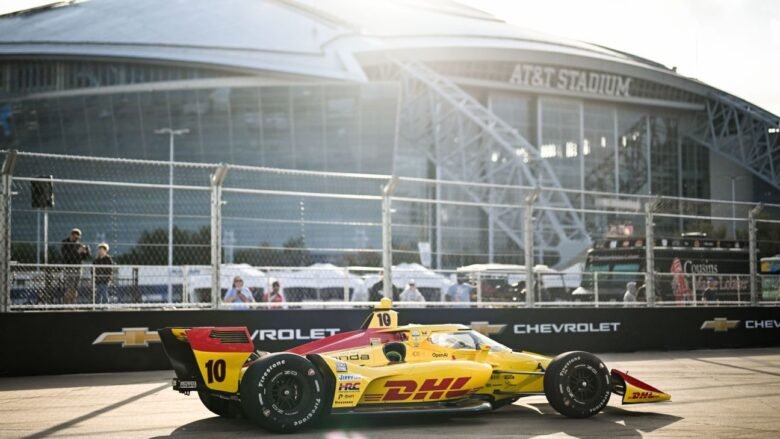
The inaugural Grand Prix of Arlington married IndyCar with the Dallas Cowboys’ AT&T Stadium and the Texas Rangers’ Globe Life Field as the centerpieces of a 2.7-mile, 14-turn street course. It brought motorsports back to the heart of Texas with a venue that wasn’t already on NASCAR or F1 calendars. And it was an unbridled success.
“Arlington is the best street course circuit and event we have in IndyCar right now,” Arrow McLaren’s Pato O’Ward told ESPN after placing fifth in his adopted home state. “It is the benchmark when it comes to the size of the circuit size, the IndyCar paddock, the suites and the overall experience. It really is the complete package, and that showed today with the sold-out crowd.”
Six-time IndyCar champion Scott Dixon has raced and won at more street races than any other driver in the field, including the marquee Long Beach Grand Prix, which celebrated its 50th anniversary in 2025, giving the 45-year-old living legend a perspective no other driver can offer.
“I think it’s definitely the standard now,” the Chip Ganassi Racing driver said. “The track and the presentation, the activation. I think in conjunction with both the Cowboys and Rangers, you couldn’t ask for much better. As I said on Thursday, I didn’t think I was turning up to an IndyCar event. I thought it was maybe an F1 event. So very cool. Kudos to everybody, and this is the standard that everybody needs to do now.”
The formula pioneered by IMSA in the 1980s was to identify metropolitan areas with strong populations and picturesque locations to hold street races and bring its exotic cars to the masses. IMSA wasn’t the first to conjure major street races, but it was the first to make it a central and expansive component of its annual schedule: Miami, San Antonio, Columbus, Del Mar, West Palm Beach.
Hardcore racing fans are happy to drive deep into the outskirts of wherever and watch their favorite racing series run on dedicated tracks, but for those who aren’t familiar with the sport or the specific types of racing on offer, the smartest way to capture a new crowd is to drop a series into their proverbial laps.
As the 1980s transitioned into the 1990s, the take-it-downtown concept evolved to include cities with major sports teams and grand stadiums where the races would run. IndyCar also got in on the game as the Canadian Football League’s BC Lions dome amplified the series’ arrival in Vancouver while IMSA charged around the Superdome in New Orleans. IndyCar rocketed around the Astrodome and the Houston Texans’ NRG Stadium in 2013 and 2014, took street racing trips around the Baltimore Orioles’ Camden Yards between 2011 and 2013.
Downtown Nashville greeted IndyCar with a contest that fired around the Tennessee Titans’ home, F1’s recent dive into Florida makes use of the Miami Dolphins’ Hard Rock Stadium, ambitions have been held to bring IndyCar back to Denver with a street race that revolves around the Broncos’ Empower Field at Mile High, and the list goes on.
Combining motor racing and big-time stick-and-ball arenas is a proven winner, which was further supported by Arlington’s sold-out grandstand seating for its first event.
“Fantastic event,” McLaren Racing CEO Zak Brown told ESPN. “Drivers loved it, sponsors loved it and it was packed. I think we should consider to look in big cities around stadiums and convention centers. It’s a good model. Long Beach, Miami F1, Toronto, Vancouver and the Meadowlands in the past all provide good opportunities to build good circuits. I’m a fan of expansion within the Americas: Mexico, Brazil. and Northeast.”
IndyCar added an 18th race to this year’s calendar with the recent greenlighting of the Freedom 250 street race in Washington, D.C. The course designed to use the nation’s capital and the National Mall as its anchor is meant to be used just once as part of the country’s 250th birthday celebrations, but D.C. mayor Muriel Bowser is known to have inquired about bringing the series back in 2027 and beyond. If it stays on its current trajectory, IndyCar’s moment could have permanence.
“The whole idea of street racing and taking our product to the to the cities, if you will, is something that obviously we enjoy,” IndyCar president Doug Boles told ESPN after the checkered flag waved in Arlington. “The nice thing about this one is you are in and amongst the community, but you have the benefit of these massive parking lots and streets and a way to really build up a proper racetrack without having to shut down a city.
“So this kind of formula for sure works in the right scenario, and obviously with the Rangers and the Cowboys and their stadiums, and the entertainment district that’s here with the hotels, it’s pretty great. Everybody just executed so well. So this absolutely gives us another formula that we can have conversations with as we continue to think about the next places that we want to take our racing.”


