

The first round of the 2026 women’s NCAA tournament is complete! We tracked every game Saturday, from USC’s overtime thriller against Clemson to UConn’s impressive start and Virginia’s come-from-behind win.
Here is ESPN’s guide to all the Day 2 results, with analysis from reporters of how each game was won, and our experts’ takes on each winner’s chances to advance to the Sweet 16.
How UCLA won: After a competitive first half, UCLA came out of halftime and scored the first 11 points of the third quarter. The Bruins never looked back, and they led by 37 points at the end of the third quarter. Their plus-27 point differential in the third quarter is their second best since quarters were adopted in 2015-16, according to ESPN Research. UCLA had five players with double-digit points in the victory, led by center Lauren Betts with 22. Betts also had 10 rebounds.
UCLA’s second-round opponent: Oklahoma State
How the Bruins can advance to the Sweet 16: Despite the 53-point win, UCLA allowed 34 points in the first half, the most the team had allowed in a first half since Jan. 18 against Maryland. The Bruins will want to compete against Oklahoma State more like they did in the second half, when they held California Baptist to nine points. The biggest discrepancy between the teams showed up on the glass. In the regular season, UCLA averaged 15.6 second-chance points per game. On Saturday against California Baptist, it had 17 second-chance points in the first half. The Bruins used their size advantage over the Lancers to outrebound CBU 62-21. — Sarah Barshop
How Illinois won: The Illini have a very young team, but they looked poised and composed Saturday in a game that was tight until the closing minutes. Illinois had two strong NCAA tournament debuts from freshmen: Forward Cearah Parchment had 21 points on 8-of-10 shooting, and guard Destiny Jackson had 16 points, 11 rebounds and six assists. Sophomore forward Berry Wallace added 18 points for the Illini, who are into the NCAA second round for the second year in a row. Before last year, Illinois had not been to the second round since 2000. Junior guard Desiree Wooten had 17 points and seven rebounds to lead the Buffaloes, who finished 22-12.
Illinois’ second-round opponent: Vanderbilt
How the Illini can advance to the Sweet 16: The Illini have made it to the regional semifinals just twice: in 1997 and 1998 under coach Theresa Grentz. To do it again, they need to beat Vanderbilt on its home court, something no team has done this season. The Commodores are 17-0 at Memorial Gymnasium in Nashville, including Saturday’s 102-61 victory over High Point. Illinois will have to try to slow down Vandy star Mikayla Blakes, the leading scorer in Division I this season, who had 30 points in the opening round. — Michael Voepel
How Oklahoma State won: Oklahoma State weathered a third-quarter storm from Princeton that brought the Tigers within four points in what was otherwise a game controlled by the No. 8-seeded Cowgirls. Oklahoma State was led by forward Achol Akot (28 points) and guard Jadyn Wooten, who led the team with 10 assists. Akot’s dominance came in the paint, where she scored 24 such points against Princeton — the most by an Oklahoma State player in an NCAA tournament game since ESPN began tracking in 2021. On defense, Oklahoma State forced Princeton to settle for jump shots. According to ESPN Research, the Tigers attempted just 13 layups compared with 47 jump shots. They were 5-of-13 on layups and 21-of-47 on jump shots.
Oklahoma State’s second-round opponent: UCLA
How the Cowgirls can advance to the Sweet 16: Oklahoma State was a well-rounded team this season, with five players averaging 10 or more points per game. According to ESPN Research, it was the only team in the Big 12 with five players averaging double-digit scoring. On Saturday against Princeton, Oklahoma State came close to that number, with four players in double digits and eight points for guard Stailee Heard. Oklahoma State lost in the first round of the tournament a year ago to South Dakota State, and that loss stuck with the team. In her pre-tournament news conference, guard Micah Gray said she thought the team was “hungry” to get a win and get out of the first round. Oklahoma State accomplished that on Saturday and will face UCLA on Monday. — Sarah Barshop
How Vanderbilt won: Vanderbilt took control of the game from the tip, jumping out to an 11-0 run, and the Commodores never looked back. Mikayla Blakes led the way, as she has all year, finishing with 30 points on 11-of-16 shooting, five assists and three rebounds in 29 minutes. But she didn’t do it alone. Sacha Washington had a double-double, and Aubrey Galvan finished with 17 points, six assists and four steals. Their well-balanced attack — as well as their big lead — allowed Blakes to rest for the majority of the second half. All of Vanderbilt’s starters were pulled midway through the third, giving them ample time to get their legs ready for the second round.
Vanderbilt’s second-round opponent: Illinois
How the Commodores can advance to the Sweet 16: The Commodores are headed to the round of 32 for the first time since 2013, where they ran into then-No. 1-seeded UConn. This year, they will face Illinois. After falling to Ole Miss in the first round of the SEC tournament a few weeks ago, the Commodores believe they have a lot more in them than what they showed. It started against High Point. — Kendra Andrews
How Syracuse won: The Orange couldn’t stop Iowa State junior center Audi Crooks, who had 37 points on 17-of-25 shooting. But the Cyclones basically stopped themselves from 3-point range, going 3-of-22 (14%). That was too much to overcome for an Iowa State program that has relied so much on 3-point shooting for the past 30 years. Junior guard Jada Williams was the only other Cyclone in double figures (14 points) as Iowa State finished 22-10.
Syracuse had a big performance from a center, too, with ACC Rookie of the Year Uche Izoje leading four players in double-figure scoring with 23 points. Guard Laila Phelia, a fifth-year senior spending her final season at Syracuse, had 18 points. Sophomore guard Olivia Schmitt had 15 points, making five of the Orange’s nine 3-pointers, and junior guard Sophie Burrows had 14 points.
Syracuse’s second-round opponent: UConn
How the Orange can advance to the Sweet 16: The Orange will need to pull an epic upset. UConn has made the Sweet 16 every tournament from 1994 to 2025, and has defeated Syracuse 27 times in a row, going back to the days when both schools were in the old Big East. In all, UConn is 39-4 against the Orange. Their last meeting was a 72-64 UConn victory in the 2024 NCAA second round.
With Izoje and another 6-foot-3 player, forward Journey Thompson, the Orange have some size to go up against UConn star forward Sarah Strong. But considering what Crooks was able to do against Syracuse, the Orange will need better defense against Strong and the Huskies. — Michael Voepel
How West Virginia won: After West Virginia fell behind 14-11 in the first quarter, it flipped a switch and never looked back, building as much as a 36-point lead. It all started with the defense, which has been the Mountaineers’ signature all season long. The press defense in particular caused a ton of issues for Miami. West Virginia held Miami to 2-of-5 shooting and forced 10 turnovers in possessions that started in a press. The Mountaineers are now the second team this tournament (along with Ohio State) to force at least 10 opponent turnovers with the defensive press. West Virginia had four players finish in double-figure scoring, led by Sydney Shaw with 19 points and nine rebounds. Kierra Wheeler had a near double-double with 14 points and nine rebounds, and Jordan Harrison had 15 points and eight assists.
West Virginia’s second-round opponent: Kentucky
How the Mountaineers can advance to the Sweet 16: The Mountaineers are heading to the second round for the third consecutive year, but their aspirations are set further than that. West Virginia wants to make it to the second weekend for the first time since 1992. That year was also the last time West Virginia hosted the first two rounds of the tournament, which it is doing this year as well. To get back to the Sweet 16, the Mountaineers will have to go through Kentucky. — Andrea Adelson
How Iowa won: It looked for a while like history might be made: the first women’s NCAA tournament victory by a No. 15 seed. The Northeast Conference champion Knights entered the NCAA tournament on a 22-game winning streak and kept Saturday’s game against Iowa at a slow pace. After three quarters, Iowa had just a 35-33 lead. But the Hawkeyes finally took control in the fourth quarter, outscoring the Knights 23-15. Iowa was led by its post players: Sophomore Ava Heiden had 29 points on 11-of-16 shooting, and senior Hannah Stuelke had 13 points and 16 rebounds. Fairleigh Dickinson made 10 3-pointers to Iowa’s one. Sophomore Ava Renninger led the Knights with 13 points as FDU finished its season 30-5.
Iowa’s second-round opponent: Virginia
How the Hawkeyes can advance to the Sweet 16: The Hawkeyes need to shoot better from the perimeter against the Cavaliers, their second-round opponent, than they did against the Knights. Virginia already has won two games on the Carver-Hawkeye Arena court: 57-55 Thursday over Arizona State in the First Four and then Saturday’s 82-73 overtime win over No. 7 seed Georgia in the first round. Virginia junior guard Kymora Johnson had a combined 45 points, 17 rebounds and 11 assists in those games, so the Hawkeyes will need to try to slow her down while continuing to rely on their powerful post offense. — Michael Voepel
 (9) USC 71, (8) Clemson 67 (OT)

 (9) USC 71, (8) Clemson 67 (OT)
How USC won: Freshman Jazzy Davidson took over for the Trojans in overtime — the second OT game of the day — scoring six of USC’s eight points in the extra period. She made history during the game, with her 31 points matching the most by a USC player in her NCAA tournament debut. She also became the first freshman with 30 points, five rebounds and five assists in her first career NCAA tournament game over the past 25 years. Davidson scored or assisted on 43 of USC’s 71 points. Kara Dunn came alive in the fourth quarter, giving Davidson just the right amount of support to steal this game away. She finished with 22 points and four rebounds.
The game saw 19 lead changes and seven ties. Mia Moore almost sealed the win for Clemson when she hit an incredible bank shot as regulation expired, but the game clock expired just moments before she got her shot off.
USC’s second-round opponent: South Carolina
How the Trojans can advance to the Sweet 16: The Trojans have one of the toughest tests in the bracket ahead of them as they face South Carolina in the next round. But they’ve been through trying times before: Last year, USC lost its star JuJu Watkins in the second round of the tournament, winning two more games before falling in the Elite Eight. The Trojans were a No. 1 seed at the time, and now are further down in the bracket, but they are trying to get back to where they felt they should have been a year ago: heading to the Final Four. — Kendra Andrews
How UConn won: Despite early foul trouble for starters Azzi Fudd and KK Arnold, the Huskies controlled their first-round game easily, recording their 51st straight win going back to last season. The Huskies outscored the Roadrunners 48-18 in the paint, while Sarah Strong led four UConn players scoring in double figures with 18. Fudd, who came in averaging 17.7 PPG, played just 17 minutes and had seven points. The Roadrunners, who got their NCAA tournament bid after winning the American Conference title as a No. 6 seed, finish the season 18-16.
UConn’s second-round opponent: Syracuse
How the Huskies can advance to the Sweet 16: UConn has advanced to at least the regional semifinals every season since 1993, when they fell in the first round. So the Huskies are heavily favored to move on to Fort Worth, but there are some things they will want to do better than they did in the first round. That includes 3-point shooting — the Huskies were 7-of-33 (21%) from behind the arc against UTSA — and avoiding the foul trouble that limited the minutes for Fudd and Arnold on Saturday. — Michael Voepel
How Alabama won: Simply put, Alabama had more in its offensive repertoire than Rhode Island. The Rams struggled mightily on contested shots, and that ended up being the biggest story in the game. Alabama had three players score at least 15 points — Jessica Timmons led the way with 21 points, while Essence Cody added 19 and Diana Collins had 16. Collins’ performance was particularly notable because it was the best shooting day she has had in two months. Rhode Island, playing in its first NCAA tournament game in 30 years, came in with one of the best defenses in the country, holding opponents to 53.8 points per game and 37.3% shooting. Alabama ended up shooting 53% in this game, thanks in large part to its ability to get inside. The Crimson Tide outscored the Rams 42-12 in the paint.
Alabama’s second-round opponent: Louisville
How the Crimson Tide can advance to the Sweet 16: There will be plenty for Alabama coach Kristy Curry to correct headed into its matchup against Louisville. Though the Crimson Tide dominated Rhode Island in the paint, they had too many turnovers (14), leading to 18 Rhode Island points. Rhode Island also outrebounded Alabama 32-31 — including 13-5 on the offensive boards. One more area of note: Alabama missed six free throws, going 14-of-20 from the line. Having said all that, Louisville started slowly in its game against Vermont. If the Crimson Tide can set the tone early and find ways to establish themselves as the aggressors in the paint, it will give them a shot to pull the upset. — Andrea Adelson
How Kentucky won: The Wildcats joined Ohio State and Louisville as Saturday favorites to ride one big quarter to a comfortable win. Kentucky blitzed James Madison with 61.1% shooting, four 3-pointers and seven players scoring in a 32-point opening 10 minutes. After that first quarter, the Wildcats just held serve, even as the Dukes won the final three quarters 46-39. Every Wildcat who played got on the score sheet, and Tonie Morgan led the way with 18 points, seven assists and six rebounds. She led the SEC in assists this season, and her passes helped created open looks for Kentucky’s eight 3-pointers, four of which were from Amelia Hassett, who totaled 14 points in the game.
Kentucky’s second-round opponent: West Virginia
How the Wildcats can advance to the Sweet 16: Kenny Brooks, who won 337 games at JMU and took the Dukes to six NCAA tournaments from 2002 to 2016, probably would have preferred the urgency that his Wildcats showed in the first quarter to continue, but the Wildcats did plenty right that they can carry over into Round 2. The Wildcats won the rebounding battle (46-38), took away JMU’s perimeter game (3-of-17 from 3-point range) and had 16 assists on 24 field goals. — Charlie Creme
How Notre Dame won: Notre Dame’s victory was fueled by Hannah Hidalgo’s historic night. She finished with a near quadruple-double — 23 points, nine rebounds, eight steals and six assists. Her eight steals marked a Notre Dame record for a tournament game. On the defensive end, she held Fairfield to 1-of-2 shooting and forced it into nine turnovers on the 11 possessions she was the final defender. The Irish held Fairfield — the best 3-point shooting team in the nation — to nine 3-pointers, but they got them on 35% shooting. That, combined with the way Notre Dame kept the Stags quiet in the paint, made this a runaway game.
Notre Dame’s second-round opponent: Ohio State
How the Fighting Irish can advance to the Sweet 16: Notre Dame will enter their matchup with Ohio State on a hot streak, with wins in 10 of their last 11 games. As always, Hidalgo will be the key to their success. This was Hidalgo’s second career NCAA tournament game with at least 20 points, five rebounds, five assists and five steals — and no other player has ever had three. If she completes that feat against the Buckeyes, the Fighting Irish should make their fourth straight Sweet 16. — Kendra Andrews
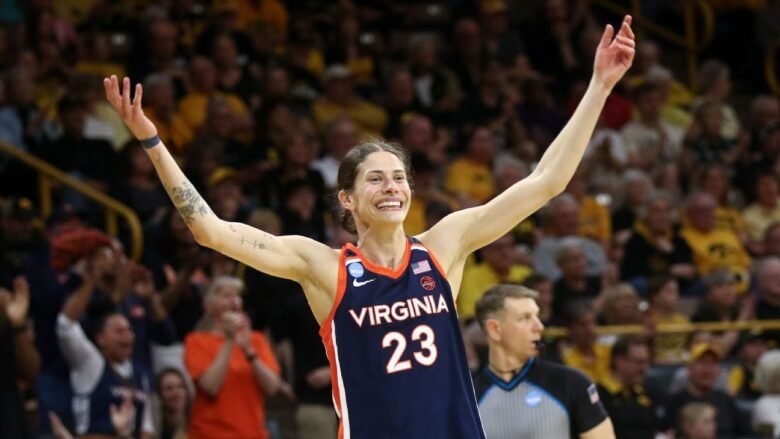
How Virginia won: Virginia clearly thrives under pressure because the Cavaliers have now won two NCAA tournament games after going down to the wire in both games — and, in their second, became the first lower-seeded team to win this year. The Cavaliers erased an eight-point fourth-quarter deficit to take Georgia to overtime, then dominated the extra period to advance to the next round. That performance came on the heels of a 57-55 win over Arizona State in the First Four after Kymora Johnson hit a 3-pointer with 30.6 seconds remaining. It is their first NCAA tournament appearance with multiple wins since 2000.
Over the final 8:20 of the Georgia game, the Bulldogs scored just two points. Georgia had built its big lead thanks to a large discrepancy at the free throw line; the Bulldogs took 35 free throws, compared to 15 for Virginia. Mia Woolfolk, who dominated the second half for the Bulldogs, had 16 of those free throw attempts. But in the final 3:20 of regulation, Georgia went scoreless. Romi Levy hit a 3-pointer with 1:29 remaining to tie it up. Woolfolk then missed two free throws with 1:03 left that would have given Georgia the lead. In overtime, Woolfolk appeared to be laboring early, and she was subbed out with 2:54 left and Virginia up four. The Cavaliers never looked back from there, outscoring Georgia 11-2 in overtime.
Virginia’s second-round opponent: Iowa
How the Cavaliers can advance to the Sweet 16: The Cavaliers are playing with confidence and belief right now. Even when they trailed in the fourth quarter, they stayed calm and poised. It helps to have scorers such as Johnson, who had 28 points in the win. Sa’Myah Smith also had a huge game, with 23 points and 11 rebounds in her best game this season. Romi Levy scored 14 and played terrific defense in the second half, shutting down Rylie Theuerkauf, who had 20 points on 5-of-7 3-point shooting at the break. If Virginia can stay out of foul trouble and play more cleanly when defending, the Cavaliers have the scorers to help them advance. — Andrea Adelson
How South Carolina won: The Gamecocks’ size and skills around the rim were too much for Southern from the opening minutes in the routine, 103-34 first-round win. South Carolina scored 44 points in the first half, including 32 in the paint, where Joyce Edwards had 19. Then in the third quarter, 6-foot-6 Madina Okot took control. As if a 44-19 lead at halftime wasn’t comfortable enough, the Gamecocks scored the first 20 points of the third quarter, with Okot contributing seven points. Ultimately, South Carolina outscored Southern 32-2 in the period to become the third team in NCAA tournament history to outscore an opponent by 30 or more in a quarter (joining UConn in 2016 and 2018). Edwards finished the game with 27 points and became the first South Carolina player with more than 25 points on better than 70% shooting (11-of-14) in an NCAA tournament game. Okot had 15. Ta’Niya Latson contributed 17 points and six assists.
South Carolina’s second-round opponent: USC
How the Gamecocks can advance to the Sweet 16: This was an impressive way for the Gamecocks to begin the NCAA tournament, but even a blowout win here was just a necessary step to the bigger goal of a national championship. The 69-point margin in the first round was the largest in program history. If Dawn Staley has to look for something to address in film sessions, it might be 3-point shooting. South Carolina improved as the game progressed, finishing 8-of-28 from beyond the arc after starting 1-of-13 in the first half, but that remains an area of improvement for a team that ranked eighth in the country at 37.1% during the season. — Charlie Creme
How Louisville won: Louisville used a dominant second half to pull away and beat Vermont. The Cardinals overcame a disjointed first half in which they struggled to make open shots and had trouble slowing down Vermont guard Keira Hanson. But it was a different story after the break as Mackenly Randolph led the offensive charge. Her nine third-quarter points helped Louisville outscore Vermont 23-10 in the quarter, building off what had been just a four-point halftime lead. Vermont, on the other hand, struggled to connect — Hanson went 1-of-4 from the field after scoring 14 first-half points. Louisville shot 55% in the second half.
Randolph led Louisville with a career-high 20 points on 8-of-14 shooting and a career-high 11 rebounds for her fourth double-double in the last five games. Hanson finished with 22 points to lead Vermont.
Louisville’s second-round opponent: Alabama
How the Cardinals can advance to the Sweet 16: There is no doubt Jeff Walz will want his team to get off to a much better start in the next round after struggling in particular to score off the pass. The ball movement vastly improved in the second half, and the way Randolph has played over the last five games is something for Louisville to build off headed into its next game. It is clear that Vermont provided a test the Cardinals can learn from as they move forward. — Andrea Adelson
How Ohio State won: The Buckeyes’ 75-54 victory over Howard was sealed in the second quarter, and their full-court press was responsible. Howard had done a good job of handling the press in the opening quarter, but then Ohio State’s defense went to another level. Ohio State outscored the Bison 23-4 in the next 10 minutes, forcing 12 turnovers that the Buckeyes turned into 16 points — and changing the game. The Buckeyes are 17th in the country in turnover rate, forcing 21.4 per game. Other than the rough second quarter, the Bison handled the press well — they had a total of 17 turnovers — but the damage was done.
Ohio State’s second-round opponent: Notre Dame
How the Buckeyes can advance to the Sweet 16: While the press is disruptive against any team, it typically is less impactful the higher the level of competition. That’s where Jaloni Cambridge comes in. She is one of the best guards in the country. Her ability to penetrate and create fuels anything Ohio State does on offense. The Buckeyes’ hopes for their first trip to the Sweet 16 since 2023 rest with Cambridge playing well. She did that against Howard with 21 points, two steals and two blocks. The Buckeyes were also effective from 3-point range (9-of-24), particularly Chance Gray, who made 3-of-6 and finished with 11 points. — Charlie Creme