
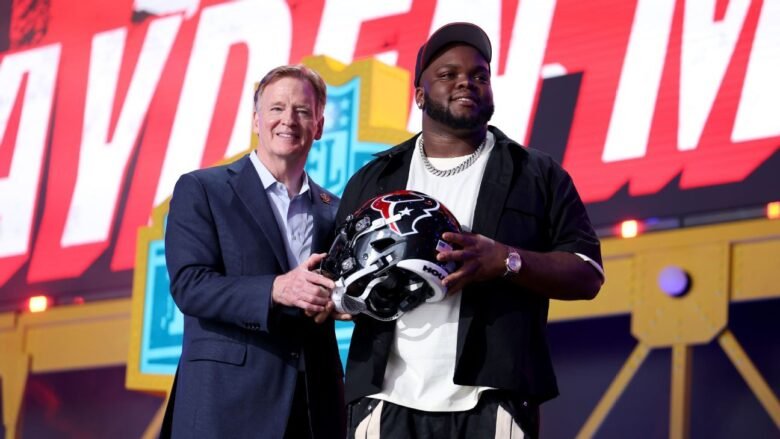
Two days of the 2026 NFL draft down, one to go. I broke down what I liked (and didn’t like) in Round 1 on Thursday night, and now I’m doing the same for Rounds 2-3.
Only four players in the top 32 of my Big Board rankings were still available Friday, which meant teams had to be savvy in finding strong fits and value. The 49ers — who had traded back with the Jets to land at No. 33 — started things off with De’Zhaun Stribling. It took seven picks before receiver Denzel Boston came off the board, joining the Browns’ offense — he was my best available prospect coming out of Round 1. We also saw two quarterbacks get picked; Arizona took Carson Beck, then Pittsburgh selected Drew Allar. And one of the stories of the night was the tight end run. The picks came fast at the position, but they might have come too fast.
There were some really strong selections, where front offices attacked roster needs. But there were also some confusing moves, where teams missed opportunities to make better additions. Let’s put the 68 picks into context.
Which teams were the big winners of the night? To break down the best and worst from Friday, I leaned on my own Big Board rankings and prospect grades to get a sense of which teams got steals and which teams reached. Each roster’s biggest needs, what each front office did in Round 1 and any trades involved in the picks — both up and down the board — were also important considerations.
We’ll be back for Rounds 4-7 on Saturday (noon ET on ESPN and the ESPN App). I still have 21 players in my top 100 on the board, so expect more impact selections on Day 3. (I listed my best available prospects at the bottom here with early lookahead thoughts.) I’ll also have complete postdraft grades for all 32 franchises late Saturday night, sizing up each class. But first, let’s recap the highs and lows of Rounds 2 and 3.
NFL draft coverage:
Kiper’s Day 1 winners
Draftcast | Sizing up every pick
Kiper’s Big Board | More
Jump to:
Biggest winners | Head-scratchers
Best prospects still available

Biggest winners and best picks from Rounds 2-3

The pick: Denzel Boston (No. 39), Emmanuel McNeil-Warren (No. 58), Austin Barber (No. 86)
Cleveland reached for KC Concepcion a little Thursday, but they turned it around and got value on Boston on Day 2. He was my best remaining player on the board coming into Friday night, and he can immediately make an impact in this Browns offense. Boston runs strong routes, and he uses his 6-foot-4, 212-pound frame to take defenders out of the play. With long arms and sure hands, he catches everything (which is the knock on Concepcion), adjusting his body to haul in the ball.
If you were questioning the Browns going with two receivers inside the top 40 picks, well, look at the stat sheet from 2025. Cleveland didn’t have a single wideout crack 650 yards, and the WR room combined for a league-low 1,467 receiving yards. Keep the WR picks coming.
Elsewhere, McNeil-Warren was 33rd on my board, and the Browns found him still available at No. 58. I was surprised he slid this far. McNeil-Warren was a combine standout, running a 4.52 at 6-4, 201 pounds. And he can create turnovers for the defense, with five picks and 10 forced fumbles over his career. The Browns hit value all night.
However, there were a few better options at tackle on the board when Cleveland traded fourth- and sixth-rounders to move from No. 105 all the way up to No. 86. Barber started as a right tackle before moving to the left side, and he has 39 career starts. He’s great in the running game, getting movement on drive blocks and showing lateral agility. But Barber loses to power too often. Between the trade and passing up other OTs, this one was iffy, but throwing assets at the offensive line is a good idea overall for Cleveland.

The pick: Zion Young (No. 45), Ja’Kobi Lane (No. 80)
The Ravens wanted to pair Trey Hendrickson with another impact edge rusher, and they found a first-round talent here in Round 2. Young was No. 22 on my board, the last remaining prospect from my final top 25 still available at this No. 45 pick. Young plays to the whistle with energy, and he uses his strong hands and quick feet to get to the QB, with 46 pressures and 6.5 sacks last season.
But here’s why I really like the fit. Baltimore was originally going to add Maxx Crosby via trade, and one of his best traits is his run-stopping ability. The move allows Crosby to stay on the field all three downs. Young is a fantastic run blocker, too. He seals the edge and crashes down the line, finishing 2025 with 16 run stops.
Lane was WR15 for me, and he’s a silky-smooth mover with the length, explosion and strong hands to high-point the football. At 6-4 and 200 pounds, he is a challenge for smaller cornerbacks to handle on the outside, and 11 of his 16 touchdown catches over the past two seasons have come in the red zone. Lamar Jackson will love that skill set.
0:30
What Zion Young brings to the Ravens
What Zion Young brings to the Ravens

The pick: Avieon Terrell (No. 48), Zachariah Branch (No. 79)
The Falcons took the first night of the draft off as result of the James Pearce Jr. trade last year, but they caught my attention midway through the second round. Not only did they get one of my favorite players in the class, they united him with his brother. Avieon Terrell is the brother of A.J. Terrell Jr., and now these two will share a cornerback room in Atlanta. Avieon Terrell flips his hips and runs with receivers well, and although he didn’t have any interceptions in 2025, he had five forced fumbles and nine pass breakups. At 5-11 and 186 pounds, he will be a slot guy at the next level.
Branch is also one of my favorites, and I might have been higher on him than most, grading him as an early Round 2 pick. Getting him late on Day 2 is tremendous. He’s 5-9 and 177 pounds, but he’s also lightning quick with 4.35 speed and explosive traits. Branch can take a quick-game pass for a big play with his elusiveness in space. I comped him to Zay Flowers, and he’ll be in the mix behind Drake London for either Tua Tagovailoa or a healthy Michael Penix Jr. while also chipping in as a kick returner.

The pick: CJ Allen (No. 53), A.J. Haulcy (No. 78)
The Colts waited until No. 53 to make a pick, and they still got the 28th-best player on my board. Getting value that strong with the team’s first pick of the draft lightens the hurt of missing out on the first round. Linebacker was a problem in Indianapolis; the Colts signed Akeem Davis-Gaither, but the depth chart is lacking. Allen enters as a three-down ‘backer who makes plays in all phases of the game because he reads and reacts so well.
Twenty-five picks later, the Colts added Haulcy to their secondary. He’s all ball skills. This kid had eight interceptions and 12 pass breakups over the past two seasons, and he can help fill Nick Cross’ vacated spot on the back end alongside Cam Bynum.
0:38
What CJ Allen brings to the Colts
What CJ Allen brings to the Colts

The pick: Jake Slaughter (No. 63)
The Chargers didn’t find their interior lineman in Round 1, but they got a powerful center on Day 2. Slaughter was on my “favorite players in the class” list at the position. He has started 33 games in the tough SEC, and he allowed just six pressures over that time. He is a big, strong pivot at 6-5, 303 pounds, and he drives defenders out of the way. But it’s not all power — he’s light on his feet and reads out the play fast, showing awareness on stunts.
Justin Herbert took 54 sacks last season, third most in the NFL. Some of that falls on tackles Rashawn Slater and Joe Alt being out with significant injuries, but the interior was rough. Slaughter is exactly what Herbert needs, even with the Tyler Biadasz signing.

The pick: Chase Bisontis (No. 34), Carson Beck (No. 65)
Bisontis was a nice pick early on Day 2 to shore up the interior blocking for the Cardinals’ new star running back, Jeremiyah Love. Arizona signed Isaac Seumalo in free agency and now has a good tandem inside. But the real reason Arizona is listed here is the pick it made at the top of Round 3.
The Cardinals had been matched to Ty Simpson at the end of Round 1, but they never had the option because the Rams took him early (taking the No. 3 pick out of the equation). Still, the Cards currently have Jacoby Brissett and Gardner Minshew II as their options under center, so taking a swing on one of the candidates for QB3 of the class on Day 2 makes a lot of sense. Taking Beck at No. 65 in no way keeps them from targeting one of the promising 2027 quarterback prospects next April. But it’s a worthwhile flier to see what Beck can be in the NFL.
He shows good ball placement to all levels of the field, and I love his deep touch in particular. Beck makes smart decisions with the football (30 touchdown passes, 12 interceptions in 2025), and he’s mobile enough to make plays. Plus, he has a great work ethic and is a team-first guy. Beck was No. 111 on my board, but he’s still my QB3 in a class without too many solid options, so I don’t have an issue with taking him in the third round.

The pick: Germie Bernard (No. 47), Drew Allar (No. 76), Daylen Everette (No. 85), Gennings Dunker (No. 96)
The Allar pick in Round 3 was the perfect quarterback addition for Pittsburgh. He’s big at 6-5 and 228 pounds, which fits the mold of what the Steelers like at the position. He’s a tough kid with a decent arm, and he had a solid 2024 season with 24 touchdown throws and eight interceptions. An ankle injury ended his 2025 season after six games, but he’s healthy now and can be an insurance policy alongside Will Howard if things don’t come together with Aaron Rodgers. Of course, if Rodgers does sign with the Steelers, Allar can learn behind the legend and potentially get a shot down the road.
Pittsburgh also drafted Bernard, and he’s an All-Hands Team candidate. He catches everything, has underrated speed out of the slot and tacks on extra yardage after the catch. But Alabama moved him all over the place, including out of the backfield, and new coordinator Brian Angelichio can get creative with him as the third or fourth option behind DK Metcalf and Michael Pittman Jr. Bernard can be the underneath guy in this offense, which is of course important if it’s Rodgers’ quick game.
Everette and Dunker were the team’s late picks. Everette will provide some depth for the secondary after 10 pass breakups in 2025, and Dunker will likely kick inside to guard and help the run blocking.
1:02
What Drew Allar brings to the Steelers
What Drew Allar brings to the Steelers
More picks I liked in Rounds 2-3
Jacksonville didn’t have the most consistent night, but someone is going to have to explain why guard Emmanuel Pregnon was there for the Jaguars at No. 88. I thought he might even go in the first round based on what I was hearing and what I saw on tape. He’s a people-mover in the run game who pops defenders and then sustains his blocks. And he can get to the second level. What a pick.
People were talking about Treydan Stukes maybe clipping the end of the first round earlier this week, so Las Vegas getting him early in Round 2 (No. 38) is actually decent value even though I had him ranked 45th. Stukes was a walk-on at Arizona and quickly became a team captain. He tore an ACL in 2024 and missed 10 combined games across the 2024 and 2025 seasons, so he fell off the radar a bit. But I love the way he plays the game. His speed (4.33-second 40) and ball skills (four interceptions in 2025) will be welcomed into the Raiders’ secondary.
The Giants needed another outside cornerback beyond Paulson Adebo and new addition Greg Newsome II, and Colton Hood was a first-round talent still on the board at No. 37. He has long arms and plays a physical press style. I had Tennessee teammate Jermod McCoy ranked higher, but it’s understandable that New York went with the cleaner prospect in terms of the medical situation.
Kayden McDonald (No. 36 pick) was my No. 2 defensive tackle behind first-rounder Peter Woods, and though there aren’t many legit needs on the Texans’ elite defense, they could use a havoc wreaker in the middle of the line. McDonald broke out in his lone season as a starter with 17 run stops and three sacks, and he’d be able to make Will Anderson Jr. and Danielle Hunter that much better by taking some attention on the interior. Go watch his tape from the Miami game. He was outstanding. McDonald plays with leverage and still has a little untapped pass-rush potential.
D’Angelo Ponds is another one of my favorites in this class, joining Terrell and Duke’s Chandler Rivers as a trio of undersized corners who make plays on the ball and play bigger than their frames. Ponds had seven INTs and 27 pass breakups over three college seasons. Might I remind you that the Jets went INT-less in 2025? This was a good get at No. 50.
Chicago traded for Garrett Bradbury in March to replace Drew Dalman, who retired, at center. But the offense needed a longer-term option, and Logan Jones made a lot of sense at No. 57. He was my top-rated center, coming with 51 career starts, a lot of athleticism and plenty of power. The Bears have their franchise QB in Caleb Williams, so getting a promising prospect at the pivot was important.
The Commanders took receiver Antonio Williams at No. 71; he’s an outstanding football player. Jayden Daniels needs more help beyond Terry McLaurin, and Williams will contribute out of the slot and as a kick returner. He caught 130 passes over the past two years, scoring 15 receiving touchdowns. There’s a bit of value to this pick, too. I ranked him 48th overall.
Carolina now has Tetairoa McMillan and Chris Brazzell II on the outside. Brazzell, who went No. 83, has 6-4 size, great hands and 4.37 speed. That’s a wild combination. Bryce Young can put the ball up to him just about anywhere, and he can come down with it thanks to his wide catch radius.
Questionable picks and reaches from Rounds 2-3

The pick: De’Zhaun Stribling (No. 33), Romello Height (No. 70), Kaelon Black (No. 90)
I had mixed feelings on the 49ers kicking off Day 2 with Stribling. He has 4.36 speed and shows burst out of his breaks, and the pick hit on a need. But he was No. 73 on my board and the No. 12 wideout. Denzel Boston? Germie Bernard? Antonio Williams? I had a half-dozen receivers who made more sense in that spot. For the next 20-30 picks teams were taking guys ranked ahead of him. And although there wasn’t an offensive tackle in range at No. 33, there were edge rushers, which I clocked as a bigger need than receiver.
San Francisco did get an edge rusher in Round 3, but it went down the board again to do so. My No. 107 prospect went No. 70. Height plays with speed off edge and easy bend, converting that into 10 sacks last season. But I wonder about how his skill set is going to translate to the pros.
Black attacks the line of scrimmage and runs hard through contact. But just two running backs were off the board at pick No. 90, and the Niners took my RB12. Can you imagine Mike Washington Jr.’s speed in Kyle Shanahan’s offense? Or Emmett Johnson’s ability in the pass game? Black doesn’t contribute as a pass catcher. He capped off a really odd night for San Francisco.

Multiple teams reaching on tight ends
The picks: Nate Boerkircher (Jaguars, No. 56), Marlin Klein (Texans, No. 59), Max Klare (Rams, No. 61), Sam Roush (Bears, No. 69)
I’m going to group these all together, because there were a string of confusing tight end reaches. I get teams looking to stock up on the position, but there were better players out there. I’m not including Eli Stowers to the Eagles at No. 54; that was a strong move for Philadelphia in landing the Dallas Goedert heir apparent. Same goes with Oscar Delp to the Saints at No. 73. He’s going to help Tyler Shough both underneath and potentially downfield if New Orleans can unlock that part of his game.
But you have to go way down my board to find Boerkircher. He was No. 127 overall. He was the No. 6 tight end, behind a bunch of other tight ends and halfbacks who hadn’t been drafted. What’s more, Jacksonville has Brenton Strange, who had 540 receiving yards last season despite playing only 12 games. The Jags needed another tight end behind Strange, but I wasn’t expecting to hear Boerkircher’s name in Round 2. He’s an old-school in-line type who will help with blocking, but he has 38 career catches over five seasons.
And then soon after, Klein went. Frankly, the value was even worse than the Boerkircher pick. He wasn’t in my top 150 (the first such pick of the draft), and he barely cracked the top 10 of my tight end list. Klein hasn’t really put it all together, and he needs to work on his strength in contested situations and blocking.
The Rams’ Klare pick was only a slight reach for Los Angeles, at least in relative terms, as the 93rd player for me. But given the tackles and receivers — bigger roster holes — who were on the board at No. 61 (Zachariah Branch, Antonio Williams, Caleb Tiernan, et al.), this one didn’t make sense either. There was one tight end drafted in the first 53 picks — and then four in the next eight picks. Three of those four were questionable.
In Round 3, it continued. Chicago took Roush at No. 69. Again, guys such as Delp, Justin Joly and Eli Raridon were still there. But the Bears — who spent a top-10 pick at the position on Colston Loveland and also have Cole Kmet — opted for my TE7 and 141st-best prospect. I would have liked to see an edge rusher there.
More picks I questioned in Rounds 2-3
I didn’t have issues with most of Miami’s picks on the night. Linebacker Jacob Rodriguez is going to be great for that defense, and Chris Bell has first-round traits if healthy. But the Dolphins’ other receiver pick was a big, big reach. Caleb Douglas went No. 75. He was my WR24. Thirteen receivers ranked above him were still out there. For a team with Malik Washington and Jalen Tolbert topping the depth chart right now, the Dolphins had to do better there. Bell can become an impact receiver, but he’s coming off a torn ACL.
An equally big reach was the Bears taking Zavion Thomas at No. 89. He was the WR29 on my list. As with Douglas, there were 13 receivers with higher grades still available. Chicago is looking for more depth at the position after trading DJ Moore, but Thomas might not be the answer. He had only 488 yards last season.
The Bills taking Davison Igbinosun wasn’t great value. I had six available cornerbacks ranked higher, and Buffalo got my No. 103 prospect at No. 62.
Kiper’s best available prospects for Round 4
Here are the best players on my board still available for Day 3. I have their predraft top-150 ranking in parentheses.
1. Jermod McCoy, CB, Tennessee (29)
2. Kyle Louis, S/LB, Pittsburgh (53)
3. Dani Dennis-Sutton, Edge, Penn State (65)
4. Mike Washington Jr., RB, Arkansas (67)
5. Malik Muhammad, CB, Texas (71)
6. Brenen Thompson, WR, Mississippi State (74)
7. Keith Abney II, CB, Arizona State (77)
8. Connor Lew, C, Auburn (78)
9. Keionte Scott, CB, Miami (80)
10. Jalen Farmer, G, Kentucky (81)
McCoy is still on the board going into Day 3, but teams are obviously concerned about that knee injury. Remember, he missed the entire 2025 season and didn’t work out at the combine. Ten corners have been picked, so it just depends on when someone feels comfortable enough to take him. If healthy, he has first-round traits.
I really like Louis, but teams will have to figure out where to play him. He’s a hybrid, but in the right system, a defensive coordinator could line Louis up as a box safety, an off-ball linebacker, at outside linebacker, in the slot and over the top. He closes on the ball with pace.
Some speedsters are out there, too. Washington cruised to a 4.33 at the combine, while Thompson had a 4.26. I was wondering if a team would snag Thompson on Day 2 not only for his slot ability but also for his returner skill set. Keep an eye on both of them Saturday.