
I love a draft-day trade.
There’s a reason I just put 32 of them in my all-trades NFL mock draft a week ago. Though some might call that annual endeavor a cry for help or a sign that I have too much time on my hands, I consider it a thought exercise based on what teams are likely to be thinking about as they approach the draft. What sort of moves could they consider? Is there a player they would sell out for to add? Should they be moving down at all cost? For some teams, I produced scenarios where they’d trade up with one deal and down as part of another, because there are worlds where either move made sense given a particular set of circumstances.
Today, I’m approaching draft-day trades a little differently. Instead of trying to argue for what teams could do or are likely to do given their history, this column is about what organizations should do with their picks at the end of the month.
Subscribe: ‘The Bill Barnwell Show’
Should they move down and recoup some missing draft capital? Should they strike and move up if a particular player is available? Does it make sense to try to trade some of their capital into future drafts? For different teams, each of those scenarios seem logical to me.
So with that in mind, I’ve picked 10 teams that should lean heavily toward moving up or down over the 2026 draft weekend. These aren’t predictions — they are suggestions. And there is at least one team where my suggestion would go against decades of how a certain general manager has approached the first round of his drafts. But given where each team stands and how they project to look in 2026, I’m going to make my best argument for why trading up or down is the right move on April 23 in Pittsburgh.
Jump to a team:
CHI | DAL | DET | KC | MIA
NO | NYJ | PHI | SEA | TEN

A rebuilding Titans team doesn’t have much to show for years of neglect after peaking under former coach Mike Vrabel. There’s nobody left on this roster from the draft classes of 2020, 2021 or 2022. The 2023 class delivered a Pro Bowl-caliber guard in Peter Skoronski, but the only other draftees left from that year are backups Will Levis and Tyjae Spears. And the 2024 class isn’t looking hot, given that JC Latham has struggled in pass protection at both left and right tackle, and second-round pick T’Vondre Sweat was traded for edge rusher Jermaine Johnson (who is entering the final year of his deal).
The Titans understandably want to surround quarterback Cam Ward with premium talent at No. 4, but this roster is riddled with holes or short-term free agent patches. If the Titans can move down into the bottom half of the top 10 and pick up another second-round pick, that’s a move general manager Mike Borgonzi should seriously consider. Tennessee simply has too many issues to fix throughout its roster to focus on adding one particular player early in the draft.

In my mock draft of only trades last week, I tried to account for what the Saints are most likely to do. General manager Mickey Loomis doesn’t ever trade down in the first round, and as a result, I had the Saints moving up. But here I’m arguing for what teams should do. And for the Saints, that’s pretty clearly trading down.
There are certainly reasons to be optimistic about where things are heading in New Orleans. Coach Kellen Moore did a great job of scheming for Spencer Rattler and then for rookie Tyler Shough, who did an admirable job in his half-season as a starting quarterback. First-round pick Kelvin Banks Jr. improved massively as a pass blocker, as his quick pressure rate improved from 5.8% over the first half of the year to 1.4% afterward. Defensive tackle Bryan Bresee, the team’s 2023 first-rounder, was more productive on film than his 2.5 sacks and eight knockdowns would suggest. And receiver Chris Olave stayed healthy and was deservedly a second-team All-Pro selection. There’s a young core beginning to emerge here.
And yet, we should also be realistic. The Saints won six games against the league’s third-easiest schedule (per ESPN’s Football Power Index). Their three wins outside the moribund NFC South came against the Giants, Titans and Jets, who were a combined 10-41 last season. New Orleans finished 28th in DVOA, and while it swept the eventual division-champion Panthers, DVOA had Carolina as only the 25th-best team in the league.
The Saints did that while fielding the league’s 10th-oldest team by snap-weighted age, including the third-oldest defense. And though the contracts of such stalwarts as Demario Davis, Cameron Jordan and Taysom Hill have finally expired after years of restructures, Loomis signed veterans David Edwards and Kaden Elliss, who will be 29 and 31 this season, respectively, to fill holes in the starting lineup.
Like the Titans, the Saints should prioritize adding premium picks in bulk as opposed to focusing on adding one star-level talent. It would be tough to turn down Ohio State wide receiver Carnell Tate if he’s still on the board at No. 8, but it would also be a surprise if the Titans, Browns and Commanders all passed on him. There should be plenty of talent at wideout available in the bottom half of Round 1, and moving down would allow the Saints to comprehensively address both receiver and the secondary within the top 75 picks of the draft.
The Chiefs are not going to have this chance very often, are they? Picking at No. 9, the Chiefs can land a player who projects to offer significant upside at a premium position. Coach Andy Reid had to trade two first-round picks to move up for Patrick Mahomes in 2017, and though they appear to have landed a standout left tackle in Josh Simmons, it required taking a leap of faith on a player coming off a serious injury.
Picks on the most premium positions late in Round 1 in recent years have delivered players such as George Karlaftis, Felix Anudike-Uzomah and Xavier Worthy — guys who have ranged from solid to disappointing. It’s entirely possible to land standouts in that range, but it’s always going to be easier to hit on players at the most difficult positions in football if you’re picking in the top 10.
At No. 9, the Chiefs could stay put and hope that one of those players at premium positions like wide receiver or edge rusher fall to them. Armed with extra draft capital from the Trent McDuffie trade, though, this might be an opportunity for general manager Brett Veach to go big. I wouldn’t want to sacrifice that No. 29 pick altogether, but if the Chiefs can use that to move up and then land another Day 2 pick as part of a deal, it might give them a chance at the sort of pass-rushing prospect they wouldn’t normally see at the bottom of Round 1, such as Texas Tech’s David Bailey. Drafting a player out of Tech didn’t go too poorly the last time the Chiefs tried it, right?
1:07
Why Schrager has ‘most polarizing prospect’ going to Chiefs in his mock draft
Peter Schrager breaks down why he has Arizona State receiver Jordyn Tyson going ninth overall to the Chiefs in his NFL mock draft.

The Jets would obviously love to trade up from No. 2 to No. 1 for Indiana quarterback Fernando Mendoza, but I suspect the Raiders might not be willing to pick up the phone. Here, I’m referring to their pick at 16. Gang Green has two second-rounders (Nos. 33 and 44) and two fourth-rounders (Nos. 103 and 140), so general manager Darren Mougey should have the latitude to move around, especially if teams trading up can pay discount prices in a year in which there doesn’t appear to be a ton of demand to jump ahead.
What happens at No. 2 would determine who and why the Jets would be moving up from No. 16. If they go edge rusher or front seven at No. 2, then No. 16 could be a wide receiver to play alongside Garrett Wilson, and the Jets would want to get ahead of the Dolphins (No. 11) and Rams (No. 13).
If coach Aaron Glenn wants to double up on defense and add a defensive back, every team picking from 7-12 and the Ravens (No. 14) and Buccaneers (No. 15) will at least be considering taking a defensive back with their first-round pick. After the Jets traded Sauce Gardner at the deadline, it’s easy to imagine Glenn pushing for LSU cornerback Mansoor Delane, who won’t be around at No. 16.

After years of growth and sustained success, GM Brad Holmes and the Lions are in the middle of a difficult offseason. The 2025 team that had Super Bowl aspirations missed the playoffs, and the young core that propelled the Lions forward on rookie deals is getting much more expensive. Though several standouts have already signed extensions, the likes of Jahmyr Gibbs, Sam LaPorta, Jack Campbell and Brian Branch are all eligible for their second contracts this offseason.
Even if the Lions hold off on a new deal for Branch as the talented safety recovers from a torn Achilles, the other three players are going to earn significant raises. Gibbs, LaPorta and Campbell were averaging about $10.7 million combined on their rookie deals; extensions could take their combined deals north of $60 million per year. With Jared Goff, Aidan Hutchinson, Penei Sewell, Amon-Ra St. Brown and others already on significant deals, the Lions are going to be facing a cap crunch in the years to come.
Having too many talented players is a good problem for teams to have, but Holmes now needs to find the next generation of young Lions to supplement those players as they enter their primes. The Lions have been quiet in free agency owing to those financial constraints apart from a deal for center Cade Mays, who steps in for the released Graham Glasgow. Detroit is also down a pair of third-round picks in this year’s draft after trading up for receiver Isaac TeSlaa last year.
It would be a surprise if the Lions traded out of the first round and did something drastic, and given their needs at offensive tackle and edge rusher, they probably don’t want to drop too far to ensure having a shot at a player who can step in as a starter in 2026. But dropping down a few spots and getting a third-round pick back would be the ideal scenario for Holmes.

As with the Jets, this is referring to the latter of Dallas’ two first-round picks, which comes in at No. 20. Unlike the Jets, though, the Cowboys don’t have the same sort of draft capital through the rest of the 2026 draft and into 2027. They don’t have a second-round pick in this year’s draft, and their third-rounder is 16 picks later than where it would have originally landed as a result of the George Pickens and Osa Odighizuwa swaps. The Cowboys will send the better of their two first-round picks in 2027 to the Jets, and they don’t have fourth- or fifth-round picks next year, either.
Though trading Micah Parsons avoided what could have been a record-setting commitment to the top of their roster, the draft capital sent to the Jets for Quinnen Williams all but ensures that the Cowboys will make their defensive tackle one of the highest-paid defenders in football over the next 12 months. Between Williams, Kenny Clark, Dak Prescott, CeeDee Lamb and Pickens, the Cowboys have a very expensive core.
The way to survive with that sort of roster is to build through the draft and rely on talent making an impact while players are on rookie-scale deals. The Cowboys typically do a good job of selecting talent all things considered, but they don’t appear to have found much between their 2023 and 2024 draft classes beyond center Cooper Beebe and linebacker DeMarvion Overshown. Adding more young talent to this roster is the only way the Cowboys can build a Super Bowl contender around their big-money group of veterans. And moving down from No. 20 to add more capital would be the right way to get them there.
1:42
What are the Cowboys looking for in the first round?
Dan Graziano and Domonique Foxworth discuss the Cowboys’ strategy in this year’s NFL draft.

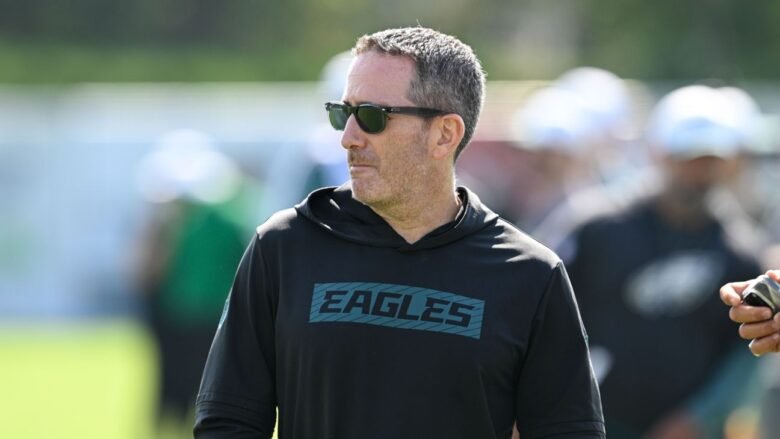
Howie Roseman is the king of the selective strike. The Eagles’ general manager has a habit of making small moves up the board to get ahead of nearby rivals for a player at a position of need. Sometimes, that delivers Andre Dillard. Other times, the Eagles land Jordan Davis. Even after trading a third-round pick for Jaelan Phillips and a fifth-round pick for Dontayvion Wicks, Roseman has his own picks in the first two rounds, pick Nos. 68 and 98 in the third round, and two picks in the fourth round (one of which jumped by eight spots after the Eagles dealt Sydney Brown to the Falcons).
It’s also about time for the Eagles to start shifting their draft picks to offense. Eight of Philly’s nine Day 1 or Day 2 selections over the past three years have been on defensive players, as Roseman has committed to building a young defense to complement what has been the most expensive offense in NFL history. The Eagles have just about every one of their starters except right guard Tyler Steen on a significant deal.
That spending is about to shift to defense. Zack Baun is getting $17 million annually, but Davis became the first player from this recent core of young, homegrown draftees to sign a meaningful second contract earlier this offseason. A handful of standouts are about to follow over the next 12 months, including Jalen Carter, Quinyon Mitchell and Cooper DeJean, all of whom should land among the highest-paid players at their respective positions. That’s not even including guys such as Moro Ojomo and Nolan Smith Jr., who could also justify big deals.
Though the Eagles aren’t going to overturn their entire roster, that money is going to come from the offensive side in the big picture. It wouldn’t be a surprise to see Roseman deal A.J. Brown after June 1, when the dead money on his deal can be spread over two years. Star right tackle Lane Johnson is nearing the end of his career. Dallas Goedert is probably in his final year with the Eagles. Only $2.5 million of Saquon Barkley’s $16 million cash compensation in 2027 is guaranteed. This offense could look very different in a year or two as Philly’s money flows to the defense.
Roseman has to start thinking about what the future looks like on offense now. At No. 23, he’s stuck behind teams that could be thinking offensive tackle, including the Panthers at 19, Cowboys at 20 and Steelers at 21. Moving up ahead of them might be necessary to get Johnson’s long-term replacement on the right side. There isn’t the same sort of hunger for a wide receiver immediately ahead of the Eagles, but the teams right behind Philly (the Browns, Bears, Bills and 49ers) could try to jump Roseman to get that wideout, which might necessitate the longtime general manager beating his rivals to the punch.

General manager Ryan Poles has been aggressive in rebuilding a defense that struggled for consistency a year ago, moving on from starters such as Jaquan Brisker, Kevin Byard III and Tremaine Edmunds. The likes of Devin Bush and Coby Bryant were signed as replacements, but there’s still a need to address the defensive line. The Bears are locked into deals for Grady Jarrett and Dayo Odeyingbo for another year after signing the veteran linemen in free agency last offseason, and given that neither made a significant impact in their first season with Chicago, Poles has to treat their contracts like sunk costs. Anything in 2026 from Odeyingbo as he returns from a torn Achilles would be a bonus.
Poles was able to extract a strong return for DJ Moore from the Bills, landing a second-round pick for a player the Bears probably wanted to dump for cash and cap purposes. The Bears have pick Nos. 25, 57, 60 and 89 over the first two days of the draft, and though they shouldn’t be treating this as an all-in opportunity, this regime has a chance to move up and target a much-needed difference-maker up front.
By the Jimmy Johnson chart, packaging No. 25 with the 60th pick they landed from the Bills should be enough to get the Bears up to No. 16, where the Jets could be interested in trading down and adding more selections. They would also jump the Lions in the process, a division rival that should be looking at edge rushers with their first selection. There’s nothing wrong with staying put and holding on to both second-rounders, of course, but this could be an opportunity for Poles to both hit his biggest position of need and steal an opportunity away from a divisional foe in the process.
Clearly entering what should be a multiyear rebuild this offseason, the new regime of Jeff Hafley and Jon-Eric Sullivan have a bounty of draft picks, both via the Jaylen Waddle trade and from the trades made by the previous regime. The Dolphins enter April’s draft with two first-rounders (Nos. 11 and 30), one second-rounder (No. 43) and four third-rounders (Nos. 75, 87, 90 and 94). If anyone has the capital to move all around this year’s draft, it’s Miami.
I’m instead arguing that the Dolphins should deal some of that bounty for 2027 picks, where they currently have only an extra fifth-rounder via Pittsburgh. This is partially about draft quality. Admittedly, the idea that next year’s draft is going to be better than this year’s class has become a bit of a running joke in NFL circles. We’re often overly optimistic about who will be entering the draft and how they’ll perform next season at the college level. With that being said, teams seem to be more excited about what might be on the table in 2027, especially at quarterback and on offense. The Dolphins probably will be in the market for one of those signal-callers, so maximizing their 2027 capital would make sense.
The other factor is based on information. Though Sullivan might not completely overthrow the Dolphins’ front office over the next few months, all of the preparation for this year’s draft was done by the former regime of Chris Grier and his staff. Sullivan and his team were doing their own prep in Green Bay, of course, but the Packers were also down their first-round pick as a result of the Micah Parsons trade, which probably influenced how they approached their scouting during the 2025 college football season.
By next autumn, Sullivan will have more of his people in place and be more confident that the scouting intel he’s getting is in line with what he looks for from potential prospects. The Dolphins can’t afford to push all of their picks into the future, and there aren’t any guarantees that the new regime will be any more successful at scouting talent, but it might make sense for the Dolphins to stack more of their draft capital in 2027 than 2026. Don’t be surprised if they swap one or two of those third-round picks for Day 3 selections in 2026 and third-rounders in 2027.

John Schneider is not going to require an invitation. The Seahawks trading down at the bottom of Round 1 was one of the safest bets you could make during the Russell Wilson era, with Seattle even stringing together combos as part of multitrade ladders. In 2019, Schneider turned the 21st selection into picks 47, 64, 120, 132, 142 and 204. And while those sorts of trades can be dismissed as turning a dollar into some spare change, consider that the teams trading up grabbed eventual disappointments such as Darnell Savage, DeAndre Baker and Greg Little. And Schneider packaged two of the many picks he received to move up at the end of the second round and take DK Metcalf.
The Seahawks have their own picks at the end of each round on Day 1 and Day 2, but their fourth- and fifth-rounders were sent to the Saints for receiver Rashid Shaheed. They also traded a sixth-round selection and their lone pick in the seventh round, meaning Schneider & Co. have only one pick on Day 3 — and it doesn’t come until No. 213. Sliding down a few spots from Nos. 32 or 64 and recouping some of those missing selections in the later rounds of the draft seems like an obvious move.