
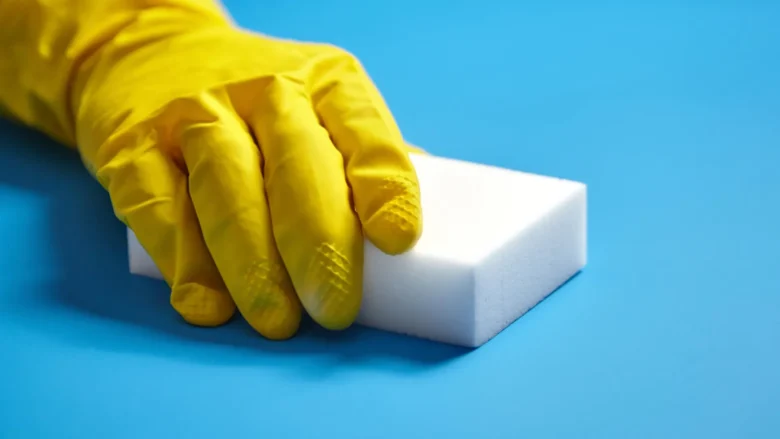
If you have ever used a “magic eraser” sponge to scrub away scuffs on white shoes or crayon marks on a wall, you have seen how powerful these cleaners can be. Melamine sponges are known for removing stubborn stains without the need for extra chemicals. But scientists are now raising concerns about an unexpected side effect. As these sponges wear down, they can release tiny plastic particles into the environment.
A study published in ACS Environmental Science & Technology suggests that melamine sponges could be a surprisingly large source of microplastic pollution. Researchers estimate that more than a trillion microplastic fibers may be released worldwide every month as people use and discard these everyday cleaning tools.
What Makes Melamine Sponges So Effective
Melamine sponges are made from a material called poly(melamine-formaldehyde) polymer. This substance forms a rigid, web-like structure of plastic strands that are arranged into a lightweight foam. Even though the sponge feels soft, its internal structure acts like extremely fine sandpaper.
This abrasive quality is what allows the sponge to “erase” stains. Instead of using soap or chemicals, it physically scrapes away dirt and marks from surfaces. Over time, however, that same scraping action causes the sponge itself to break apart.
How Microplastics Are Released
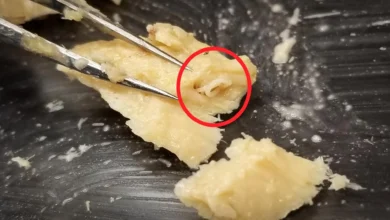
As the sponge is used, small pieces of the foam gradually wear away. These fragments can break down further into microplastic fibers, which are tiny strands of plastic often too small to see. Microplastics are typically defined as plastic particles smaller than 5 millimeters.
Once rinsed down the drain, these fibers can enter wastewater systems. From there, they may pass through treatment plants and end up in rivers, lakes, or oceans. In the environment, microplastics can be ingested by fish and other wildlife, potentially moving up the food chain and eventually reaching humans.
Inside the Study
To better understand how much plastic these sponges release, researchers Yu Su, Baoshan Xing, Rong Ji, and their colleagues tested several products from three well-known brands. They simulated real-world use by repeatedly scrubbing the sponges against rough metal surfaces.
The results showed that sponge density plays an important role. Denser sponges held up better over time and released fewer microplastic fibers, while less dense versions broke down more quickly.
The team also estimated how many fibers are produced as a sponge wears out. They found that a single sponge can release about 6.5 million fibers per gram of material lost. Assuming that the average sponge is worn down by about 10% during use, the researchers combined this figure with sales data to estimate the global impact.
Using Amazon sales from August 2023 as a reference point, they calculated that approximately 1.55 trillion microplastic fibers could be released each month. Because this estimate is based on just one retailer, the true number could be significantly higher.
Reducing Microplastic Pollution From Sponges
The findings suggest several ways to limit the environmental impact of these popular cleaning tools. One option is for manufacturers to design sponges that are denser and more durable, which would slow down wear and reduce the number of fibers released.
Consumers can also make choices that help reduce pollution. Switching to natural cleaning materials that do not contain plastic is one approach. Another is improving filtration, either at home or in wastewater treatment systems, to capture microplastics before they reach the environment.
A Hidden Source of Everyday Pollution
Melamine sponges remain highly effective cleaning tools, but their widespread use may come with an environmental cost that many people have never considered. What seems like a simple household product could be contributing to a much larger global issue.
The authors acknowledge funding from the National Natural Science Foundation of China and the Key-Area Research and Development Program of Guangdong Province.