
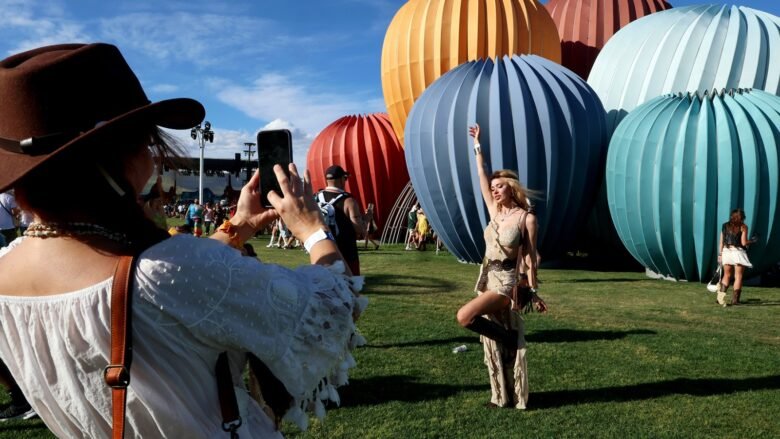
Every year, for two weekends in April, a small patch of desert in Indio, California becomes the hottest ticket in the country. Most people know it as Coachella, a once-scrappy music festival first held in 1999 that’s grown into one of the biggest festivals in the world. But online, thanks to the sheer amount of money poured into creator marketing, there’s a much simpler name for it: the influencer Olympics.
This weekend, an estimated 375,000 visitors will file in to see headliners Sabrina Carpenter, Justin Bieber, and Karol G. But their experience at the campgrounds isn’t just about having a fun time; it takes the online economics of creators and gives it a real-life presence. Since Coachella hit its stride and its first years of profitability in the late 2000s, the festival has touted its celebrity artists and visitors, with celebrities like Kendall Jenner and Vanessa Hudgens popularizing an entire era of bohemian Coachella style. But beginning in 2011, festival execs wove brands into the event, building and encouraging more pop-ups, sponsored parties, and activations. And where the brands are, creators will follow.
Coachella began as an “anti-Woodstock,” a trial run for the idea that a festival could give concertgoers a smooth, curated experience. Now the symbiotic relationship between brands and influencers is part of the very structural makeup of Coachella. The festival’s campground runs on layers of exclusivity, which have consistently increased online interest and engagement. For creators, it can be the biggest payday of the year. Coachella didn’t invent the influencer — but it’s making them a whole lot of cash.
Justine O., a creator with over 300,000 followers on TikTok, has been posting behind-the-scenes content on what it takes to be an influencer since 2023, explaining everything from how to book your first brand deal to picking a management team. She’s attended the festival three times. The first time, in 2024, she made no money, but was given two VIP tickets and had transportation, hotel, and food covered for herself and a plus one. In 2025, she got all of the above in addition to $25,000.
“Coachella is definitely a business,” she tells Rolling Stone. “I think that influencers realize and brands realize how many eyes and how much commentary is made about Coachella — especially as it’s become more influencer focused. Brands are really capitalizing on that. Brands are paying creators to go and engage and that is why it has become a business opportunity.”
Creators aren’t the only ones who are cashing in. From a marketing standpoint, a brand may pay a creator thousands of dollars for the event or give tickets in exchange for sponsored posts. But with engagement rates on Coachella-related content continuing to grow every year, a single post from an influencer in the desert could grab more social impressions than an entire month of consistent marketing from a brand’s team. “[Most brands have] a heavily influencer dependent marketing strategy at these events. It’s bringing a cohort of influencers with you and having as much content captured as possible,” says Sarah Pollack, the VP global head of consumer marketing at Pinterest. “They’re generally looking at things like impressions as a measure of success.”
But attention also means the potential for controversy. This year, commenters aimed most of their ire at influencers who attended a pop-up from Starbucks pop-up, which has been consistently under boycotts in the past two years for alleged anti-union and anti-Palestinian actions. People online understand that when influencers post videos about brands at Coachella, they’re probably doing it for money. And if they’re doing it with a brand people dislike, it can feel like a betrayal. One of the most popular videos skewering these creators was a skit from Benton McClintock, who jokingly posted that he was attending Coachella with Lockheed Martin. His comments mimicked how many average TikTokers felt watching the Coachella content roll in. “OMFGGG I’m staying in the United Healthcare claim denial mansion – see you there!!,” wrote one TikTok user. “Guyssss! The department of war wants to take me to Coachella!,” wrote another.
With Coachella well known as such a moneymaking event, brand approaches to the festival are evolving. Some are pulling back from working with multiple creators and instead focusing on one or two big names. That can be difficult for creators who don’t make the cut. Days before the first weekend, several creators revealed that they had been uninvited from the festival by brands — linking their cancelled invitations to growing demand from brands to get the most bang for their buck.
Emmy Hartman, 26, has been a content creator since she was 17, when a video of her having an emotional breakdown in her car went viral. “Karma got its kiss from me,” she cried as she described the problems plaguing her day: a ticket from the cops, puffy eyes, and a bald spot. Even with 2.3 million followers on TikTok, she was excited when a brand reached out and invited her to the festival. (Hartman declined to name the brand.) They described the deal, laid out the content required, and called the agreement “locked in.” And then the week of the festival they cancelled.
“I understand,” Hartman says. “ I was excited. I love music and I love music festivals. But it’s not the end of the world.” Hartman notes that the engagement around Coachella isn’t just about people inside the festival, it can extend to activations outside the campgrounds. “I still went down there for the weekend,” she added. “There’s still so much to do that’s also content.”
But for influencers who land brand deals, the event can be an enticing combo of networking access, perks, and fun. Micky Gordon’s has been to Coachella before, but this year was her first as a brand trip. On TikTok, her 1.1 million followers called it “Mickychella” and followed along as soda brand Poppi paid for Gordon and 10 plus ones to stay the weekend in an AirBnB they called the “Mick Mansion.” She tells Rolling Stone it’s the first time she’s ever understood the title of the influencer Olympics.
“I think creators really want to attend because it’s one of the only weekends where music, fashion, brands, and community all collide,” she says. “You’re creating, you’re networking, and it’s major visibility with some of the best brands. And bonus; you can justify multiple outfit changes per day! I feel extremely lucky to call this my job.”