

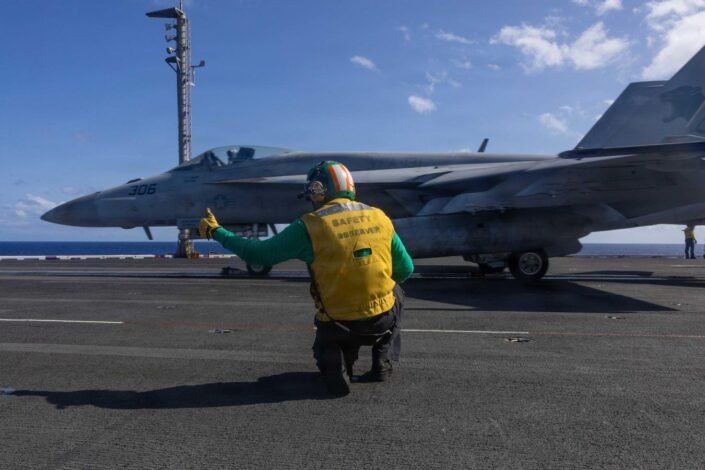
Flight operations aboard the USS George H.W. Bush continue as the carrier heads to the Middle East
(U.S. Navy photo by Mass Communication Specialist Seaman Soley Reed)
There are now three United States Navy nuclear-powered aircraft carriers operating in the U.S. Central Command’s area of responsibility. CENTCOM confirmed in a post on X on Thursday afternoon that the 10th and final Nimitz-class supercarrier, the USS George H.W. Bush (CVN-77), has entered the Indian Ocean.
CVN-77 joins the USS Abraham Lincoln (CVN-72), which is now in the Arabian Sea, and the U.S. Navy’s newest and largest supercarrier, the USS Gerald R. Ford (CVN-78), operating in the Red Sea after transiting the Suez Canal from the Mediterranean.
As previously reported, the USS George H.W. Bush may have taken the “long way” around Africa, likely to avoid the Bab el-Mandeb Strait that connects the Red Sea and the Gulf of Aden. No U.S. Navy aircraft has transited the Bab el-Mandeb Strait since the USS Dwight D. Eisenhower (CVN-69) in December 2023. CVN-77 began her current deployment on March 31, 2026, departing from Naval Station Norfolk, Va.
It is unclear how long the United States Navy will maintain three carrier strike groups in the Middle East, but their presence greatly increases U.S. naval firepower in the region. The United States announced a naval blockade of Iranian ports on April 13, and according to CENTCOM, at least 33 commercial vessels have been directed to turn around or return to Iranian ports since the blockade was initiated.
As of Thursday, USS Gerald R. Ford has been deployed for 303 days, the longest time at sea for a U.S. Navy aircraft carrier since the 332-day deployment of USS Midway (CVA-41), which lasted from April 10, 1972, until March 3, 1973, at the peak of the Vietnam War.
Laser Focused
The arrival of the USS George H.W. Bush in CENTCOM’s area of responsibility comes days after it was announced that the U.S. Navy successfully tested the AeroVironment palletized LOCUS Laser Weapon System aboard the supercarrier last fall as it began to prepare for the current deployment.
The demonstration included a live-fire event, where the palletized High Energy Laser system “tracked, engaged, and neutralized multiple target drones—marking a major milestone toward fielding operational directed energy capabilities across all domains and platforms,” the defense developer explained.
The containerized LOCUST LWS was set up on the aircraft carrier’s flight deck and used to neutralize multiple drones. The tests were conducted as the U.S. Navy has sought cost-effective weapons to counter low-cost unmanned aerial systems. The service has largely relied on intercept missiles, each costing hundreds of thousands to millions of dollars, to shoot down the relatively cheap drones.
A containerized LOCUST Laser Weapon System (LWS) is set up on the flight deck of the Nimitz-class aircraft carrier, USS George H.W. Bush (CVN 77)
(Photo courtesy U.S. Navy)
“LOCUST delivers effective, all-domain protection against emerging drone threats at the speed of light—on any platform, in any domain, for any mission,” John Garrity, vice president of Directed Energy Systems at AV, said in a statement. “Rolling LOCUST onto a ship and quickly initiating operations facilitates the expanded use of high-energy lasers across the Fleet without the need for costly, time-consuming ship modifications. This is a game-changer for the Navy and for our national security.”
The advantage of the LOCUST is not only its cost but also its containerized roll-on/roll-off design, which could allow it to be readily integrated onto various warships without requiring significant, costly upgrades to existing vessels.
According to a report from The War Zone, the central component of the LOCUST is a laser-directed energy weapon mounted in a turret, outfitted with built-in electro-optical and infrared video cameras for target acquisition and tracking.
Attack Of The Drones
Even before the start of the current hostilities, the drones have been seen as a significant and growing threat to U.S. Navy warships. One danger is that inexpensive, increasingly autonomous platforms could overwhelm traditional, high-cost defense systems through swarm tactics.
It is unlikely that such low-cost drones could sink a vessel. Still, the UAS could be employed to conduct a “mission kill” type of attack that destroys or at least disables sensitive sensors, radar, and communication equipment.
Last year’s tests involving the anti-drone laser system showed that the U.S. Navy is taking this threat seriously. Perhaps seriously enough that the U.S. Navy ensured USS George H.W. Bush avoided that narrow waterway between Africa and the Arabian Peninsula, and that USS Gerald R. Ford will also remain in the Red Sea. The best defense against drones may be to ensure the carriers maintain some distance while still able to conduct air strikes if necessary.