

Topline
President Donald Trump said Saturday he cancelled a trip for U.S. envoys to engage in peace talks in Pakistan, one day after the White House announced Jared Kushner and Steve Witkoff would travel to Islamabad, with Trump claiming the United States holds “all the cards.”
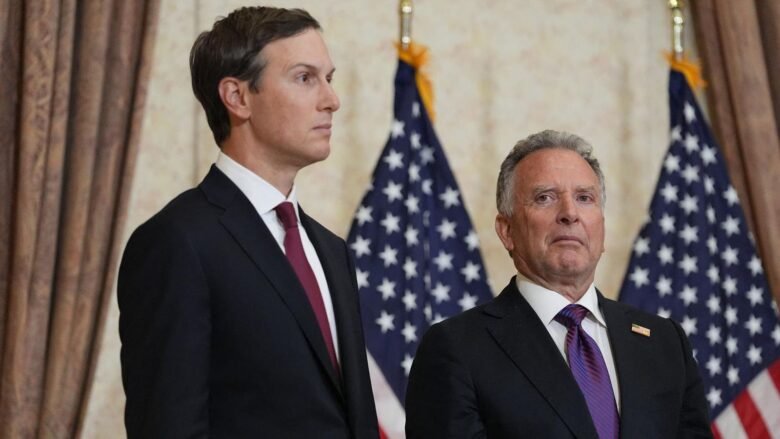
Steve Witkoff and Jared Kushner are expected to head to Islamabad for negotiations Saturday. (Photo by Jacquelyn MARTIN / POOL / AFP via Getty Images)
POOL/AFP via Getty Images
Key Facts
Trump, in a Truth Social post Saturday afternoon, said he cancelled Kushner and Witkoff’s trip to Islamabad because “we have all the cards, they have none,” and if Iran wants to talk, “all they have to do is call.”
“Too much time wasted on traveling, too much work,” Trump said, adding, “Besides which, there is tremendous infighting and confusion within their ‘leadership.’ Nobody knows who is in charge, including them.”
Trump told Fox News he canceled the trip earlier Saturday, saying the U.S. envoys are “not going to be making any more 18 hour flights to sit around talking about nothing.”
The White House announced Kushner and Witkoff’s trip on Friday, though Iran’s foreign ministry spokesperson Esmaeil Baqaei said in a post on X Iranian officials would not meet directly with U.S. envoys and would instead communicate through Pakistani mediators.
Iran’s foreign minister Abbas Araghchi met with Pakistani Prime Minister Shehbaz Sharif on Saturday, as Pakistan mediates talks between the United States and Iran to end the war.
Sharif said in a post on X Saturday he had “a most warm, cordial exchange of views on the current regional situation” with Araghchi, in which they discussed “matters of mutual interest, including the further strengthening of Pakistan–Iran bilateral relations.”
Earlier Saturday, Iran’s Khatam al-Anbiya military command warned in a statement carried by state media the “aggressive U.S. military” will “face a response from Iran’s powerful armed forces” if it continues its “blockade, banditry, and piracy in the region.”
What Do We Know About The United States’ Blockade?
President Donald Trump announced the United States would impose a naval blockade on Iranian ports nearly two weeks ago, in hopes of pressuring Iran to open the Strait of Hormuz and accept a peace deal to end the war. But in response to the blockade, Iranian officials said last week it had reimposed “strict control” over the Strait of Hormuz, saying the closure would continue until the United States lifts its blockade. The United States has vowed to keep the blockade going, and Trump said in a Truth Social post earlier this week he would extend a ceasefire with Iran and direct the military to continue its blockade of Iranian ports. Defense Secretary Pete Hegseth said at a news conference on Friday the blockade would continue for “as long as it takes” for Iran to comply with U.S. demands. “All they have to do is abandon a nuclear weapon in meaningful and verifiable ways, or instead they can watch the regime’s fragile economic state collapse under the unrelenting pressure of American power,” Hegseth said.
What Do We Know About U.s.-Iran Talks?
Before Trump cancelled Witkoff and Kushner’s trip, White House Press Secretary Karoline Leavitt announced they would travel to Islamabad to “hear the Iranians out.” Leavitt claimed “the Iranians want to talk, they want to talk in person,” though Iran’s foreign ministry said no direct talks would take place. Vice President JD Vance, who previously led a U.S. delegation for talks in Pakistan, was not scheduled to be in attendance, though Leavitt said he would be “on standby” to travel to Islamabad “if we feel it’s a necessary use of his time.”
Key Background
Vance, Kushner and Witkoff traveled to Pakistan earlier this month for peace talks, the most high-level, face-to-face meeting between U.S. and Iranian officials since 1979. Vance said no peace deal was reached after a marathon negotiation session that stretched for more than 20 hours. The New York Times reported the Strait of Hormuz remained a sticking point in the negotiations, as the United States demanded an immediate reopening, while Iran vowed to reopen it only after a final peace deal was brokered. The talks came days after Trump announced a two-week ceasefire, which put a halt to his previous threat that Iranian civilization would “die.”
Further Reading
Iran says no direct talks planned as U.S. envoys set to leave for Pakistan (Washington Post)