
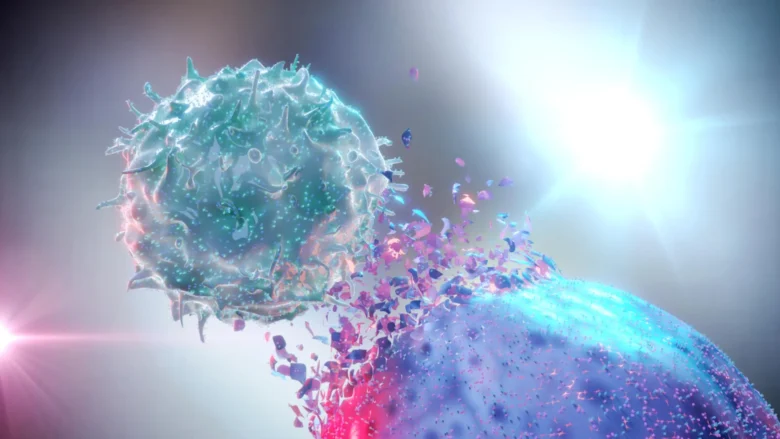
Researchers in Brazil are advancing a promising form of cancer immunotherapy by making natural killer (NK) cells more powerful and precise. In a recent study, scientists at the Ribeirão Preto Blood Center and the Center for Cell-Based Therapy (CTC) used the NK-92 cell line to test new designs of chimeric antigen receptors (CARs). These engineered receptors included specific costimulatory components, such as 2B4 and DAP12, that help activate the cells. The findings showed that these additions made the cells “ready to attack,” significantly improving their ability to destroy tumor cells. The study was published in Frontiers in Immunology.
CAR-based therapies have already transformed cancer treatment, particularly for blood-related cancers. While CAR-T cells are well studied, scientists are still working to understand how to optimize CAR-NK cells. One key challenge is identifying which internal signaling mechanisms allow these cells to perform at their best.
The new research addresses this gap by focusing on how specific signaling domains influence NK cell activity. By incorporating 2B4 and DAP12 into the CAR design, the researchers were able to enhance the cells’ activation state, making them more effective at targeting tumors.
Combining activation signals with drug control
The team also explored a strategy to fine-tune the cells using a temporary drug-based approach. They tested dasatinib, a drug that can briefly suppress cell activity, to see how controlled pauses might affect performance.
Their results suggest that combining optimized activation signals with reversible pharmacological control can improve both the strength and efficiency of CAR-NK therapies. This approach may help researchers design more advanced and controllable cell-based cancer treatments in the future.
Stronger tumor control in preclinical models
According to the Ribeirão Preto Blood Center Press Office, experiments in animal models showed encouraging results. CAR-NK cells engineered with 2B4-DAP12 and pretreated with dasatinib were better at controlling tumor growth compared to more traditional versions of the therapy.
Research collaboration and institutional support
The Center for Cell-Based Therapy (CTC) is one of the Research, Innovation, and Dissemination Centers (RIDCs) supported by FAPESP. It operates within the Ribeirão Preto Blood Center and is affiliated with the general and teaching hospital (“Hospital das Clínicas”) of the Ribeirão Preto Medical School of the University of São Paulo (FMRP-USP).
Together, these findings point toward a new generation of CAR-NK therapies that could offer stronger, more adaptable ways to fight cancer.